Toward an easily fabricated artificial leaf
DOI: 10.1063/PT.3.1356
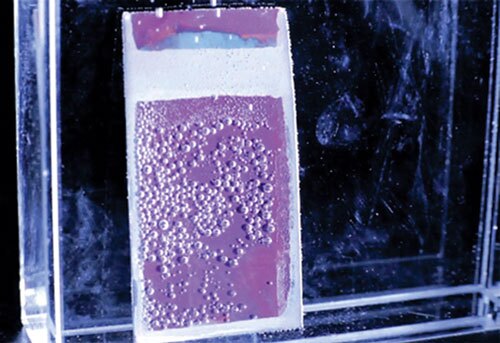
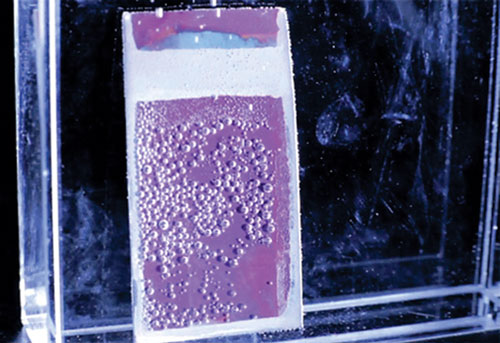
Toward an easily fabricated artificial leaf. Photosynthesis, the original green technology, converts solar energy into the chemical energy of nourishing sugars. In the step that crucially depends on sunlight, plants and other organisms use solar energy to break water down into oxygen and hydrogen. Today, research teams worldwide are replicating that ubiquitous natural feat in the lab. One group, led by MIT’s Daniel Nocera, has now devised an artificial leaf with several attractive features: It’s compact, uses inexpensive and easy-to-get materials, works in environments that are not corrosively acidic or basic, and allows wireless operation. The figure shows the oxygen bubbles generated by a 1 × 2 cm artificial leaf immersed in an electrolyte; the device, though, can also function in pure water. The apparatus consists of a piece of silicon covered by catalytic chemicals—on one side is a compound called cobalt oxygen-evolving catalyst; on the other is an alloy of nickel, molybdenum, and zinc. When struck by light, the silicon spits off electrons and holes that, aided by the catalysts, induce the water’s disintegration. Nocera and colleagues expect they can readily increase the modest efficiency of their proof-of-principle artificial leaf; at present, in wireless mode, 2.5% of the incoming radiation energy is chemically stored, though a variation with wires achieves 4.7% efficiency. Those figures are a bit better than the efficiencies typical of crop plants, but more expensive artificial systems have achieved efficiencies of 18%. (S. Y. Reece et al, Science 334, 645, 2011 doi:10.1126/science.1209816 .) —SKB