To catch a solar neutrino, search at night
DOI: 10.1063/PT.3.2338
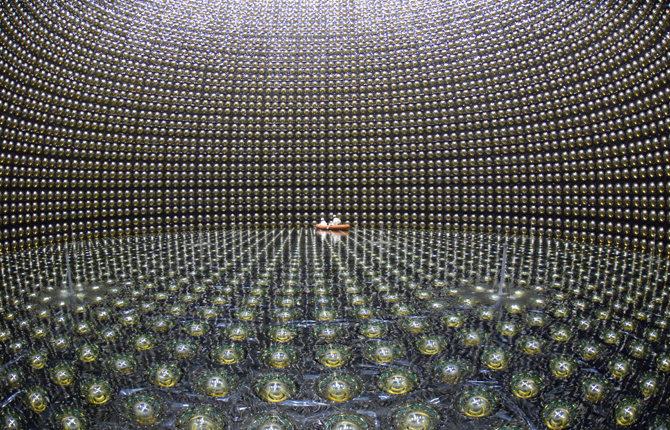
A neutrino is created or detected in one of three flavor states named after the electron, muon, and tau particles. But those are not the stationary states of well-defined mass. As a result, an electron neutrino leaving the Sun and headed toward Earth, for example, could change flavor on the way and avoid notice by electron-neutrino detectors. That phenomenon—vacuum neutrino oscillation—has been confirmed in numerous experiments and was a key to understanding one of the great mysteries of 20th-century physics: Why do we observe so many fewer solar electron neutrinos than we expect based on reliable models of neutrino production in the Sun’s core? But vacuum neutrino oscillation alone is not enough to solve the solar-neutrino problem. The second important ingredient leading to neutrino metamorphosis arises because electron neutrinos traveling from the Sun’s core to its surface interact more strongly with solar matter than do other flavors. The effect of matter on neutrino identity has now been directly observed by the enormous Super-Kamiokande neutrino detector in Japan (see the figure). The Super-K experiment is conceptually simple: Experimenters compare the flux of solar electron neutrinos observed during the day and night. The neutrinos detected after sunset must have passed through Earth to reach the detector, so a day–night flux differential confirms flavor changes induced via matter interactions. The 3% enhancement in electron-neutrino flux observed during the evening hours—a 2.7-sigma effect—is in accord with theoretical expectations based on well-established vacuum-oscillation parameters. (A. Renshaw et al., Super-Kamiokande collaboration, Phys. Rev. Lett. 112, 091805, 2014, doi:10.1103/PhysRevLett.112.091805 ; figure courtesy of Super-Kamiokande.)

Courtesy of Super-Kamiokande