Tiny robots can be moved by sound

If you’ve ever produced a tone by blowing a stream of air across the mouth of a bottle, you’ve used a Helmholtz resonator—even if you didn’t know it by that name. Any cavity with a single opening can produce the same acoustic resonance effect. And the opposite also occurs: If you play a sound at a bottle’s resonant frequency, air is pushed out in a jet of vortices. Now a team of researchers led by Selman Sakar at EPFL, the Swiss Federal Institute of Technology in Lausanne, have used the thrust from such a vortex jet to maneuver a variety of small robots. 1
The thrust generated by a Helmholtz resonator is small, so any vehicle powered by it must be lightweight. Advances in 3D-printing technology were key to the team’s success, says Sakar. The team fabricated acoustic resonators using various 3D-printing techniques, materials, shapes, and sizes and then fitted them to a fleet of small boats and aircraft.
For the boats, specific vibrations in the range from 455 Hz to 2.4 kHz were induced in the resonators by using airborne sound from external speakers or transducers attached directly to them. By using three resonators, each excited by a different frequency, the researchers could steer the boats around obstacles and along preplanned paths.

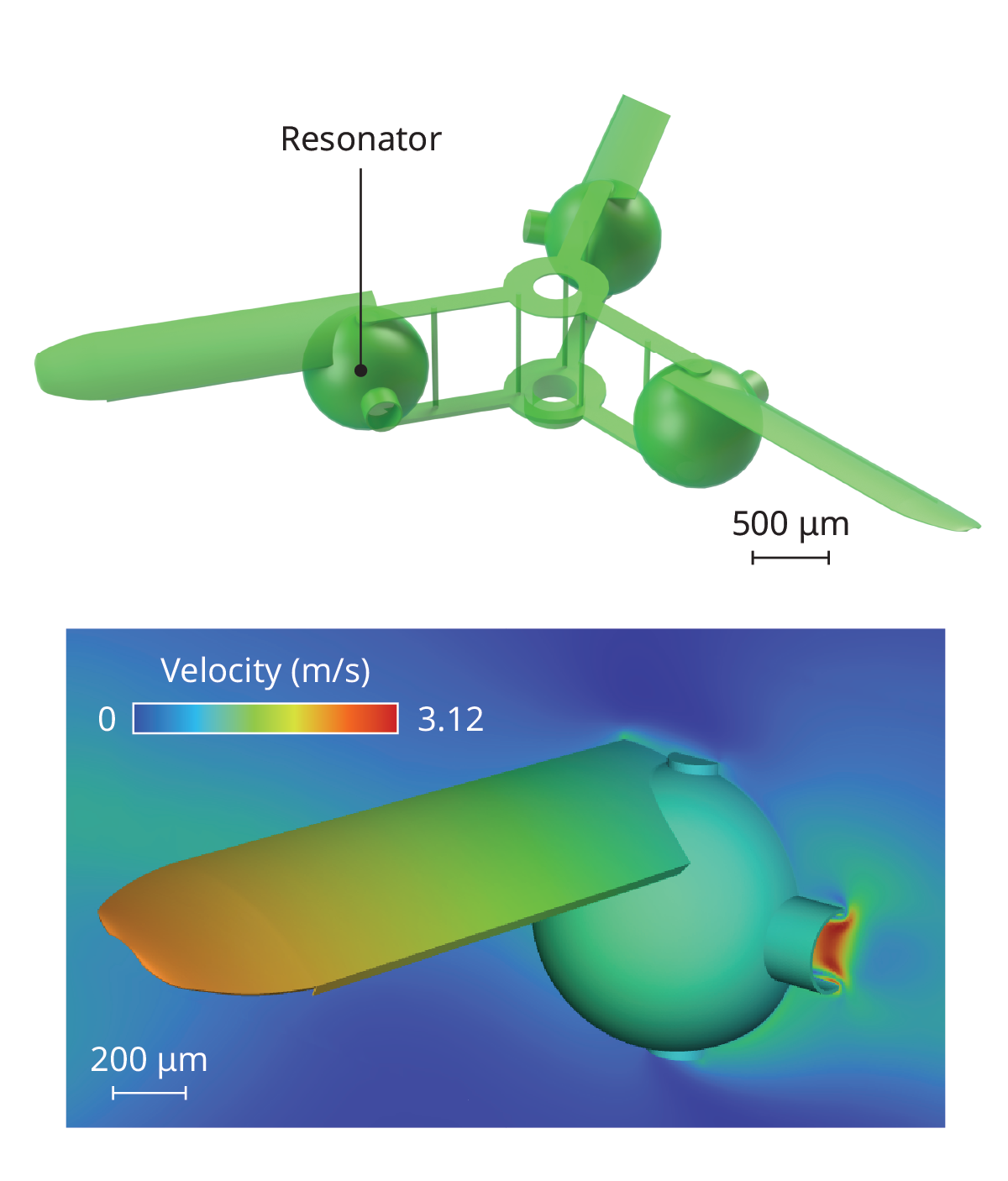
A miniature 3D-printed aircraft (top) was designed to spin from the thrust generated in three acoustic resonators. Spinning blades generate lift that propels the vehicle into the air. An airflow simulation (bottom) shows how a resonator generates thrust when excited by 40 kHz sound.
(Images adapted from ref. 1 .)

The small aircraft required directed, higher-frequency vibrations of 40 kHz. The researchers used an ultrasonic phased array that focused airborne sound in the region of the microflier. They designed two types of aircraft: one that was propelled directly by the thrust of the resonators and one, shown in the figure, that used the resonators to spin helicopter-style blades and generate aerodynamic lift. To control the direction of flight, the researchers attached the aircraft to pins or wires that acted as guides.
Reference
1. J. Hwang et al., “Acoustic resonators as wireless actuators in air for small-scale robots, ” Sci. Adv., 12, eaef5620 (2026).