Tiny mirror asymmetry in electron scattering confirms the inconstancy of the weak coupling constant
DOI: 10.1063/1.2117811
Spin-polarized beams of high-energy electrons scattering off unpolarized electrons or nuclei are particularly useful for examining the very slight preference for left handers in the realm of fundamental particles. But because that preference is measured in parts per 10 million, such experiments require extraordinary care. For longitudinally polarized electron spins, any difference between the scattering of electrons spinning like left- and right-handed screws violates parity conservation—that is, mirror symmetry. Electromagnetic interactions, which dominate electron scattering, strictly respect parity conservation. But the weak interactions do not.
In 2002, the E158 collaboration at SLAC began measuring the tiny fractional difference between the cross sections for the elastic scattering of left- and right-polarized 50-GeV electrons off electrons in an unpolarized liquid-hydrogen target. The polarized beam electrons were accelerated in the laboratory’s 3-km-long linac. The collaboration’s final report, just published, gives a right–left asymmetry measurement precise enough to demonstrate for the first time that the fundamental coupling “constant” of the weak interactions does in fact vary with the energy–momentum scale at which it is measured. 1 This so-called running of the weak coupling constant was an important, unconfirmed prediction of the standard model of particle theory.
Running constants
In fact, the standard model predicts such oxymoronic running for all three coupling constants of the theory: strong, electromagnetic, and weak. It’s a characteristic of gauge-invariant field theories like those that constitute the standard model. The Lorentz-invariant magnitude Q of the four-momentum transferred between interacting particles is an inverse measure of their distance of closest approach. The variation of the constants with distance (and therefore with Q) is a consequence of the creation and destruction of virtual particle–antiparticle pairs. Those evanescent pairs effectively shield the interacting particles from each other by polarizing the vacuum, much as a polarized dielectric shields capacitor plates.
For electromagnetism and the strong nuclear force, the running of the coupling constants is well established. The fine-structure constant α ≈ 1/137, the square of the electron’s charge e in natural units, really describes electromagnetic coupling only in the limit of large distance or, equivalently, negligible Q. As charged particles get closer, there’s less vacuum shielding between them. At 10−16 cm (Q near 100 GeV), the effective α(Q) has increased to about 1/128.
Whereas the shielding of electric charge is due mostly to virtual e+e− and other fermion pairs, the running of the strong nuclear coupling constant is dominated by virtual pairs of massless spin-1 gluons. It turns out that, unlike spin-1/2 lepton or quark pairs, pairs of spin-1 particles such as gluons or the heavy W± bosons that mediate the weak interaction actually provide antishielding between interacting particles. That is, the strong coupling between quarks decreases as they approach each other. At zero separation, it vanishes altogether. That’s called asymptotic freedom (see Physics Today, December 2004, page 21 ).
For the weak couplings, the standard-model prediction is more complicated. The heavy Z0 boson is the neutral partner of the charged Ws. These three mediators of the weak force couple to each other and to all other known particles. The expected Q dependence of the Z0’s weak coupling constant, g W, is not monotonic. For Q between 1 and 100 GeV, virtual quark–antiquark pairs dominate the vacuum polarization and g W, like e, should increase with Q. But then, starting near 160 GeV, twice the W± mass, virtual W pairs begin to contribute significant antishielding and g W should begin to decrease.
All that running of the weak coupling constant has, until now, been theoretical expectation. Only at Q = 91 GeV, the mass of the Z0, is there a precise determination of g W. That was accomplished with high-statistics studies of Z0 production in e+e− colliding-beam experiments at SLAC and CERN. The principal purpose of the E158 experiment has been to measure the weak coupling at much lower Q with enough precision to confront the standard-model prediction.
Significant departures from the standard model would point to new physics at high energies not yet explored directly. Despite E158’s modest beam energy, the experiment would be sensitive, for example, to the existence of a neutral cousin of the Z0 as heavy as 1000 GeV. Such speculative objects appear in theories that seek to unify the strong and electroweak interactions.
A tiny asymmetry
The E158 collaboration, led by Krishna Kumar (University of Massachusetts, Amherst), Emlyn Hughes (Caltech), Yuri Kolomenski (University of California, Berkeley), and Paul Souder (Syracuse University), set out to measure the right-left asymmetry
with a combined statistical and systematic uncertainty of about 15%. The cross sections σR and σL are for e−e− elastic scattering near 90° in the center-of-mass frame, with right- and left-polarized 50 GeV electrons. The acceptance range of center-of-mass scattering angles included in the measured cross sections was about 45°. In the laboratory frame, the maximum scattering angle was only about 0.3°.
The invariant magnitude Q of the four-momentum transferred between the colliding electrons is given, in any reference frame, by Q 2 = (Δp)2−(ΔE)2, where Δp and ΔE are the transferred momentum and energy. In the experiment,
Rather than measuring
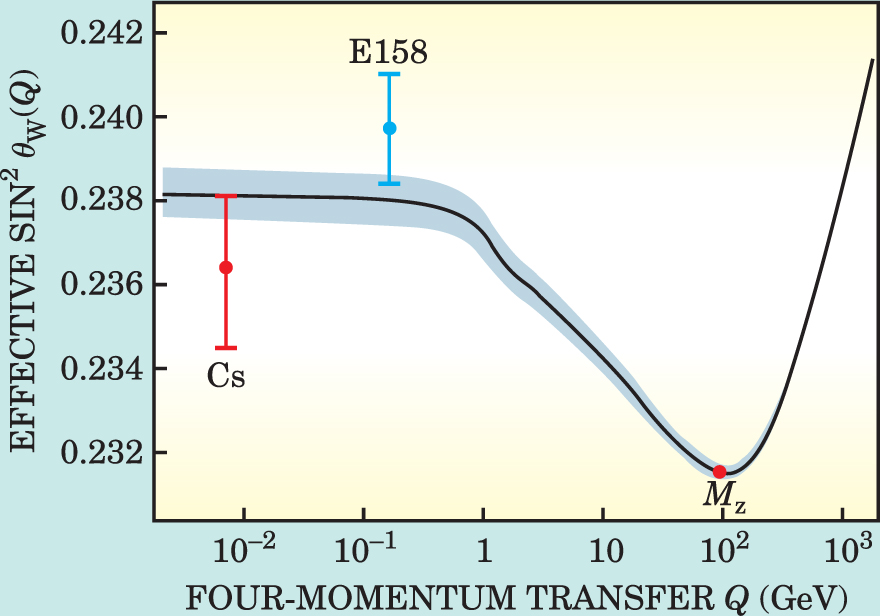
The standard-model prediction for the running of sin2 θW is shown by the curve in figure 1.

Figure 1. Running of the electroweak mixing parameter sin 2 θW as a function of Q, the magnitude of the four-momentum transfer between interacting particles. The mixing parameter is inversely proportional to g W 2 , the square of the weak coupling constant. The curve showing the standard-model prediction is anchored at M Z, the mass of the Z0 boson, where the mixing parameter has been precisely determined. Lying 6 standard deviations higher, the new SLAC E158 point demonstrates the running of the mixing parameter. The point at still lower Q, from a 1999 measurement of parity violation in cesium atoms, is consistent with both the predicted running and no running at all.
(Adapted from ref. 1.)

For elastic e−e− scattering at center-of-mass scattering angles near 90°, the electroweak mixing parameter for a given Q is related to the right-left asymmetry by
where G F is the Fermi constant, which characterizes the strength of the weak interactions in the low-energy limit.
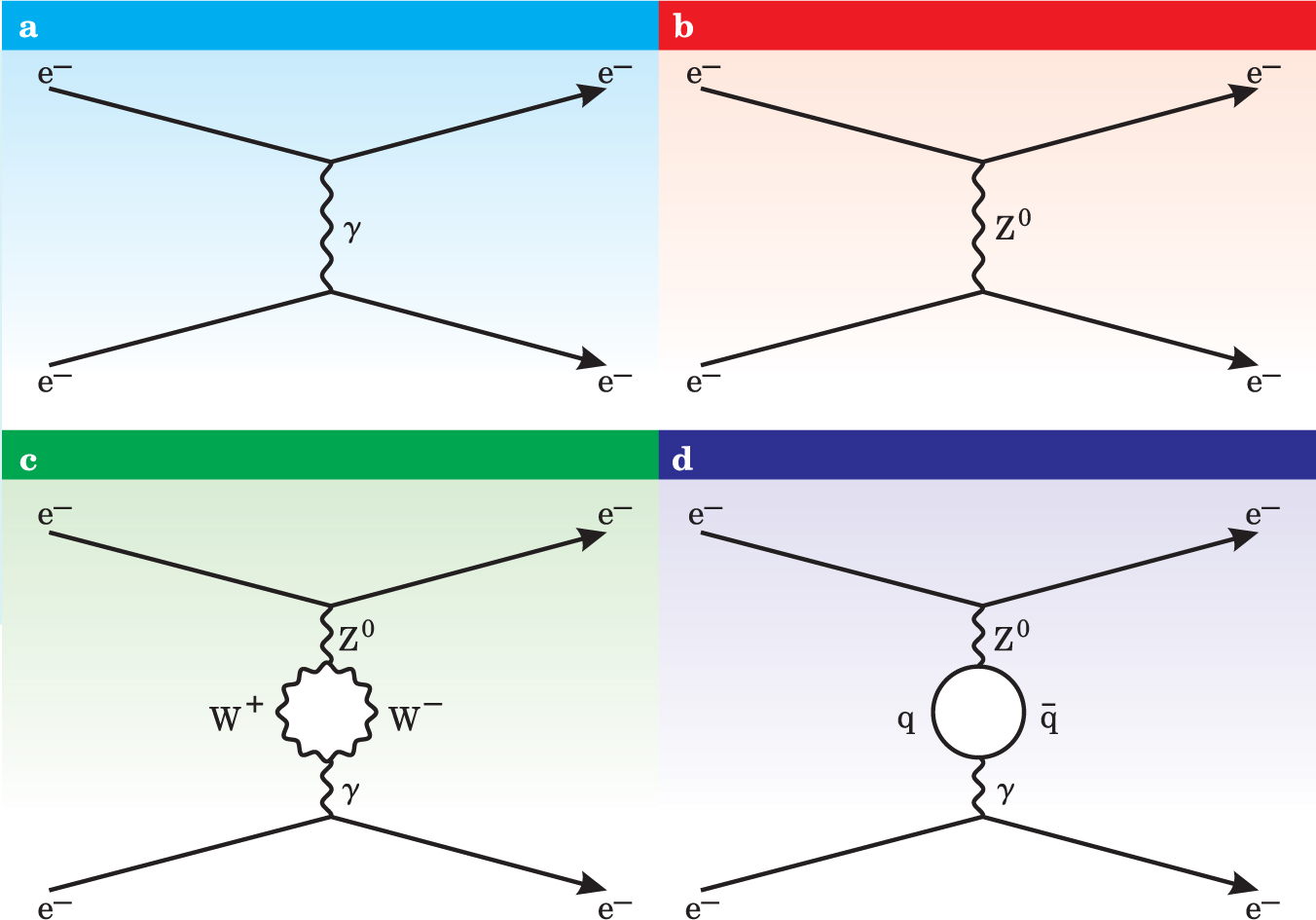
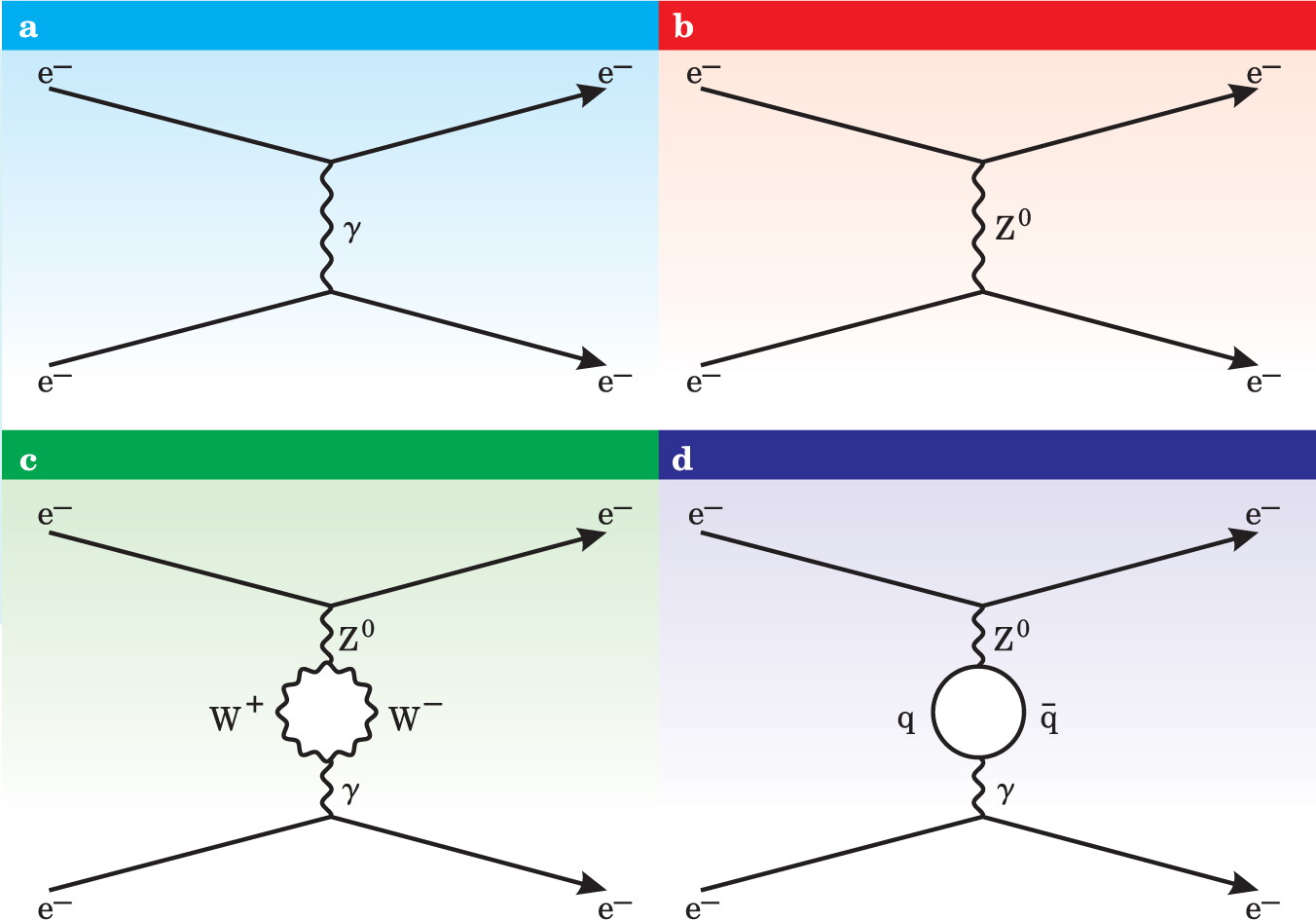
The asymmetry comes from the interference term between the photon-exchange amplitude, which dominates the elastic scattering, and the much smaller Z0-exchange amplitude (see the leading-order Feynman diagrams in figures 2(a) and

Figure 2. Feynman diagrams for electron–electron scattering. The left–right asymmetry predicted for polarized-beam experiments is due to interference between a and b, the leading-order diagrams for photon and Z0exchange. The running of the electroweak mixing parameter is attributed to higher-order loop diagrams like c and d. While the quark loop in d shields the weak force between electrons, the W-boson loop in c provides antishielding. That is, it strengthens the force with increasing separation.
Precision
For all its expected running, sin2 θW shouldn’t stray very far from
The requisite event rate was much too high for event-by-event analysis. Relative scattering rates with right-and left-polarized beams had to be measured by the light generated in electromagnetic calorimeters made of alternating layers of copper and fused silica.
Spin-polarized electrons were created at the linac’s upstream end by circularly polarized light hitting a specially developed gallium arsenide photocathode. The light began as linearly polarized laser light; it was circularly polarized by an intervening Pockels cell. One could reverse the polarization sense simply by reversing the voltage applied to the cell.
The electron beam was delivered to the hydrogen target in pulses at 120 Hz. Successive pulses were randomly given left- or right-circular polarization. “If you leave it at one polarization for longer intervals,” says Kumar, “inevitable drift in the electronics washes out the tiny asymmetry signal.” One also had to compensate for small but insidious correlations between the sign of the cell voltage and the geometry of the emerging laser and electron beams. It was crucial that the electron beam’s path through the target have no polarization dependence. To that end, an elaborate beam-monitoring system constantly fed small voltage corrections back to the Pockels cell.
For a given cell polarity, one could reverse the electron beam’s circular polarization either by inserting a half-wave plate in the laser beam or reducing the final beam energy by a few GeV—just enough to reduce the precession of the electron spin in a downstream bending magnet by precisely half a cycle. Such steps were taken every few days. The experiment ran for a total of about 3000 hours in 2002 and 2003. “We knew we had beaten the systematics,” says Kumar, “when we got the same asymmetry, within statistics, for all four combinations of beam energies and half-wave plates.”
The final measured asymmetry, A = (−131 ± 17) × 10−9, yields sin2 θW = 0.2397 ± 0.0013 for the effective mixing parameter at Q = 0.16 GeV. As shown in figure 1, that’s within one standard deviation of the standard-model prediction. And it demonstrates the anticipated running by being more than six standard deviations above the precisely measured anchor point at Q = 91 GeV, the Z0 mass.
The figure also shows a 1999 measurement at much lower Q by Stephen Bennett and Carl Wieman at The University of Colorado, based on parity-violating atomic-physics effects in cesium. 3 The point is consistent with the standard model prediction. But, being less than three standard deviations from the point at M Z, it’s also barely consistent with no running of sin2 θW. Such measurements are burdened by intricate details of atomic physics. “But recent advances in atomic theory 4 are significantly reducing the uncertainties,” says Wieman.
From the good agreement of the E158 measurement with the standard-model prediction, the collaboration concludes that the mass of any heavier recurrence of the Z0 would have to be at least 1000 GeV.
End of an era
In the mid-1970s, experimental evidence for the now-standard electroweak-unification theory was shaky. Searches for the predicted atomic-physics parity violation had yielded conflicting results, and the Z0 had not yet been discovered. But then in 1978, Charles Prescott and Vernon Hughes (Emlyn’s father) mounted E122, the pioneering precursor of E158 at the SLAC linac. Studying electron–deuteron scattering by much the same technique that was upgraded for E158, they got the first definitive evidence for parity violation attributable to the Z0. Although their determination of sin2 θW had a 10% uncertainty, the result was a historic confirmation of electroweak unification. One year later, Glashow, Salam, and Weinberg shared the Nobel Prize.
The successful completion of E158 marks the passing of an era at SLAC. For almost 40 years, the 3-km linac has been delivering high-energy electrons—and later, positrons—to particle-physics experiments at its downstream end (see figure 3). Now the experimental area is being cleared to make way for the Linac Coherent Light Source, a free-electron-laser facility fed by the linac, that will provide x-ray beams of unprecedented brightness for experiments in condensed-matter physics, materials science, and biology (see Physics Today, May 2005, page 26 ).

Figure 3. After four decades of housing targets and detectors for particle physics, the experimental area (foreground) at the downstream end of SLAC’s 3-km-long electron–positron linac (seen receding toward the hills) will soon give way to the Linear Coherent Light Source, an x-ray beam facility for condensed-matter physics, materials science, and biology. The free-electron laser that generates the x rays will be fed by electrons from the linac.

References
1. P. L. Anthony et al. (SLAC E158 collaboration), Phys. Rev. Lett. 95, 081601 (2005) https://doi.org/10.1103/PhysRevLett.95.081601 .
2. A. Czarnecki, W. Marciano, Int. J. Mod. Phys. A 15, 2365 (2000).
3. S. C. Bennett, C. E. Wieman, Phys. Rev. Lett. 82, 2484 (1999).
4. S. Shabaev et al., Phys. Rev. Lett. 94, 213002 (2005) https://doi.org/10.1103/PhysRevLett.94.213002 .