The racehorse’s debt to its jockey
DOI: 10.1063/1.4797218
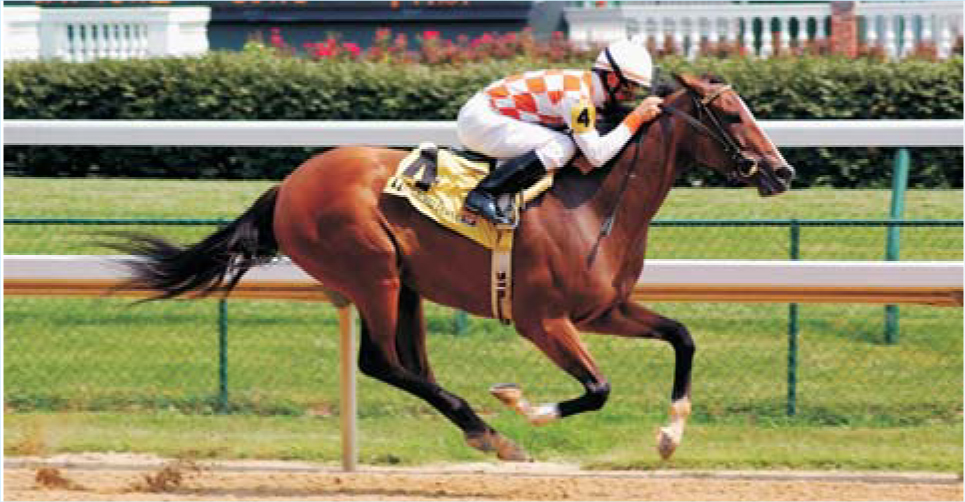
The late 19th century saw a radical innovation in horse racing: Jockeys abandoned a comfortable, upright posture for the hunched-over, short-stirrup style seen today at racetracks (and in the figure). By 1910, when the style was universally adopted, race times had dropped by more than 5%; the improvement in the first decade of the 20th century was greater than in the hundred years since. One might think that the reduced aerodynamic drag of the new style led to the faster times, but Thilo Pfau and colleagues at the University of London’s Royal Veterinary College suggest that the way the modern jockey moves in response to the horse’s galloping makes the more significant contribution. The London group measured the motion of jockeys and horses and observed that jockeys do not suffer much vertical displacement as a horse races—a consequence of the way they absorb the horse’s motion by strenuously pumping their legs while riding. So, though the horse supports the jockey’s weight, it does not expend unnecessary energy lifting and lowering its cargo. Moreover, the horse’s forward speed varies over the course of a gallop cycle. When the horse is moving faster than on average, the jockey moves slower. That out-of-phase response could help the horse to execute a smoother, more energy-efficient gallop. (T. Pfau et al., Science 325 , 289, 2009 http://dx.doi.org/10.1126/science.1174605 .)

Photo by Pharaoh Hound