Texas cuts “low-producing” physics programs
DOI: 10.1063/PT.3.1359
Despite petitions from university administrators, the Texas Higher Education Coordinating Board at a 27 October hearing denied last-ditch appeals from four schools to save their undergraduate physics programs. Ten other physics departments were among the many academic programs that failed the state requirement to graduate an average of at least five students per year and are slated to be closed or restructured: Five, including a master’s program, were phased out without appeal; three were placed on two-year probation; and two were merged with their engineering physics departments.
“The actions of the [board] to close physics programs will cripple the state’s ability to effectively prepare sufficient numbers of highly qualified physics instructors,” American Physical Society president Barry Barish wrote in a letter submitted to the Texas board just prior to the October meeting. But at the hearing, board member and Texas higher-education commissioner Raymund Paredes called the matriculation rates at some of the affected schools “indefensible” and said that the board was responsible for making universities more accountable in their use of Texas taxpayer dollars.
In a report submitted last year to Governor Rick Perry, the board claimed that shutting down low-producing academic programs would save the state up to $73 million over four years through lower overhead costs and inevitable faculty layoffs. The slashed physics programs award less than 2% of the state’s bachelor’s degrees in physics, but supporters argue that those programs are invaluable to their local communities.
Closing the gaps
The board voted down temporary exemption requests from Prairie View A&M University, Tarleton State University, Texas Southern University, and West Texas A&M University, but it accepted a proposal from the University of Texas at Brownsville to merge its physics and engineering physics departments. Students at the terminated programs will be allowed to complete their degrees, but those schools are barred from recruiting and admitting new students and are ineligible for reinstatement for at least 10 years; the schools will still offer introductory physics courses to other departments and majors that need them.
In all, 545 academic programs at Texas colleges and universities were warned early this year that they were underperforming and given an opportunity to prove they weren’t. About 300 of them were given two years to show that they could boost their enrollment and matriculation numbers. The rest either volunteered to phase out their programs or were forced by the board to do so.
The new performance standards are part of a statewide higher-education accountability system inspired by Closing the Gaps, a roadmap for higher education adopted by the state in 2000 and championed by then Lieutenant Governor Perry. The roadmap seeks to address the state’s subpar national rankings in measures of student success, excellence, and research. Its goals include increasing student enrollment, particularly of underrepresented minorities; increasing the number of degrees and certificates awarded; improving retention and graduation rates; increasing the number of nationally recognized programs; and increasing the level of federal funding for science and engineering research going to Texas institutions.
But critics of the state’s graduation requirements say that closing physics programs runs counter to the intent of Closing the Gaps. For example, the large physics programs in Texas have been ineffective at recruiting and graduating African Americans, says Carlos Handy, chair of the physics department at Texas Southern, a minority-serving institution in Houston and one of the four physics programs whose appeals were denied. “In 2010 we produced 2 of the 5 African American graduates in the entire state . . . and by May 2013 we will graduate 11 to 14 students,” most of them African American, he says.
Handy was recruited in 2005 to build up the physics program, which had recently split from the computer science department, and since his arrival, the department has attracted more than $3.5 million in federal research grants. “The greatest danger” for Texas Southern is that it could lose some of its “core physics faculty, who represent the best future growth potential for the department both academically and research-wise,” he says.
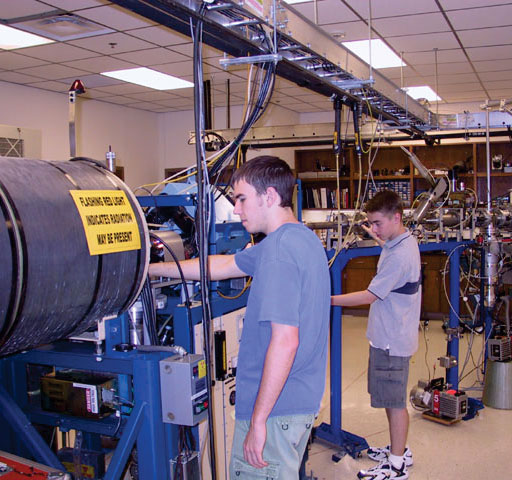
“I’m all for efficiency, but we were operating at cost,” says Daniel Marble, physics chair at Tarleton State in the central Texas city of Stephenville. At the October board meeting, Marble and the university president touted the department’s “multimillion dollar research equipment”—to no avail. Much of the equipment, including a 32-inch optical telescope, a transmission electron microscope, and a tandem accelerator, was acquired between 2001 and 2005, and the department’s recruiting numbers have been on the rise, says Marble. “The board collected [the matriculation] data at the absolute worst time.”
A blow to physics education
More than two-thirds of the physics programs nationwide would fall below Texas’s five-graduates-per-year cutoff, according to the Statistical Research Center at the American Institute of Physics. Many of those programs are located in or near communities with rural or underrepresented minority populations and disproportionally educate the high school physics teachers that serve in those areas.
A group of small physics programs, led by Tarleton State’s, is drawing up a plan that, if approved by the board, will allow the programs to continue offering advanced physics courses and recruiting physics majors. The plan involves restructuring and reforming the Texas Electronic Coalition for Physics, an existing network that allows its members to remotely teach upper-level physics courses not offered at all the schools (see PHYSICS TODAY, September 2005, page 31 ). A final proposal from the new coalition, which includes Texas Southern, is due to be presented before the board in March.

Physics students at Tarleton State University in central Texas work on a 1-megavolt tandem accelerator. Due to low matriculation dates, the school has been barred from recruiting new physics majors.
TARLETON STATE UNIVERSITY