Terrorism Drives Bush R&D Money to Defense and NIH; Other Science Funding Flat in Fiscal 2003
DOI: 10.1063/1.1480779

Marcus Peacock stepped to the front of a crowded auditorium in the headquarters building of the American Association for the Advancement of Science (AAAS) early on a February morning and began an energetic presentation of the Bush administration’s fiscal year 2003 science budget. Peacock, a program associate director at the Office of Management and Budget (OMB), was succinct.
“The nation’s priorities are defeating terrorism abroad, protecting the homeland, and reviving the economy,” he said. All of President Bush’s FY 2003 budget choices must be read against that backdrop, he continued, and the national security priorities have affected the shape of the R&D budget, including science funding.
Peacock went on to note that the federal budget proposal includes nearly $112 billion for science and technology, the highest R&D budget ever proposed. To put the budget in perspective, he said, total US public and private R&D expenditures exceed the combined R&D spending of the rest of the G-7 nations—Canada, Italy, UK, France, Germany, and Japan.
While Bush’s R&D budget of $111.8 billion sets a new record with its $8.6 billion, or 8%, increase over FY 2002, it is so heavily weighted toward the National Institutes of Health (NIH) and the Department of Defense (DOD) that funding for many other areas of science, including physics, is essentially left flat. Republican Sherwood Boehlert (N.Y.), chairman of the House Science Committee, said that, given the times, defense and health certainly should be R&D priorities. But “the focusing of the proposed R&D budget on two narrowly defined priority areas has left the spending for other agencies anemic,” he said.
Without the administration’s national security justifications for the R&D budget, Boehlert said at a recent committee hearing, “this committee collectively would be madder than hell, to put it bluntly,” about Bush’s science funding choices. Citing a campaign promise by Bush to double the NIH budget by 2003, Boehlert said that while he has “long supported, and continues to support,” the doubling of the NIH budget, the institutes’ proposed funding “is now larger than that of the rest of the civilian science agencies put together, and just the increase in the NIH budget is larger than the research budget of NSF.”
Civilian R&D frozen
The Science Committee’s Democratic minority, in an analysis released in February, summed up the administration’s budget proposal this way: “Defense increases 8%, NIH increases 17%, and all other civilian R&D is collectively frozen.” The committee Democrats said they are concerned that “R&D requests for three premier scientific agencies—NSF, NASA, and DOE—fail to keep pace with inflation.” Picking up the administration’s national security theme, the Democrats cited a report from the Hart-Rudman Commission on National Security in the 21st Century, completed six months before the September 11th attacks: “The report, which accurately predicted terrorist attacks on US soil, emphasizes that the US ‘has seriously underfunded basic scientific research’ and recommends that federal R&D funding be doubled by 2010. This recommendation is more, not less, relevant in the wake of last year’s terrorist attacks and underscores the inadequacy of the FY 2003 civilian R&D request.” While Boehlert wasn’t as critical of the administration as his Democratic colleagues, he did say that “Congress, led by the committee, will have to show its mettle and provide an infusion of cash for the rest of the research budget, even in these straitened times.”
Office of Science and Technology Policy Director John Marburger, former director of Brookhaven National Laboratory, has, in several speeches and meetings during the past two months, echoed OMB’s Peacock in stating the administration’s priorities. The FY 2003 budget “provides substantial new funding for science, and it acknowledges that the nation’s highest priorities—the war against terrorism, homeland security, and economic revival—are all served by investments in science, engineering, and education,” Marburger said at the February AAAS meeting in Boston.
In several recent speeches and interviews, Marburger has said that basic science researchers who can relate their work, even indirectly, to practical benefits for society will stand the best chance of receiving funding. While “the frontiers of … astronomy and particle physics remain unconquered,” he said in his AAAS speech, “they have receded so far from the world of human action that the details of their phenomena are no longer very relevant to practical affairs.” Because the instruments of cutting-edge science have become expensive, he continued, and “because we can no longer expect that society will benefit materially from the phenomena we discover in these remote hinterlands, the justification for funding these fields rests entirely on the usefulness of the technology needed for the quest and on the joy we experience in simply knowing how nature works—a joy, I’m afraid, that is shared fully by a rapidly declining fraction of the population.”
As for the concern that too much money is going into the life sciences at the expense of the physical sciences, Marburger said that science is within reach of the “frontier of complexity” and that “complexity creates far more opportunities in the life sciences.” He went on to say that, “given the new atomic-level capabilities, the life sciences may still be underfunded relative to the physical sciences.” When Marburger made the complexity argument before the House Science Committee, Representative Vern Ehlers (R-Mich.) commented that if scientific complexity was the true standard for funding, astrophysics should get the most money.
The administration is also looking at the budget in terms of broader R&D priorities, not just individual agency budgets. The budget names four R&D priority areas that would be funded through multiagency initiatives: Networking and information technology would receive $1.9 billion in funding coordinated by NSF, but spread through the Department of Energy (DOE) and other agencies; nanotechnology R&D, also coordinated by NSF, would receive a total of $679 million in programs at NSF, NIST, and other agencies; climate change R&D would include $1.7 billion for the US Global Change Research Program, an initiative involving nine agencies, and $40 million for the Climate Change Research Initiative, a program involving five agencies; and antiterrorism R&D would receive about $1.5 billion with money spread across many government agencies. The administration is still developing an interagency plan to coordinate the antiterrorism spending.
Marburger, Peacock, and other administration officials have stressed in recent months that the science community needs to pay attention to Bush’s “management agenda,” a series of performance measures that will be applied to R&D projects with increasing rigor. In the FY 2003 budget, agencies received grades (red, yellow, or green marks) rating their performance in five management categories that center on financial and mission efficiency. The budget numbers weren’t related to the scores in FY 2003 (NIH, with five red marks, the worst rating possible, received the largest proposed increase), but Peacock promises the performance standards will be important in setting the FY 2004 budget.
DOE recently tried a pilot program to determine how well its energy R&D programs were working and, according to Peacock, many of the programs gave themselves across-the-board high scores and the evaluations didn’t work as intended. Peacock said the “management metrics” system will be refined and used in setting the FY 2004 R&D budget. Peacock also said that similar standards are being developed to judge the value of basic science programs.
The standards fight is likely to be more important next year. This year, according to Boehlert, the funding debate will focus on “whether the R&D budget outside of DOD and NIH is a glass half full or half empty. I’m willing to see it half full, but I don’t think anyone will be able to argue that it’s any fuller than that. I do want to fill up the glass a little more.” In mid-March, in one of the first legislative responses to the Bush budget, a FY 2003 budget resolution approved by the House Budget Committee increased proposed funding for NSF from 5% to 8%. “I applaud … the Budget Committee,” Boehlert said.
A rich debate
When Peacock finished his presentation at the AAAS seminar, Bob Simon, staff director of the Senate Committee on Energy and Natural Resources, criticized a number of specific funding proposals, then said that “sometimes we [in the Senate] wonder if they [the OMB staff] aren’t institutionally ignorant.” Many of the proposals in the science budget, such as shifting programs from one agency to another, have been studied in the past and shown to be bad ideas, he said. “Our task,” he continued, “will be to separate rhetoric from fact. It promises to be a very rich debate.”
With the lines clearly drawn between the administration and Congress on how R&D money should be distributed, the following are some of the agency highlights:
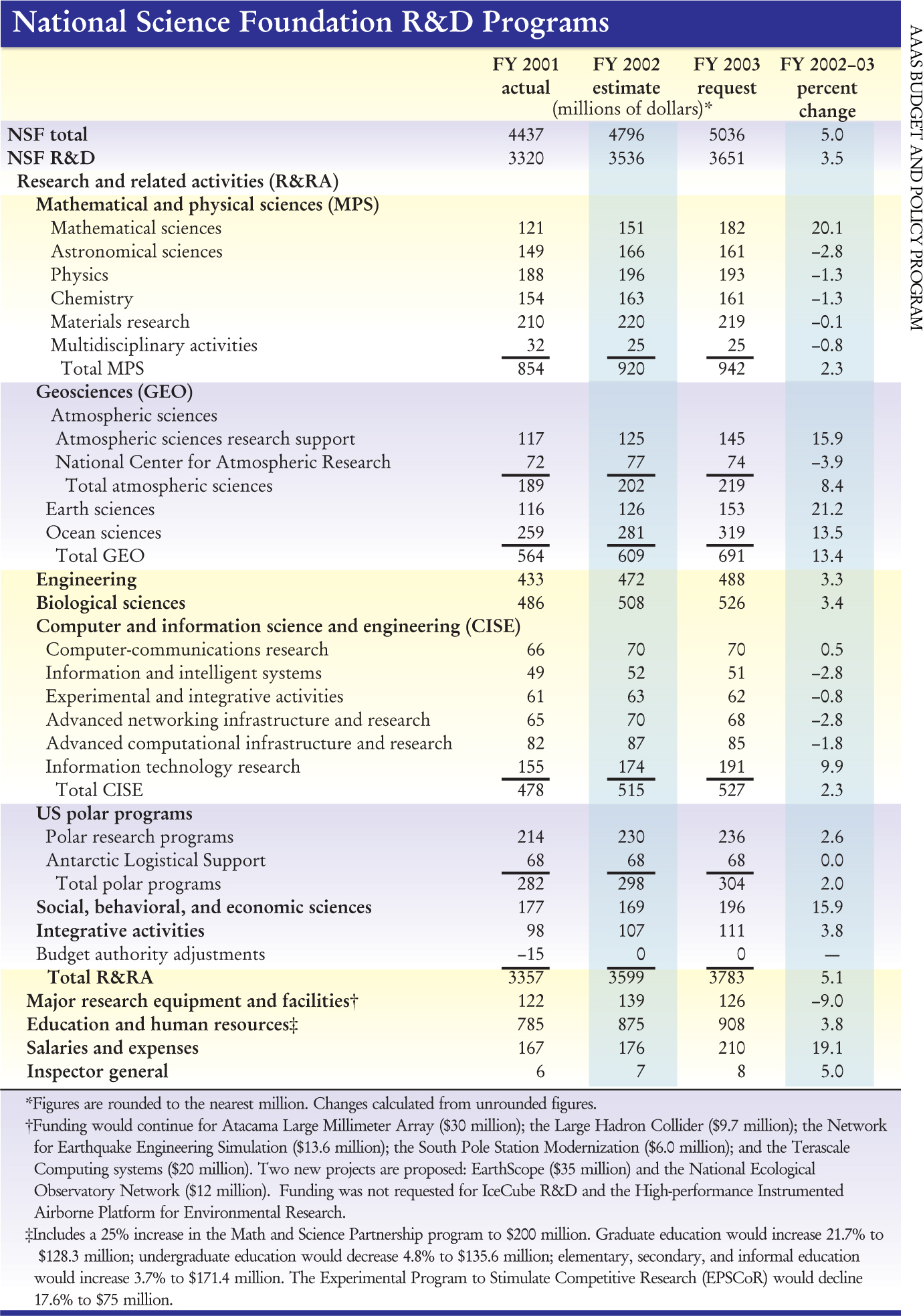
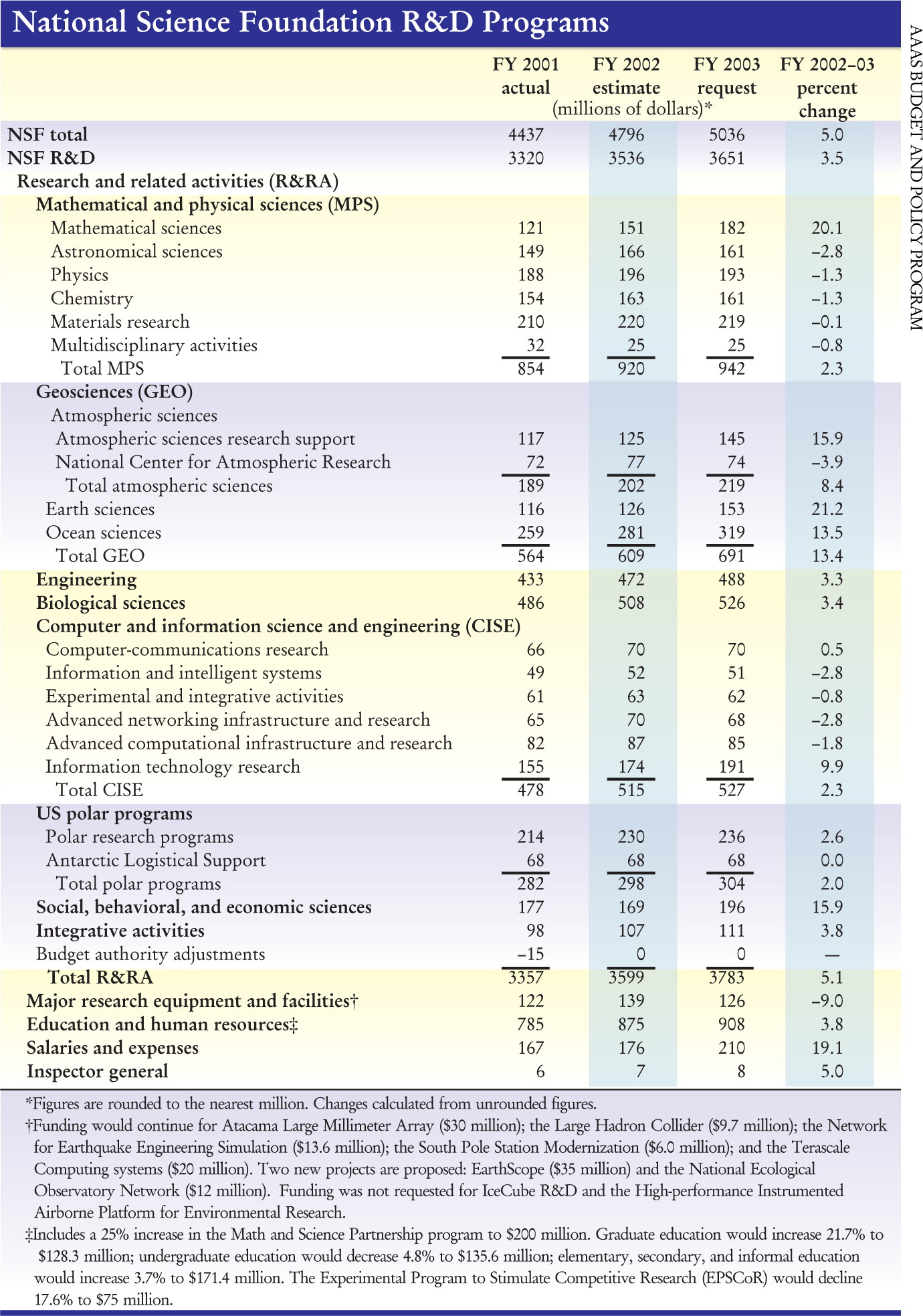
National Science Foundation. The Bush proposal calls for NSF’s budget to be $5 billion in FY 2003, compared with $4.8 billion in FY 2002, an increase of about $240 million. While that works out to a 5% increase, $76 million of the increase actually comes from a transfer of programs and their funds from three other agencies. When the transfers are taken out of the NSF budget, the FY 2003 increase is 3.6% over FY 2002.
Small decreases in funding would occur in most of the physical sciences at NSF, including physics (down 1.3%), astronomical sciences (down 2.8%), chemistry (down 1.3%), and materials research (down 0.1%). Mathematical sciences, identified as one of six priority research areas at NSF, would increase by about 20%, from $151 million in FY 2002 to $182 million in FY 2003. The increase is intended to complement a $60 million increase in the Math and Science Partnerships program, a teacher training program that would be funded at $200 million.
NSF Director Rita Colwell, in a statement accompanying the release of the NSF budget figures, picked up the administration’s theme for the budget, saying, “The future of our nation—indeed, the future of our world—is more dependent than ever before upon advances in science and technology. An inspired American scientific community is now focused on ensuring not just our security, but our very quality of life.” Colwell went on to cite a 1943 secret letter from President Franklin D. Roosevelt to Robert Oppenheimer that said, “Whatever the enemy may be planning, American science will be equal to the challenge.”
One concern on Capitol Hill about the NSF budget proposal is that more than $76 million of the foundation’s increase would come from the transfer to NSF of the National Sea Grant Program from the National Oceanic and Atmospheric Administration (NOAA) at the Department of Commerce, the US Geological Survey’s toxic substances hydrology research program, and an environmental education program from the Environmental Protection Agency. Early indications from Congress are that the transfers are unlikely. Simon, of the Senate Energy Committee staff, said the “movement of these programs into the NSF is hard to understand,” and several members of the House Science Committee were equally skeptical, with one saying the proposed transfer was “wrongheaded.” Indeed, by mid-March the Science Committee’s subcommittee on environment, technology, and standards had approved legislation eliminating the proposed transfer of the Sea Grant program and specifying that the program receive a higher appropriation than it did in FY 2002.
In addition to mathematical sciences, NSF identified five other priority areas: social, behavioral, and economic sciences (up 15.9%); biocomplexity in the environment (up 36%); information technology research (up 9.9%); nanoscale science and engineering (up 11.3%); and learning for the 21st-century work force (up 27.5%).
A serious concern in the physics community is the proposed cut in the major research equipment and facility construction account, which would decrease 9%, or $13 million, under the Bush proposal. Most of the drop comes from the elimination of projects, including two major ones funded last year by congressional earmarks, the IceCube neutrino experiment ($15 million), and the High-performance Instrumented Airborne Platform for Environmental Research (HIAPER; $35 million). Five existing programs would continue under the Bush proposal: Atacama Large Millimeter Array, Phase II ($30 million); the Large Hadron Collider ($9.7 million); the Network for Earthquake Engineering Simulation ($13.6 million); South Pole Station modernization ($6 million); and Terascale Computing Systems ($20 million).
Two new projects are included in the research equipment budget: EarthScope ($35 million), an earthquake detection and research network, and the National Ecological Observatory Network (NEON; $12 million), which would develop integrated models of ecosystems.
The Budget Committee voted to significantly increase research equipment funding in its mid-March budget resolution, raising the research equipment budget 11% over FY 2002 funding. That amounts to a 20% turnaround from the administration’s proposed 9% cut, and if it stands through the entire budget process, would likely lead to the restoration of the HIAPER project. IceCube may be deferred in the FY 2003 process because of a review of neutrino science being conducted by the National Academy of Sciences. Other projects, such as Rare Symmetry Violating Process (RSVP), a proposed international collaboration to test the standard model, are more likely to be funded if the preliminary House budget numbers hold.
The administration is trying to stop “research earmarks,” program funds that come through congressional legislation, not agency budget requests. There were about $1.5 billion in R&D earmarks across the federal government in 2002, and the administration has promised to fight attempts by Congress to put them back in the budget.
Department of Energy. Just two years ago, Millie Dresselhaus, then head of DOE’s Office of Science, was overseeing a 14% increase in R&D spending and was advocating a doubling of her budget over a five-year period. Dresselhaus, one of President Bill Clinton’s last appointments, offered to stay on at DOE, but Bush didn’t accept her proposal and the Office of Science remained leaderless until Bush nominated physicist and University of California, Riverside, Chancellor Raymond Orbach for the post in December 2001. After easily clearing Senate confirmation, Orbach was sworn in on 14 March. The administration also cut overall R&D spending by 4.5% in FY 2002 and only provided a 0.1% increase in the Office of Science budget.
The FY 2003 budget is similar to the FY 2002 proposal, with a 0.1% increase recommended for the Office of Science. The overall DOE R&D budget which would decline by 0.5%. Part of that decrease is due to a scheduled reduction in the construction costs of the Spallation Neutron Source, as well as cuts of congressional earmarks from the budget.
Many of DOE’s science programs would see small increases. Nuclear physics would increase 6.5%, fusion energy sciences would be up by 4%, basic energy sciences would increase by 2%, and high-energy physics would be up 1.7%. The science laboratories infrastructure would increase 15.1% to take care of increasing security requirements and badly needed maintenance at many of the facilities.
The high-energy physics funding of $725 million, an increase of 1.7%, would focus on two “windows of opportunity,” according to DOE officials. (See related story on page 25 of this issue.) The first is the search for the Higgs boson, which will be the primary emphasis at Fermilab for several years. The other is research on CP violation at SLAC. There is also $11 million for the construction of the Large Hadron Collider at CERN. While this is counted as new money, it is actually deferred money from FY 2002 by agreement with CERN. The Neutrinos at the Main Injector (NuMI) project based at Fermilab is up $8.7 million to $20.1 million in FY 2003 funding, based on an upward revision of the total project cost to $109 million. The DOE request also adds $2.5 million to the high-energy-physics university research programs.
Nuclear physics, up 6.5%, focuses its FY 2003 funding on expanding the operating times at the three largest research facilities. The Bates facility at MIT would increase its operations schedule from 21 to 27 weeks; the Thomas Jefferson National Accelerator Facility would increase from 26 to 28 weeks; and the Relativistic Heavy Ion Collider would double its operating time from 11 to 22 weeks. Nuclear physics university research programs would increase $3.9 million over FY 2002.
Fusion energy sciences are up 4%, thanks in part to money that was freed up with the completed decommissioning of the Tokamak Fusion Test Reactor in 2002. Total fusion funding of $257 million would go primarily to support increased operating time at DIII-D at General Atomics in San Diego, California (from 14 to 21 weeks); the Alcator C-Mod at MIT (from 8 to 21 weeks); and the National Spherical Tokamak Experiment at the Princeton Plasma Physics Lab (from 12 to 21 weeks).
In an agreement reached in early March with Washington State, the administration agreed to restore $300 million it had cut from the FY 2003 budget for cleanup of the Hanford nuclear reservation, bringing Han-ford’s budget to more than $2 billion for the year. The agreement calls for speeding up retrieval of more than 201 million liters of highly radioactive waste stored in 177 underground tanks near the Columbia River.
National Aeronautics and Space Administration. When NASA Administrator Sean O’Keefe appeared before the House Science Committee to discuss NASA’s FY 2003 budget, he had been in the job for only eight weeks (see January 2002, page 23 ) yet had already put in motion plans to reduce the agency’s size and reassign hundreds of employees. Rumors flew around Washington of an agencywide secret review and the closure of major research centers. While all the research centers survive in this budget, an announcement on their long-term future is expected later this year. “We cannot meet our oversight responsibilities if Congress is kept in the dark about such things as NASA’s Strategic Resources Review,” Rep. Ralph Hall (D-Tex.), the ranking minority member, told O’Keefe. “We need straight talk about your plans sooner rather than later.”
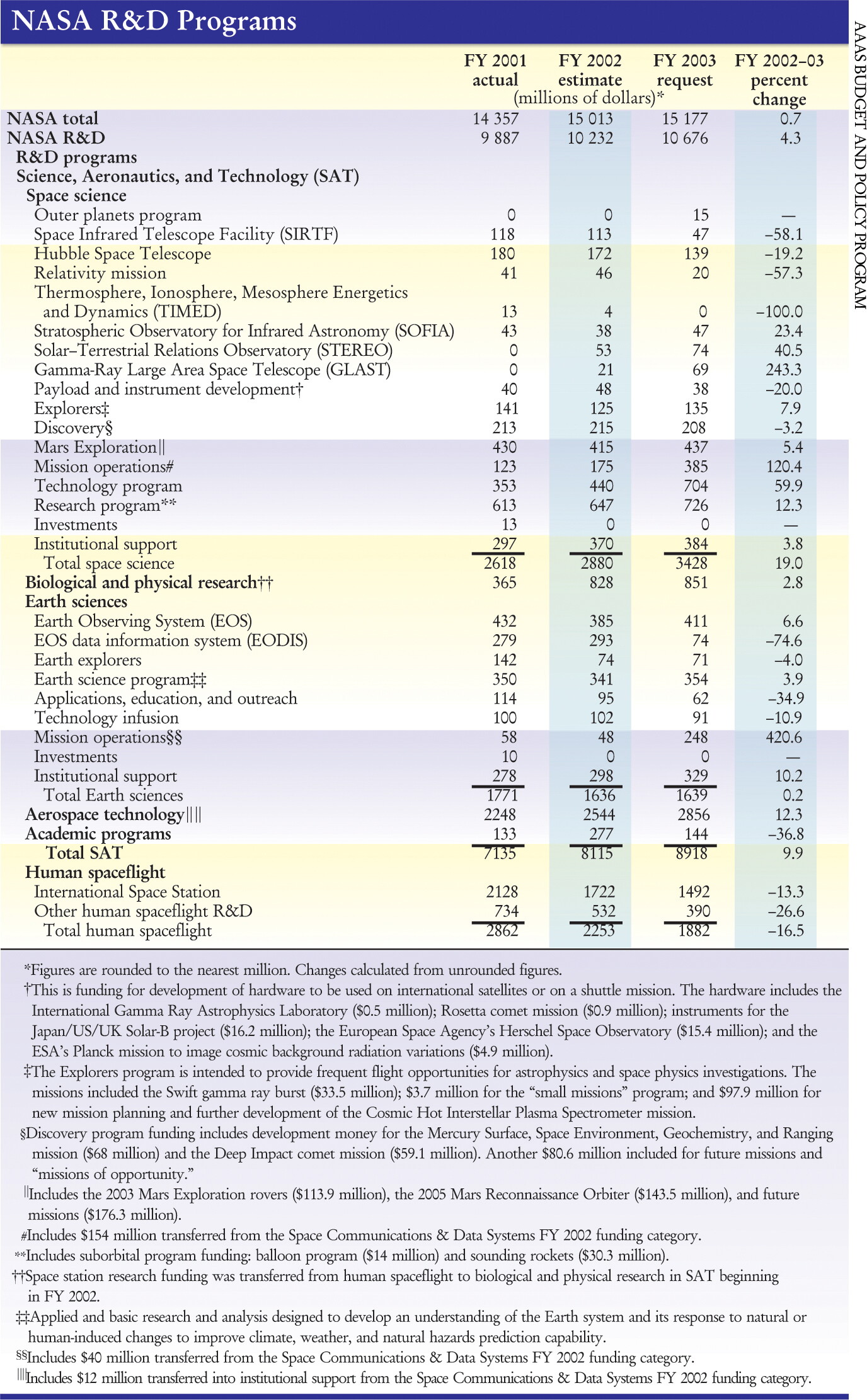
The 2003 budget, almost unchanged from FY 2002, is the first step to revamping the management and accounting structure at NASA, says O’Keefe. In the past, weak controls on some divisions, especially on work connected to the International Space Station (ISS), resulted in a $590 million overspend in the 1999 budget (missed by then-auditors Arthur Andersen) and a refusal by auditors PricewaterhouseCoopers to approve the 2001 accounts. “NASA books are in such disarray that there should be a real alarm,” said Rep. Dana Rohrabacher (R-Calif.).
To get the space station on track with a 13% cut in funds, O’Keefe is going to follow the recommendations of the ISS Thomas Young task force and keep the astronaut crew at three—which will limit the amount of science carried out on the ISS—and reduce the number of shuttle flights to four per year. Options for launching science-based shuttle missions will be severely limited by the constraints. “In the future, science missions will have to pay for shuttle transportation,” says Karen Poniatowski, deputy associate administrator for space access.
For example, launch costs for the next Hubble Space Telescope service mission, currently scheduled for 2004, will be funded from space science, not the space flight program. O’Keefe is looking at other ways to control ISS costs and promised the Science Committee that NASA “will identify all of the options by this summer.”
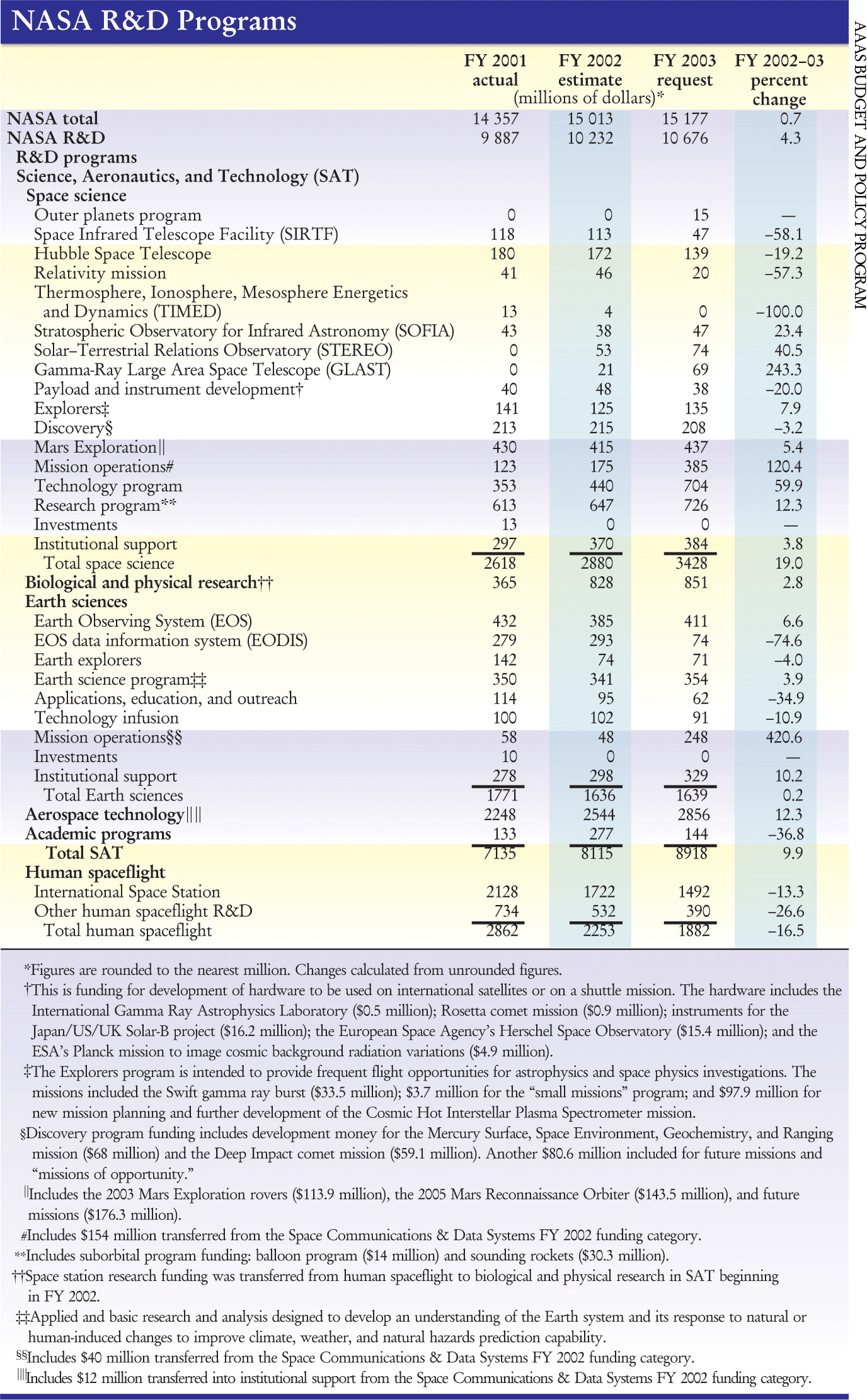
Space science, which saw a 19% increase in its budget, includes a new $125.5 million program for developing nuclear-powered Mars rovers and rocket propulsion with DOE. The Outer Planets Program, along with the Europa and Pluto Express missions, have been scrapped and replaced by a $15 million New Frontiers Program. This new program caps a typical mission at $650 million. Sen. Barbara Mikulski (D-Md.), who put Pluto Express back in the 2002 budget, has vowed to find funding for the mission again. For the first time, all the costs ($385.2 million) associated with running the Deep Space Network are included in space science.
Earth science funding is up only 0.2%, with no new climate programs planned until a review of the interagency US Global Change Research Program is finished. A 420% increase in the mission operations budget is due to a transfer of funds from the Earth Observing System Data Information Systems (EODIS).
The 12.3% increase in aerospace technology research regains an old path for NASA, building closer links with DOD. NASA and DOD are currently planning to spend $10–$12 billion on the second-generation reusable launcher vehicle program over the next few years for deployment in 2012.
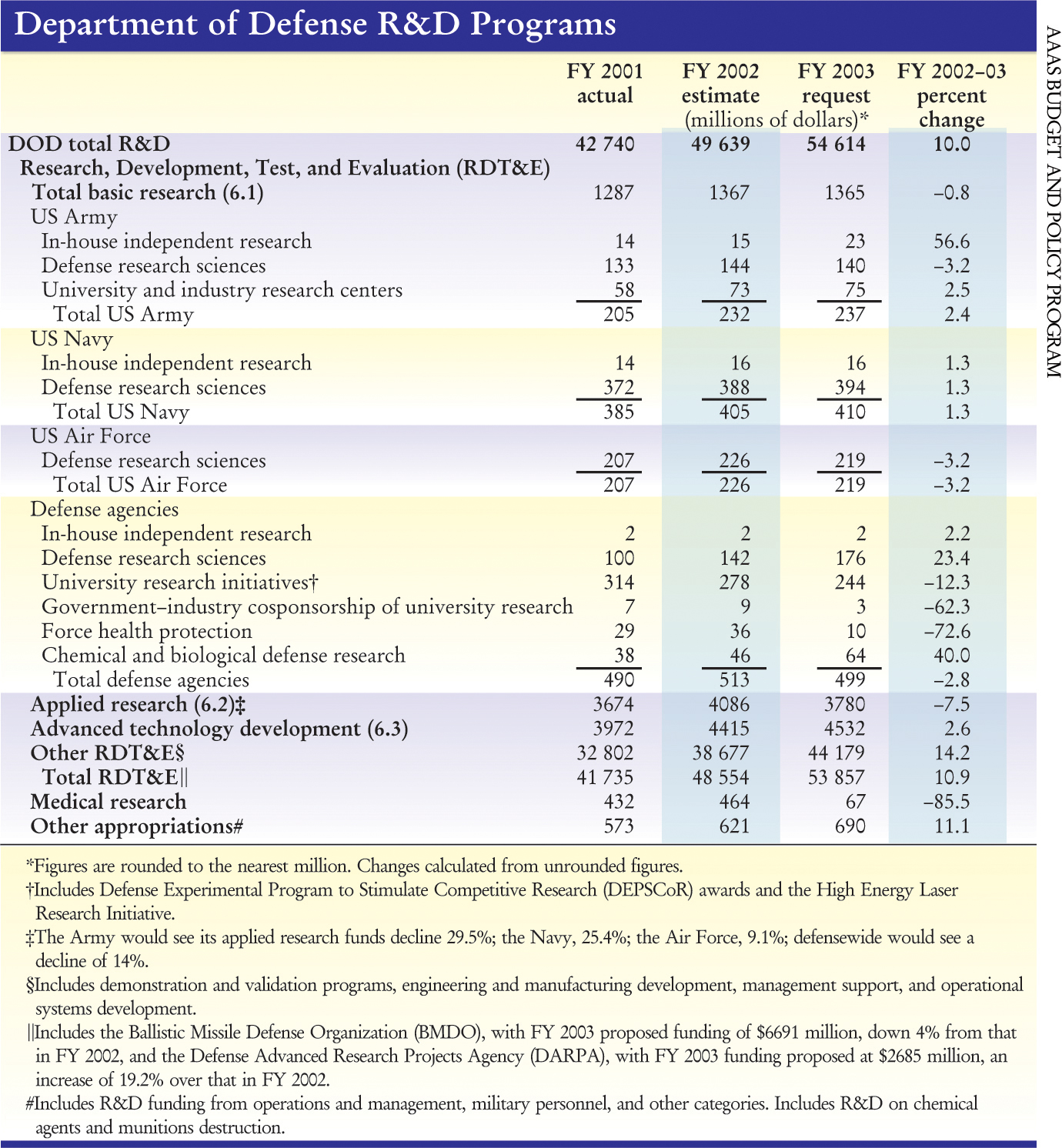
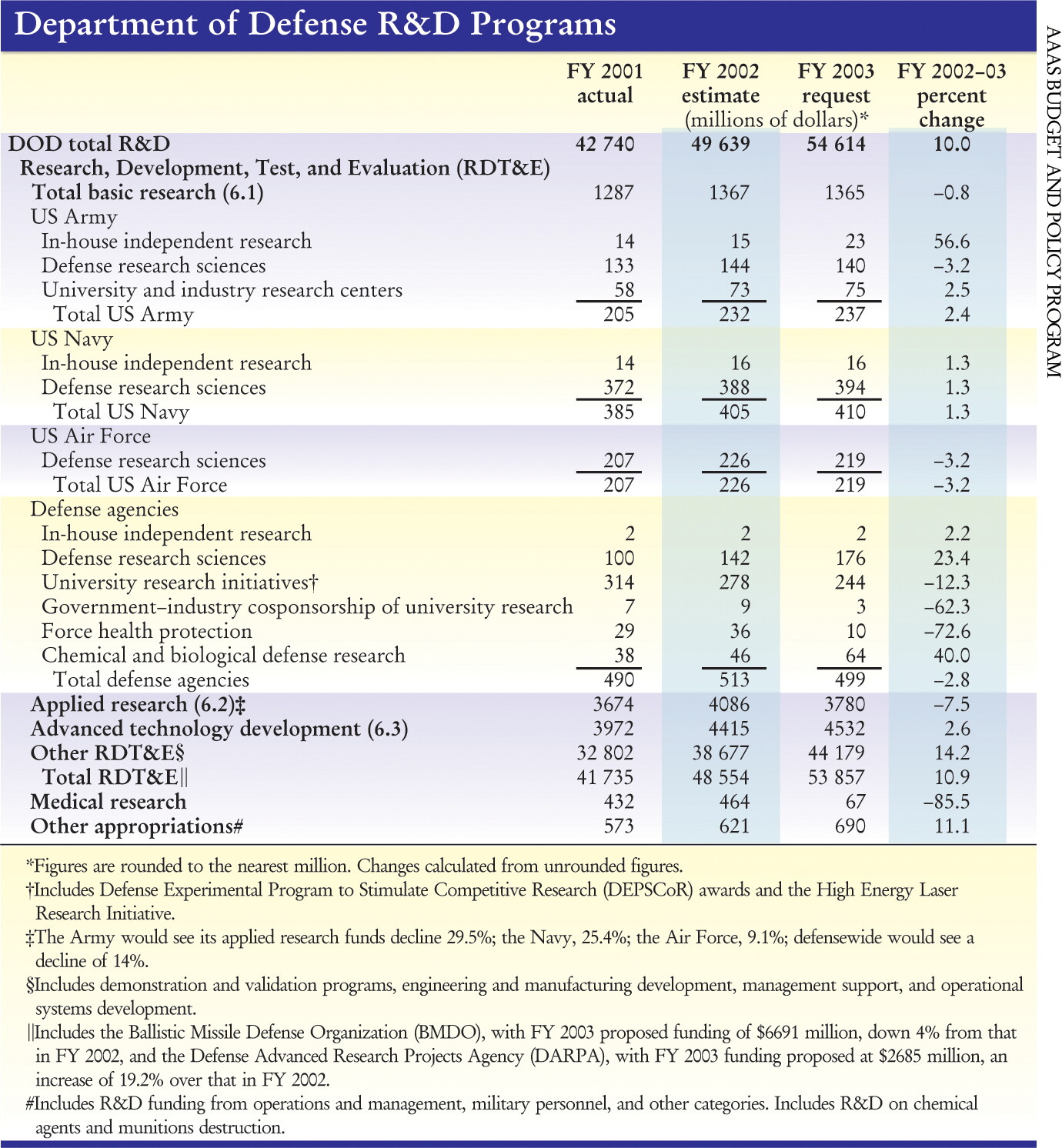
Department of Defense. After a record R&D increase of $7 billion in FY 2002, DOD is in line for a $5.4 billion R&D increase for FY 2003. “Research and development of technologies and systems that address terrorist threats have been the focus of additional funds and urgency,” the Bush budget document says. Most of the increase goes into the development of weapons systems, however, with basic and applied research remaining flat.
The Ballistic Missile Defense Organization, whose R&D budget doubled in FY 2002, would see a slight decline in its research budget, to $6.7 billion. The Defense Advanced Research Projects Agency, which has a wide range of cutting-edge military technology research programs, would receive a 19.2% increase to $2.7 billion. DARPA’s basic research programs would receive a 23% increase.
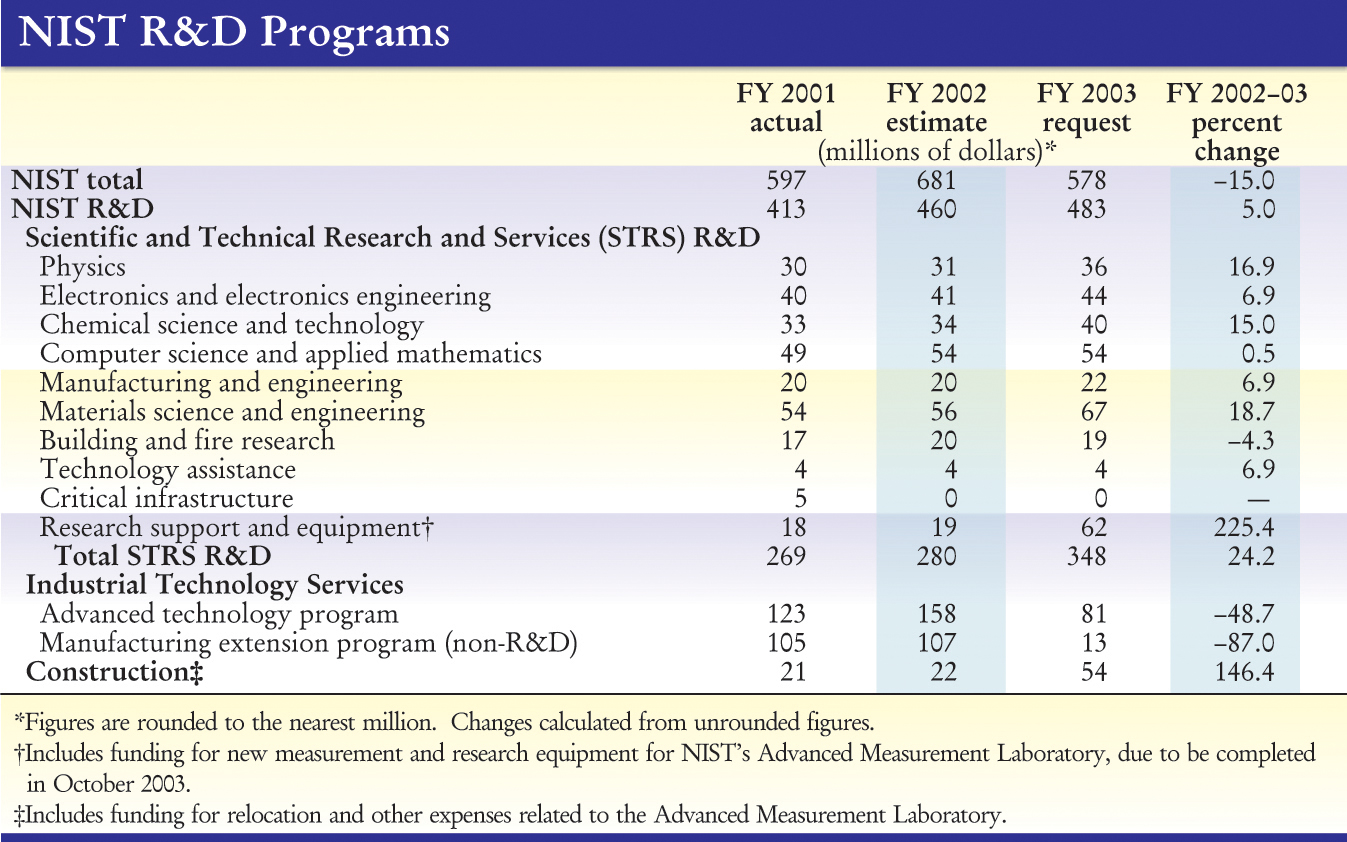
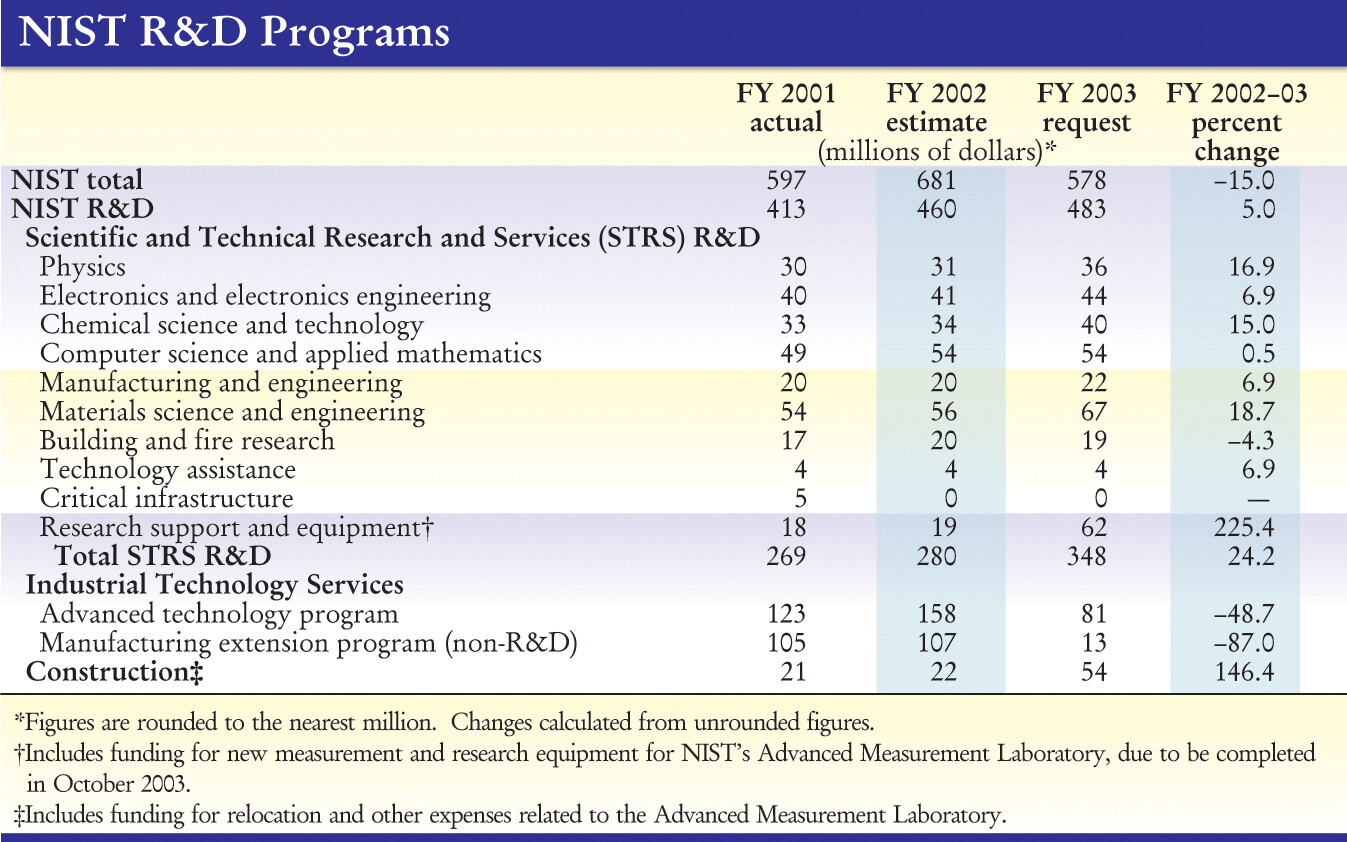
National Institute of Standards and Technology. Total R&D at NIST is up 5% in the budget proposal, with $35 million going into completing and equipping the Advanced Measurement Laboratory at NIST headquarters in Gaithersburg, Maryland. Baldrige National Quality Program funding would increase 11.7%, to $5.8 million. The Advanced Technology Program, a long-time whipping horse of congressional Republicans, would survive with an $81 million budget, a 48.7% cut from last year. In FY 2002, the program was essentially zeroed out by the administration, but revived by congressional Democrats. A repeat of that scenario may happen this year with the Manufacturing Extension Program, which is a federal-state-private partnership that has strong congressional support. The administration proposes to cut federal funding for that partnership from $107 million to $13 million, and Congress seems likely to keep the funding closer to the FY 2002 level.
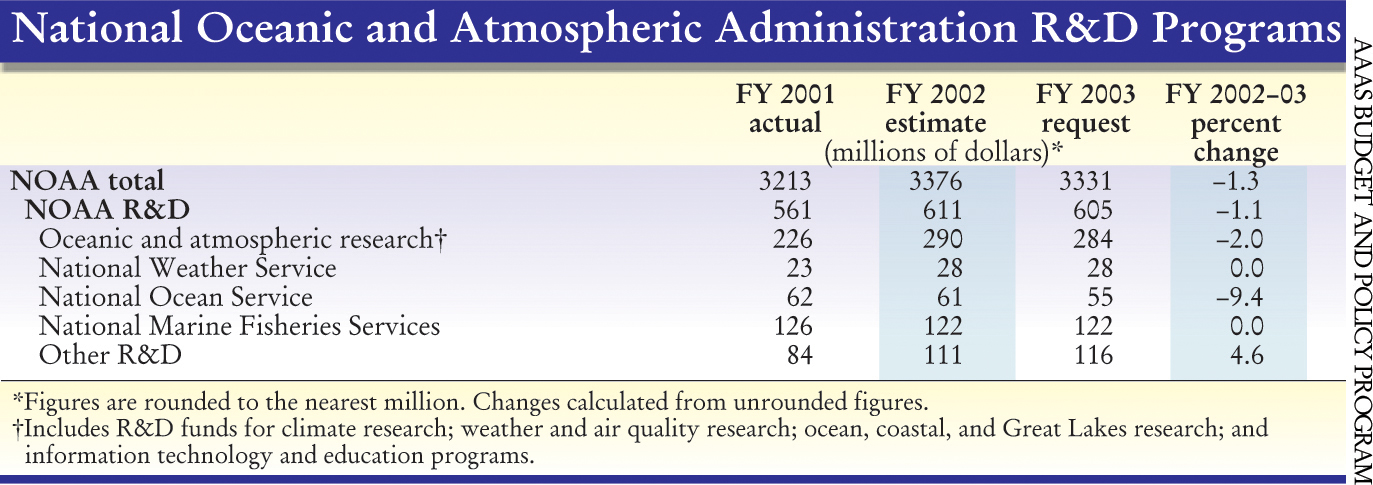
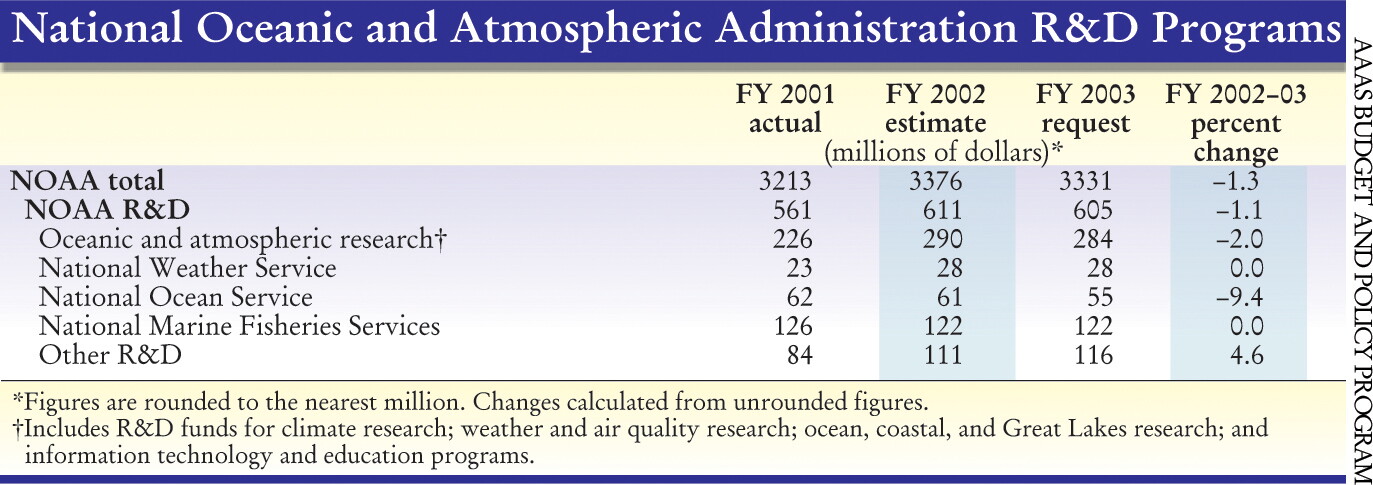
National Oceanic and Atmospheric Administration. Both the total and R&D budgets at NOAA would decrease slightly in FY 2003. The budget document notes that, in FY 2002, NOAA had 74 congressionally directed earmark projects totaling more than $160 million. The 2003 budget cuts many of the projects and redirects their funding within the Department of Commerce. The most controversial aspect of the NOAA budget is the proposed move of the $62 million National Sea Grant Program from NOAA to NSF. Most House Science Committee members are opposed to the move, as are others on Capitol Hill, so it isn’t likely to occur.

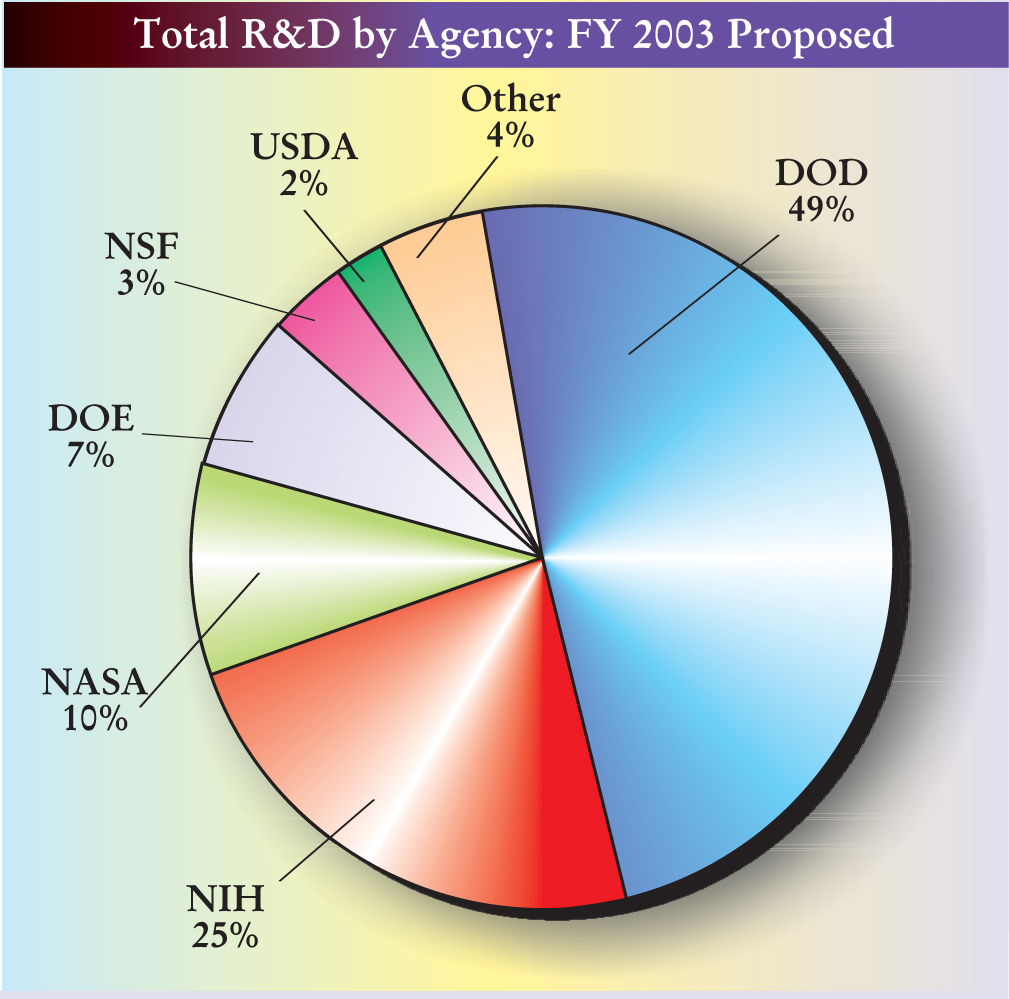
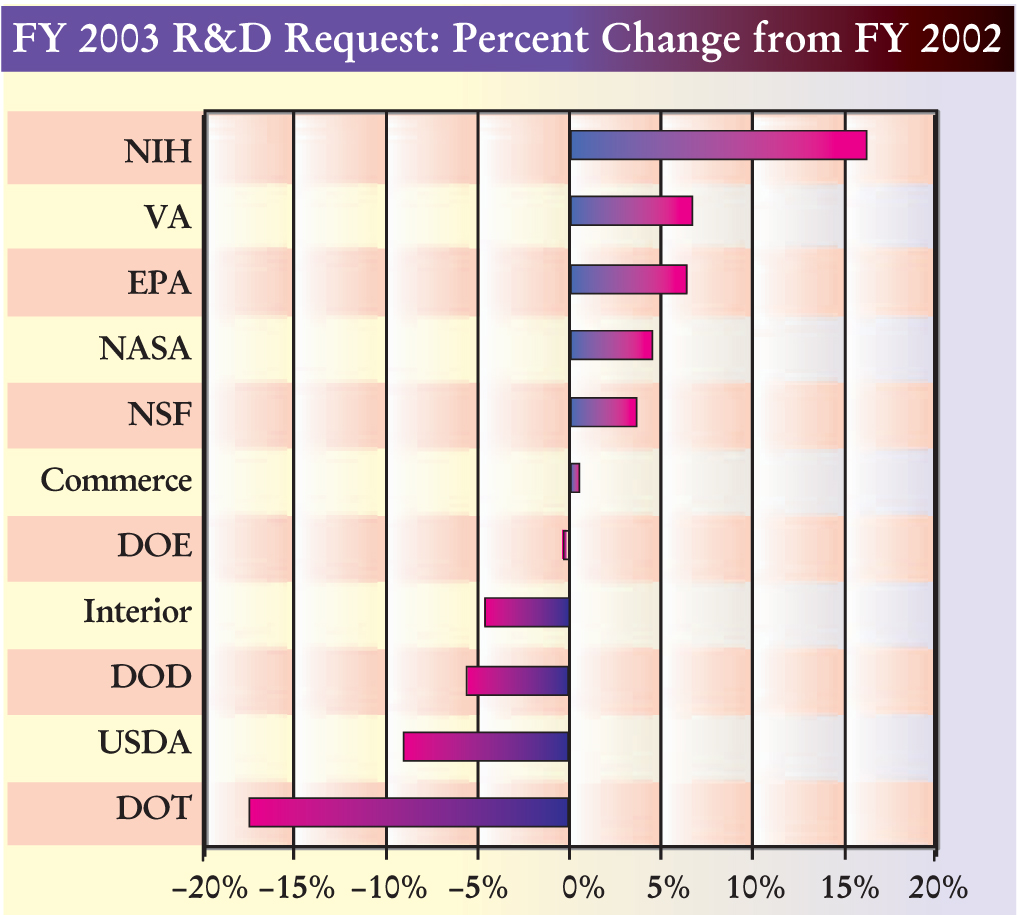
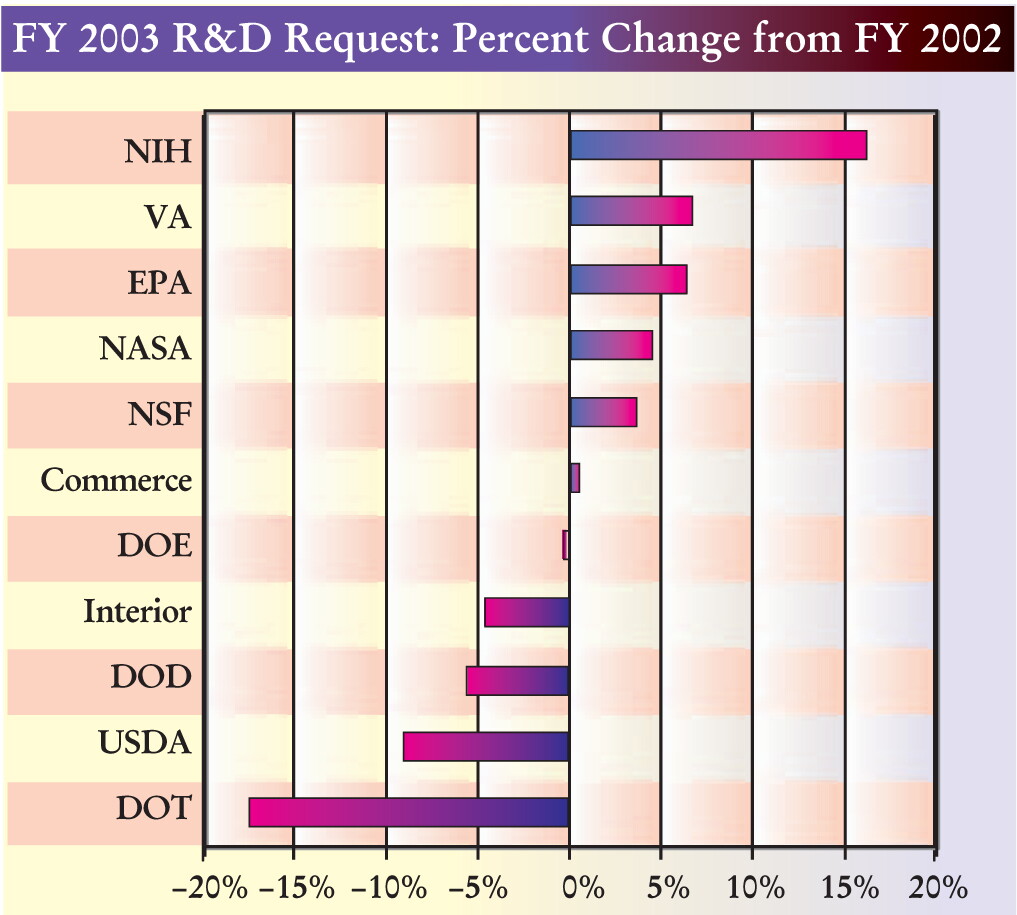
Where Bush’s R&D money would go. The FY 2003 budget request from President Bush echoes the FY 2002 budget, calling for an overall increase in federal spending for R&D and, like last year, aiming most of the increase at the Department of Defense (up 10.9%, or $5.4 billion), and the National Institutes of Health (up 17%, or $3.9 billion). The DOD and NIH increases are more than the total increase in the R&D budget, with the result that the overall proposed funding for the rest of science is lower than 2002. Nondefense R&D spending, with NIH excluded, would fall by 0.4% in FY 2003. The total federal R&D request is a record $111.8 billion, which is $8.6 billion, or 8.3%, more than FY 2002, according to analysis by the American Association for the Advancement of Science (AAAS). That money comes almost entirely from discretionary spending, the one-third of the federal budget not already committed to mandatory programs. Overall, discretionary spending would rise 6.8%, or $49 billion, to $767 billion for FY 2003.
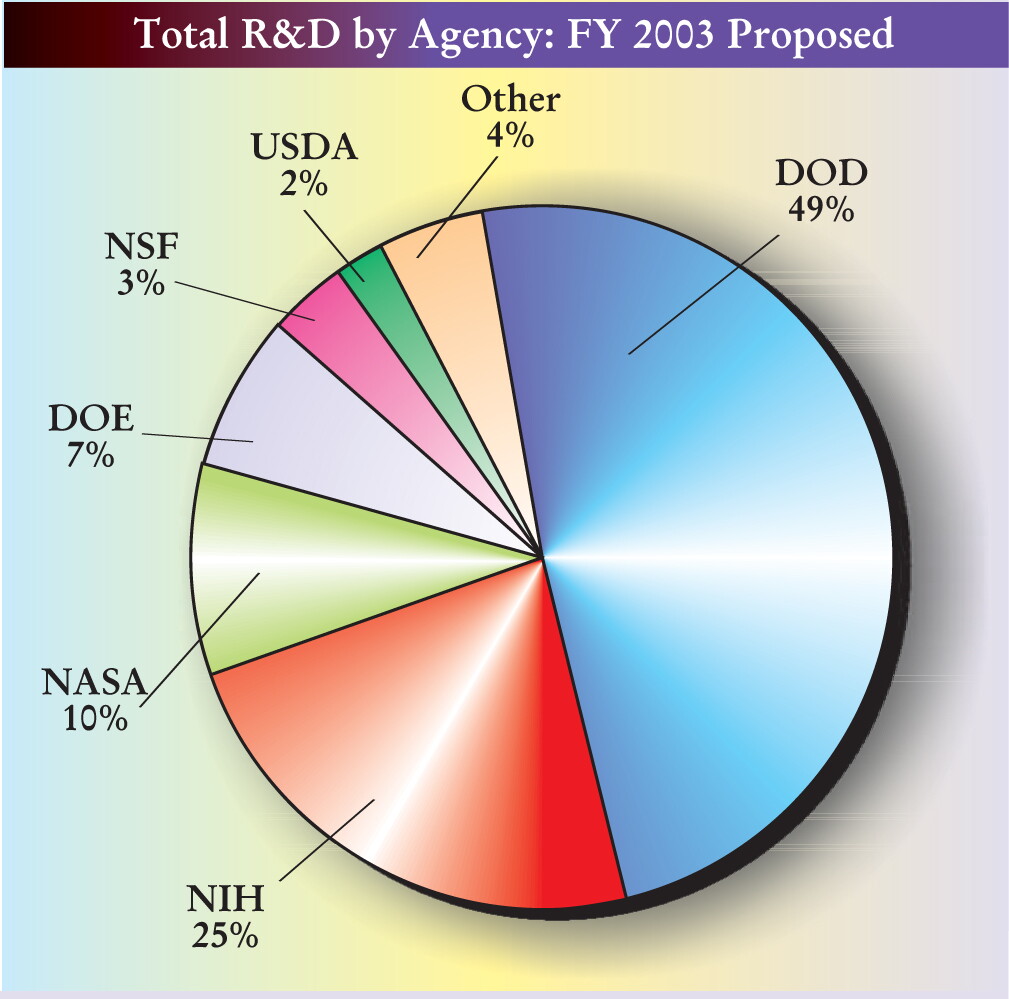

Winners and losers in Bush’s science funding. In the wake of the September 11th and anthrax attacks, the Bush administration seems more determined than ever to boost spending for national security and defense against bioterrorism. While Congress is supporting spending, even deficit spending, to wage the war on terrorism, there is growing concern that the physical sciences are too small a factor in the administration’s budget formula. Several members of Congress have indicated they will be aggressive in trying to restore balance to the federal research portfolio, so the final shape of the R&D budget may change significantly by the end of the year. Under the Bush proposal, 5 of the 11 largest R&D funding agencies would see their research budgets fall, but there is a complex mix of increases and decreases scattered within agency programs. The Bush numbers also reflect the administration’s campaign against congressional “earmarks”—more derisively known as “pork projects”—that totaled $1.5 billion in FY 2002. Many of those projects have been eliminated from the budget, but many will likely be put back in by Congress.

National Science Foundation R&D Programs.
AAAS Budget and policy program

NASA R&D Programs
AAAS Budget and policy program

Department of Defense R&D Programs
AAAS Budget and policy program

National Oceanic and Atmospheric Administration R&D Programs
AAAS Budget and policy program

NIST R&D Programs
AAAS Budget and policy program
More about the authors
Paul Guinnessy, pguinnes@aip.org