Teaching Physics with Superheroes
DOI: 10.1063/1.1535003

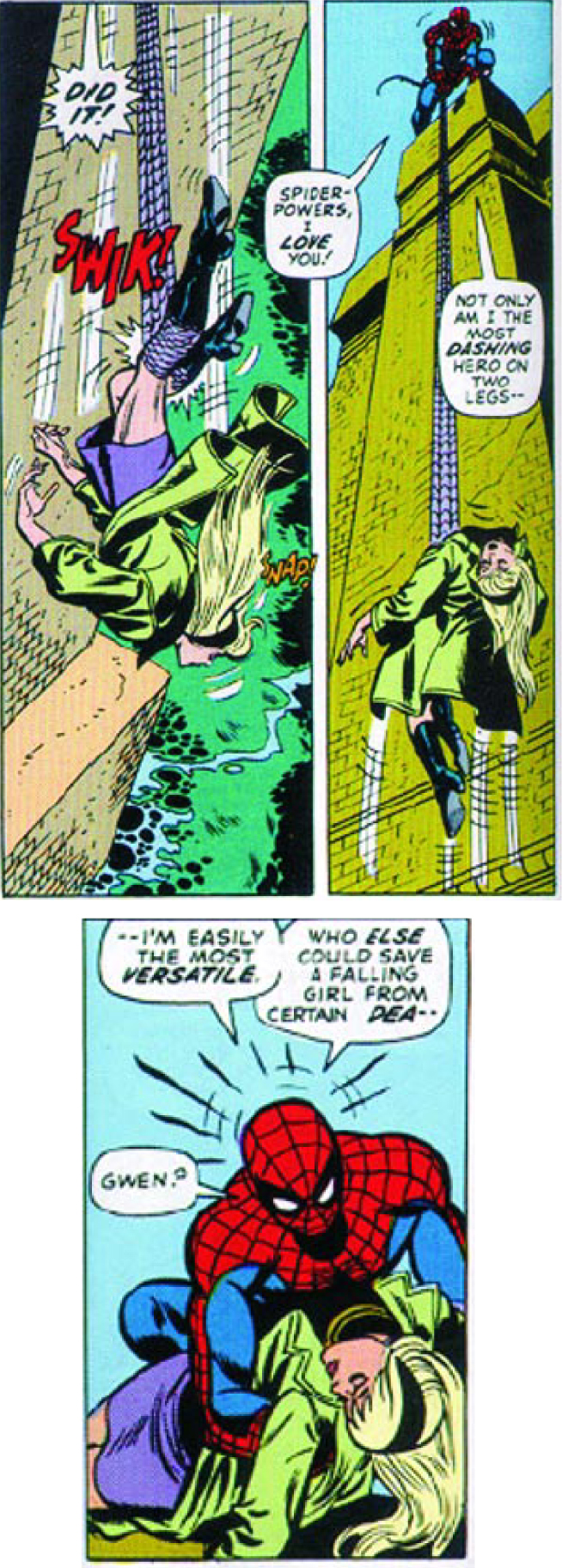
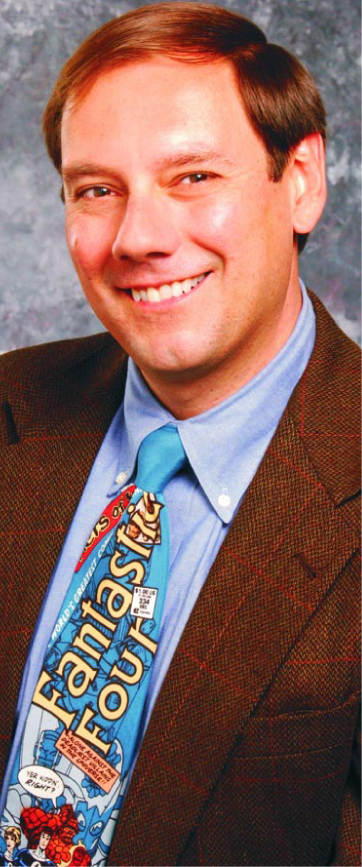
How did Superman get to be so strong? What killed Spider-Man’s girlfriend Gwen Stacy? How fast can the Flash run? Jim Kakalios, a condensed matter experimentalist and comics buff, analyzes questions like these from action comics to teach physics in a freshman seminar at the University of Minnesota–Twin Cities.
“Take Superman,” says Kakalios. “What does it take to leap a tall building in a single bound?” To find out, Kakalios’s students use Newton’s laws of motion. “We calculate how much force is required,” says Kakalios. That leads to the question, How did his legs get so strong? “Back in the 1930s,” Kakalios says, “it was presumed that Superman was so strong because he was acclimated to Krypton’s gravity.” In the class, the gravitational force of Krypton—Superman’s home planet—is calculated to be about 15 times that of Earth’s. “We talk about Newton’s law of gravity, and then we talk about how you would build such a planet, and not make it a gas giant. I bring in things from different parts of the physics curriculum, and show how interconnected everything is,” says Kakalios. “It turns out that the only way we could figure out how to make such a planet, it would be very unstable—it would explode.” It’s an amusing twist, he adds, “that this is completely consistent with the comics.”
Another example is the controversy over the death of Gwen Stacy, who was knocked off a bridge tower. Spider-Man may have been surprised to find her dead when he caught her in his web, but Kakalios’s students weren’t: By estimating the height of the bridge, Gwen’s mass, and the time Spider-Man had to catch her, and then using conservation of momentum, says Kakalios, “it turns out the force has to be at least 10 Gs. If she experienced such a sudden jerk, it’s not unreasonable that she would have broken her neck.”
The Bernoulli principle, time travel, and the biological and physical feasibility and implications of shrinking to the size of an atom or growing into a giant are among the topics Kakalios’s class tackles through comics. The comics don’t get the science right all the time, says Kakalios, “but I am struck by how often they do.” Over the years, he says, comics have kept up with the times: In the 1940s, a lot of super-heroes gained their powers through some mystical artifact from the Far East; in the 1960s, they got them through radioactivity; and, since the 1990s, they get them through genetic engineering. A few years ago, adds Kakalios, results on entangled quantum states found their way into a comic book just months after they were published in Physical Review Letters.
“Interestingly,” says Kakalios, “when I talk about comic-book examples, no one asks how they’ll use it in real life. They never expected comics to be accurate. Once you show them it’s relevant, and develop the physics, I put in real-world applications.” For example, he continues, “once we’ve talked about the Spider-Man story line, and shown that it’s conservation of momentum [that delivers the impact that kills Gwen], I bring in airbags. They increase the time to slow your head down. The force to your head can still knock you out, but it doesn’t kill you.”
It’s a sneaky class, says Kakalios. “Basically, the course is really ‘physics in the everyday world.’ [Students] are so busy eating their superhero ice cream sundaes, they don’t notice that I am feeding them their spinach.”

MARVEL COMICS


Kakalios
TOM FOLEY
More about the authors
Toni Feder, American Center for Physics, One Physics Ellipse, College Park, Maryland 20740-3842, US . tfeder@aip.org