“Switching on one of the world’s first neutrino superbeams is a great achievement,” said CERN Director General Rolf Heuer. “Even in a time of financial difficulty around the globe, it’s important not to lose sight of the fact that basic science is and always will be a crucial element of progress. It is therefore heartening to see such an important new basic science initiative getting underway now.”
“It is a big step forward,” said T2K spokesperson Takashi Kobayashi. “We’ve been working hard for more than 10 years to make this happen.”
J-PARC now produces the world’s most powerful neutrino beams to study neutrino oscillations.
“Neutrinos are the elusive ghosts of particle physics,” Kobayashi explains. “They come in three types, called electron neutrinos, muon neutrinos, and tau neutrinos, which used to be thought to be immutable.”
Interacting only weakly with matter, neutrinos can traverse the entire earth with vastly less attenuation than light passing through a window. The very weakness of their interactions allows physicists to make what should be very accurate predictions of their behavior, and thus it came as a shock when measurements of the flux of neutrinos coming from the thermonuclear reactions which power our sun were far lower than predicted.
A second anomaly was then clearly demonstrated in 1998 by Super-Kamiokande, when it showed that the flux of different types of neutrino generated within our atmosphere by cosmic ray interactions was different depending on whether the neutrinos were coming from above or below (which should not have been possible given our understanding of particle physics). Other experiments, such as Kamioka Liquid scintillator Anti-Neutrino Detector ( KamLAND), have conclusively demonstrated that these anomalies are caused by neutrino oscillations, whereby one type of neutrino turns into another.
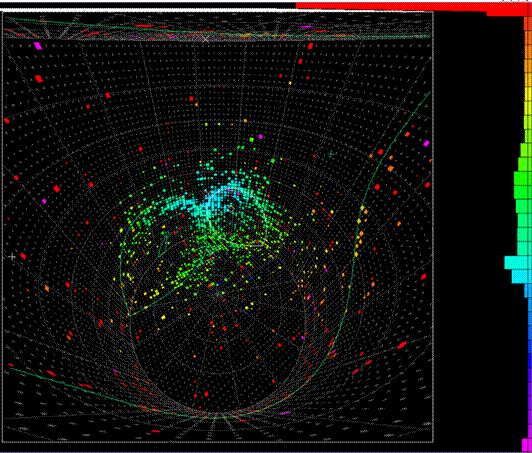
The first T2K event seen in Super-Kamiokande is seen in the image above. Each dot is a photomulipler tube which has detected photons. The two circles of hits indicate that a neutrino has probably produced a particle called a Ï 0, perfectly in time with the arrival of a pulse of neutrinos from J-PARC. Another faint circle surrounds the viewpoint of this image, showing a third particle was created by the neutrino.
The T2K experiment has been built to make measurements of unprecedented precision of known neutrino oscillations, and to look for a so-far unobserved type of oscillation which would cause a small fraction of the muon neutrinos produced at J-PARC to become electron neutrinos by the time they reach Super-Kamiokande.
Observing the new type of oscillation would open the prospect of comparing the oscillations of neutrinos and anti-neutrinos, which many theorists believe may be related to one of the great mysteries in fundamental physics—why is there more matter than anti-matter in the universe? “The observation of this first neutrino means that the hunt has just begun,” said Koichiro Nishikawa, director of the Institute for Particle and Nuclear Studies at KEK and founder of T2K. “The first physics results are expected later this year.” Today’s news he says, “is the beginning.”