Superhydrophobic tube stays afloat in extreme conditions

Figure 1.

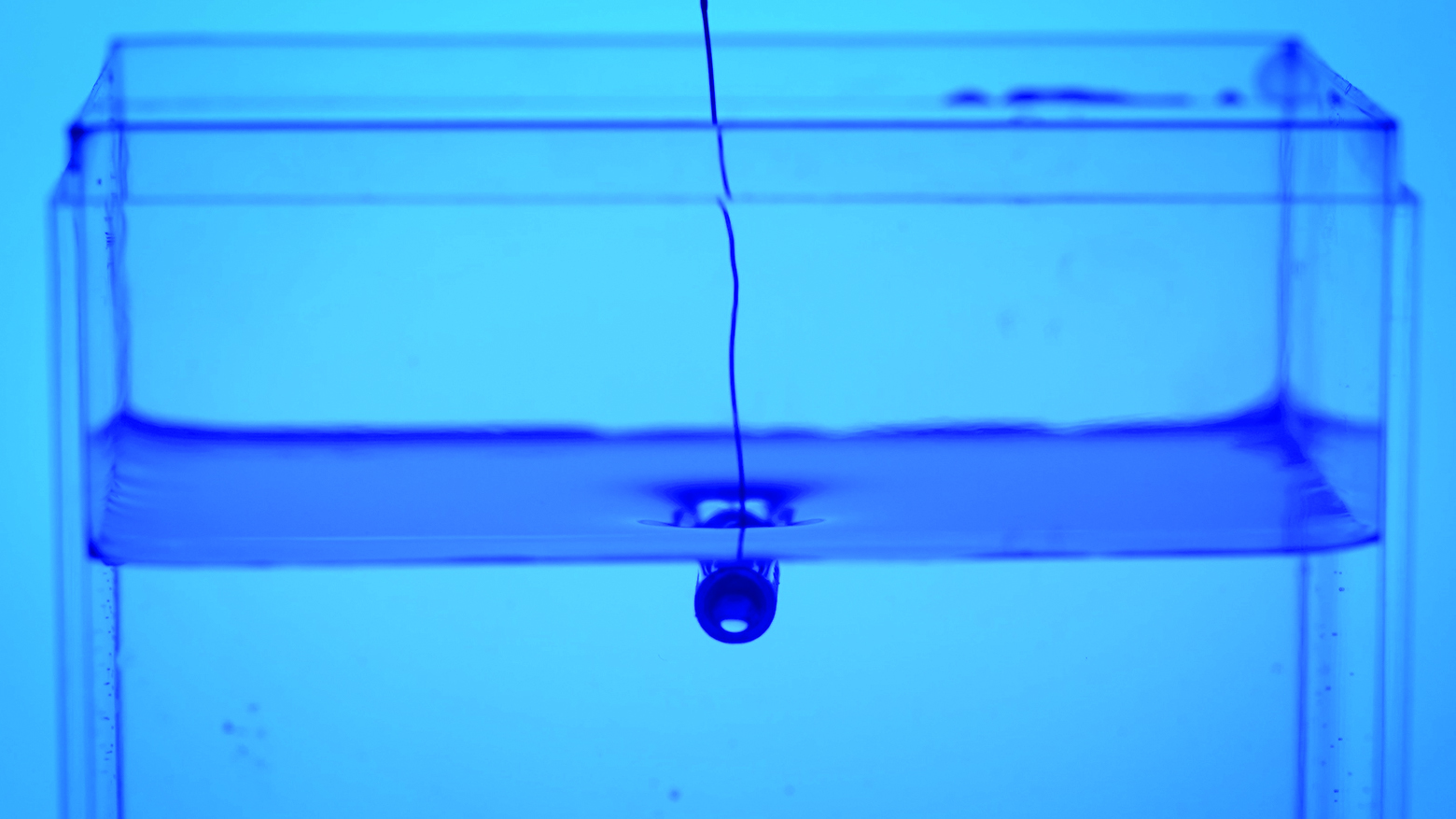
An aluminum tube displaces water around it as it is lowered into the water. Once water covers the top of the tube, a trapped air bubble allows the tube to maintain the required buoyancy to stay afloat.
(Photo courtesy of the University of Rochester.)

A newly developed aluminum tube is almost impossible to sink. The superhydrophobic tubes, developed by Chunlei Guo and colleagues from the University of Rochester, trap an air bubble to maintain buoyancy even when sloshed around by waves. 1 The design was inspired by diving bell spiders, who breathe underwater with an air bubble that forms with the help of hydrophobic hairs on their belly and legs. If scaled up from the 25- to 100-mm-long prototypes, the tubes could be used to build structures, such as ocean sensors or rafts, that stay afloat in rough waters and resist corrosion.
As the tube is submerged, the superhydrophobic surface repels water to form a dimple (shown in figure 1 ), which supports the tube’s initial buoyancy. In addition, micro- and nanopits etched on the interior of the tube enable the surface to repel water and trap an air bubble inside the tube. The team built a resin barrier (shown in figure 2 ) at the center to resist the hydrostatic pressure that would otherwise push the air bubble out. Once the tube is fully submerged, the air bubble takes over in enabling the tube to maintain the necessary buoyant force to float back to the surface.
Figure 2.

A resin seal at the center of the tube creates a barrier between the air–water interfaces at the open ends and thus prevents the air bubble from getting pushed out of the tube.
(Image adapted from ref. 1 .)

The researchers found that the inner diameter of the tube plays an important role: If the tube diameter is too low, the air bubble won’t provide sufficient buoyancy; if the diameter is too high, water can leak in and collapse the air bubble. Through theoretical modeling and experimentation, the team found that the optimal diameter was equal to the maximum depth of the submerged tube’s water dimple, or about 5 mm in the case of the 25-mm-long tube.
The team conducted experiments to see how the tubes would hold up in simulated ocean conditions. The researchers punched 15 holes in the aluminum surface to mimic a damaged ship, knocked partially submerged tubes around in a wave pool to imitate rough ocean conditions, and left the tubes in a solution with five times the corrosive ion concentration of seawater to mimic them being left in the ocean for three months. The team found that the trapped air bubble helped the tubes stay afloat and that the surface resisted corrosion.
The researchers say that it will be possible to scale the technology to design structures such as ocean sensors, energy harvesters, or even ships. As a step in that direction, the team built a small tidal energy harvester by bundling up to 15 tubes, wrapping them in copper wire, and attaching the assembly via wires to a magnet mounted above a wave pool. The device was submerged in the pool and generated electric current via electromagnetic induction as waves moved it closer and farther from the magnet.
Reference
1. T. Xu et al., “Geometry-enabled recoverable floating superhydrophobic metallic tubes ,” Adv. Funct. Mater., e26033 (2026).