Submillimeter Measurements Strengthen the Case for Supernovae as Sources of Ancient Cosmic Dust
DOI: 10.1063/1.1628991
In the late 1990s, the James Clerk Maxwell Telescope, with its Submillimetre Common-User Bolometric Array (SCUBA), gazed deep into space. The array, built at the Royal Observatory, Edinburgh, in Scotland, looked for submillimeter (100–1000 µm) radiation, and saw significant quantities of luminous matter. 1 Observers reasoned that SCUBA had seen high-redshift (z) analogs of infrared emissions from dust heated by starlight in low-z galaxies.
In April of this year, researchers nailed down the redshifts of 10 of those SCUBA galaxies. 2 Their median z is 2.4, which indicates that the universe was about two billion years old when a typical SCUBA galaxy emitted its light. The SCUBA observations, explains University of British Columbia astronomer Douglas Scott, mean that star-forming dusty galaxies were far more common in the past—by factors of a thousand or more per unit volume—than they are today.
But what was the source of the dust in those ancient galaxies? Much of the dust in our galaxy is from the winds of stars that have been around for roughly 10 billion years. The SCUBA galaxies had not lived long enough to get their dust from such old stars. They were, however, old enough to accumulate dust from the explosions of type II supernovae, the death throes of massive stars that live for only a few million years.
Even before SCUBA saw first light in 1996, two satellites, the Infrared Astronomical Satellite and the Infrared Space Observatory, began to measure IR spectra of dust from supernova remnants in our galaxy. Their observations, sensitive to dust with temperatures in the 100–200 K range, revealed 10−7-10−3 solar masses (M ⊙) of dust in remnants. But that’s considerably less than the approximately one solar mass needed to account for the quantity of dust in each SCUBA galaxy.
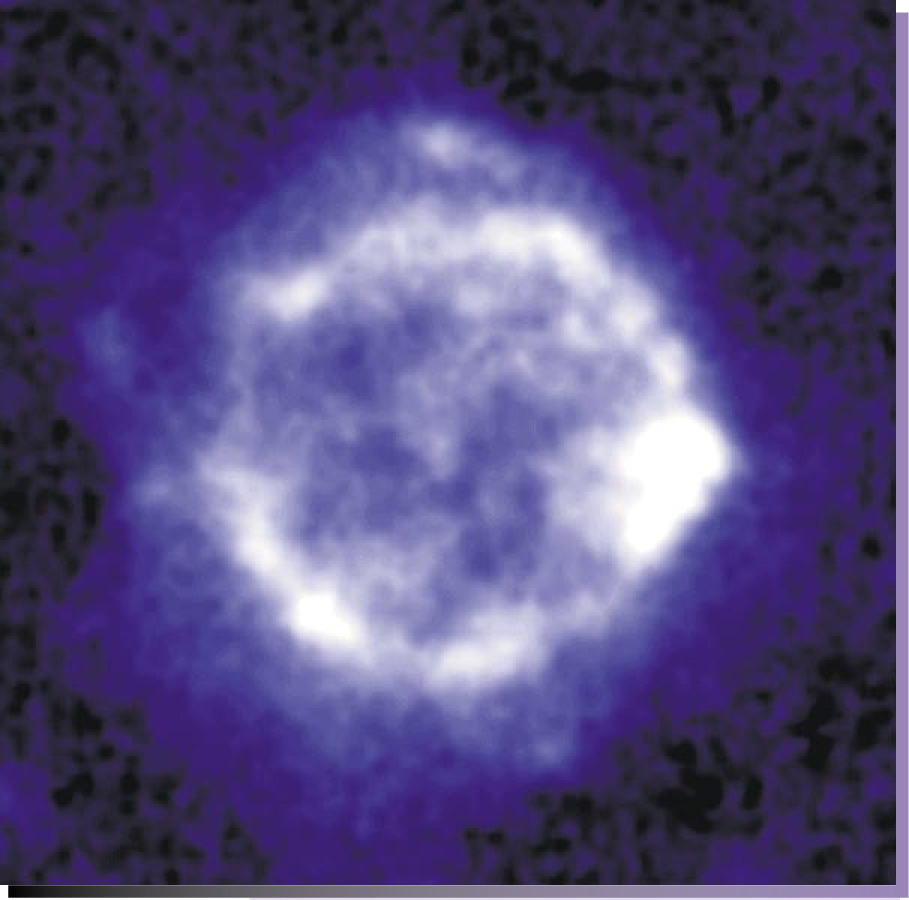
Loretta Dunne of Cardiff University in Wales and her colleagues from Cardiff and Edinburgh offer an explanation for why the IR satellites saw such a small dust portion: They argue that the overwhelming majority of dust generated in supernova explosions has now cooled to a temperature of around 20 K. Their case is based on recent observations they made with SCUBA of the Cassiopeia A supernova remnant. 3 The submillimeter array’s measurements of Cas Aat 850 µm (see figure 1) and 450 µm provided decisive information that could not be extracted from the shorter-wavelength IR spectra.

Figure 1. Supernova remnant Cassiopeia A, as imaged by the Submillimetre Common-User Bolometric Array (SCUBA) at 850 µm. The remnant is about 15 light years across and about 11 000 light years away.
(Adapted from ref. 3.)
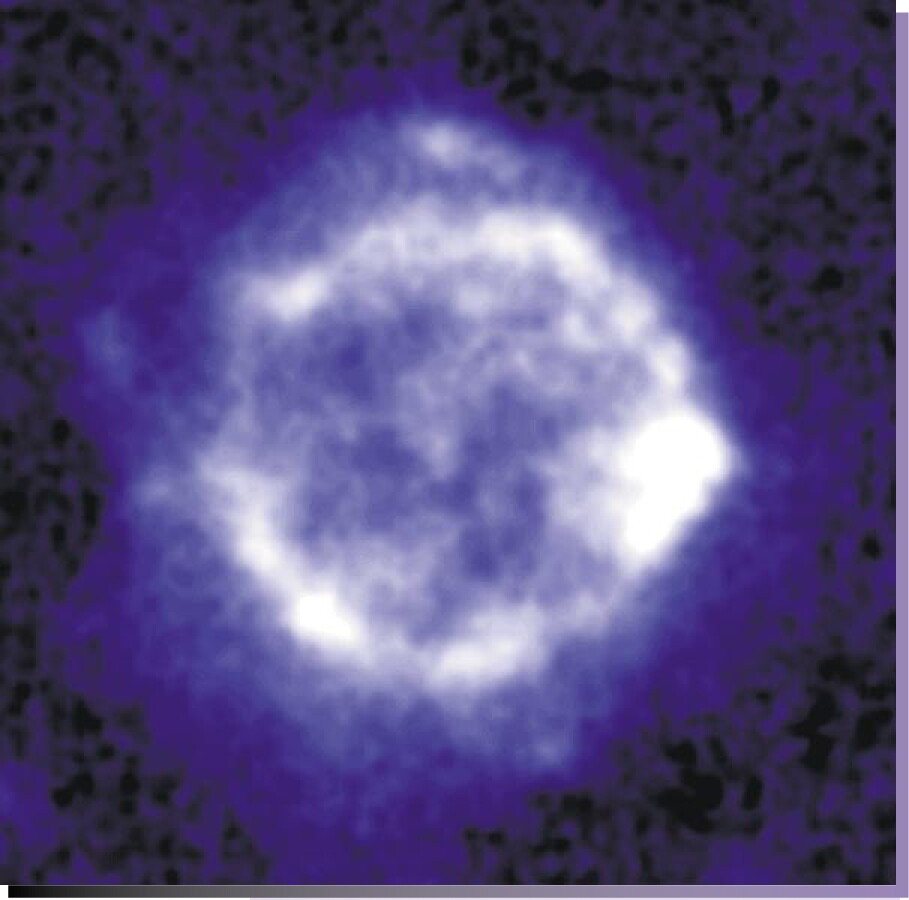
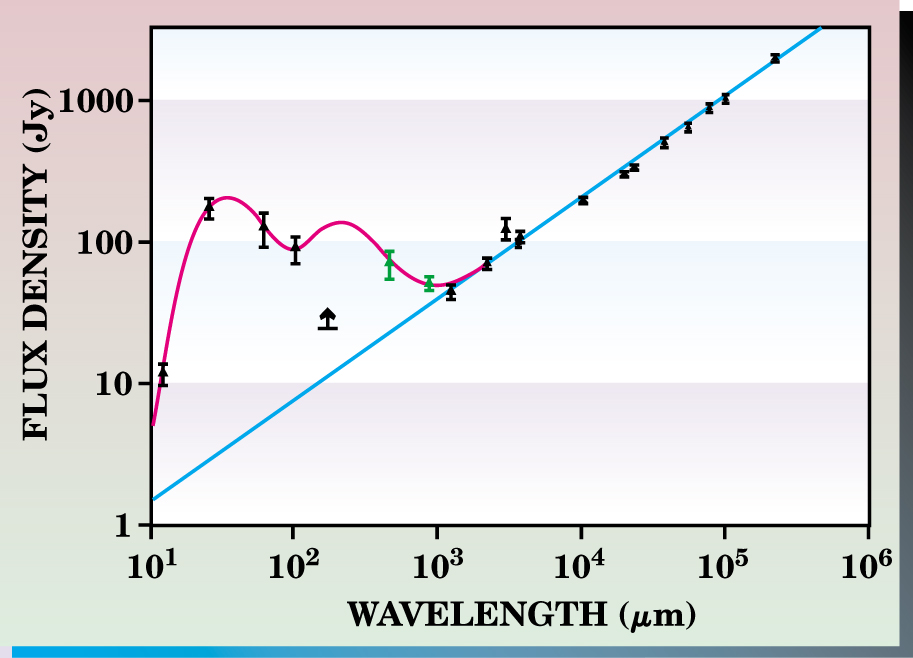
Figure 2 summarizes the spectral energy distribution for Cas Ain a wavelength range from the mid-IR to radio. After subtracting the synchrotron radiation, Dunne and colleagues fit the data with a two-temperature gray-body model that accounted for both cold and warm dust. The temperatures, ratio of cold to warm dust, and some of the frequency dependence of the emissivity (essentially the efficiency with which the dust radiates) were allowed to vary. According to the group’s best fit, the mass of cold (18 K) dust is 700 times greater than that of the warm (112 K) component. The details of data fitting are not essential to that conclusion, but the two submillimeter points are. As collaborator Mike Edmunds (Cardiff) comments, “However you try to draw a curve accounting for error bars, if our two data points are right, there’s a significant component of cold dust.” Some of that dust may be material in the interstellar medium that has been swept up by Cas A, but the interstellar density is not high enough to account for the quantity of observed dust.

Figure 2. Energy flux density from Cassiopeia A, in wavelengths ranging from the mid-infrared to radio. The flux density is measured in janskys; 1 Jy = 10−26 W/m2-Hz. The radio flux is synchrotron radiation emitted by high-energy electrons spiraling about magnetic field lines. The synchrotron data lie on a straight line that has been extrapolated to short wavelengths. The five data points at the shortest wavelengths (one of which furnishes only a lower bound) come from infrared satellites. The two points in green are the submillimeter measurements made by SCUBA.
(Adapted from ref. 3.)
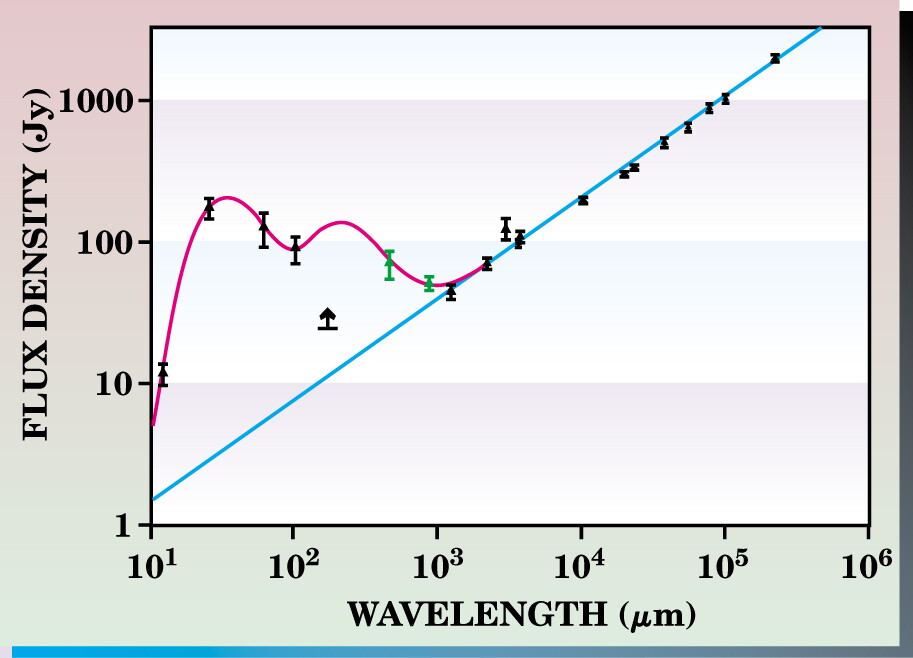
The derived mass of the cold dust is a function of its temperature, the measured submillimeter flux densities, and the known distance to Cas A. It also depends on the emissivity of the dust. That emissivity, which in turn depends on the chemical and physical composition of the dust, is not at all well-established for the material in Cas A. The Dunne group’s best-fit curve gave an estimate for the dust emissivity at the two submillimeter frequencies they considered; nonetheless, the researchers turned to the literature for typical emissivities of various kinds of dust. When they plugged in an emissivity appropriate to the diffuse interstellar medium, they estimated that the cold dust in Cas A weighs in at some 20 M ⊙. That’s roughly an order of magnitude higher than the maximum value theoreticians predict for a typical supernova.
The dust in Cas A, though, is younger than dust in the interstellar medium by a factor of about 10 000. So it may well be quite different from that material, which has endured numerous cycles of collisions, cloud formation, recycling in stars, and so forth. Emissivities appropriate to clumpy aggregates of dust, or dust in planetary nebulae, are more in line with Dunne and colleagues’ best-fit value. Mass estimates based on those emissivities yield 2 to 6 M ⊙ of cold dust. Still, says Edmunds, “It seems almost too much; it’s an embarrassment of riches. Maybe the value should come down a bit.”
In addition to Cas A, the Dunne team has also observed Kepler’s supernova remnant, and hopes to report observations of Tycho’s remnant before long. All three remnants are young and nearby. The group’s analysis of its data from Kepler’s remnant, to be published in Astrophysical Journal, indicates a quantity of cold dust comparable to, if somewhat smaller than, that of Cas A.
SCUBA-2, where are you?
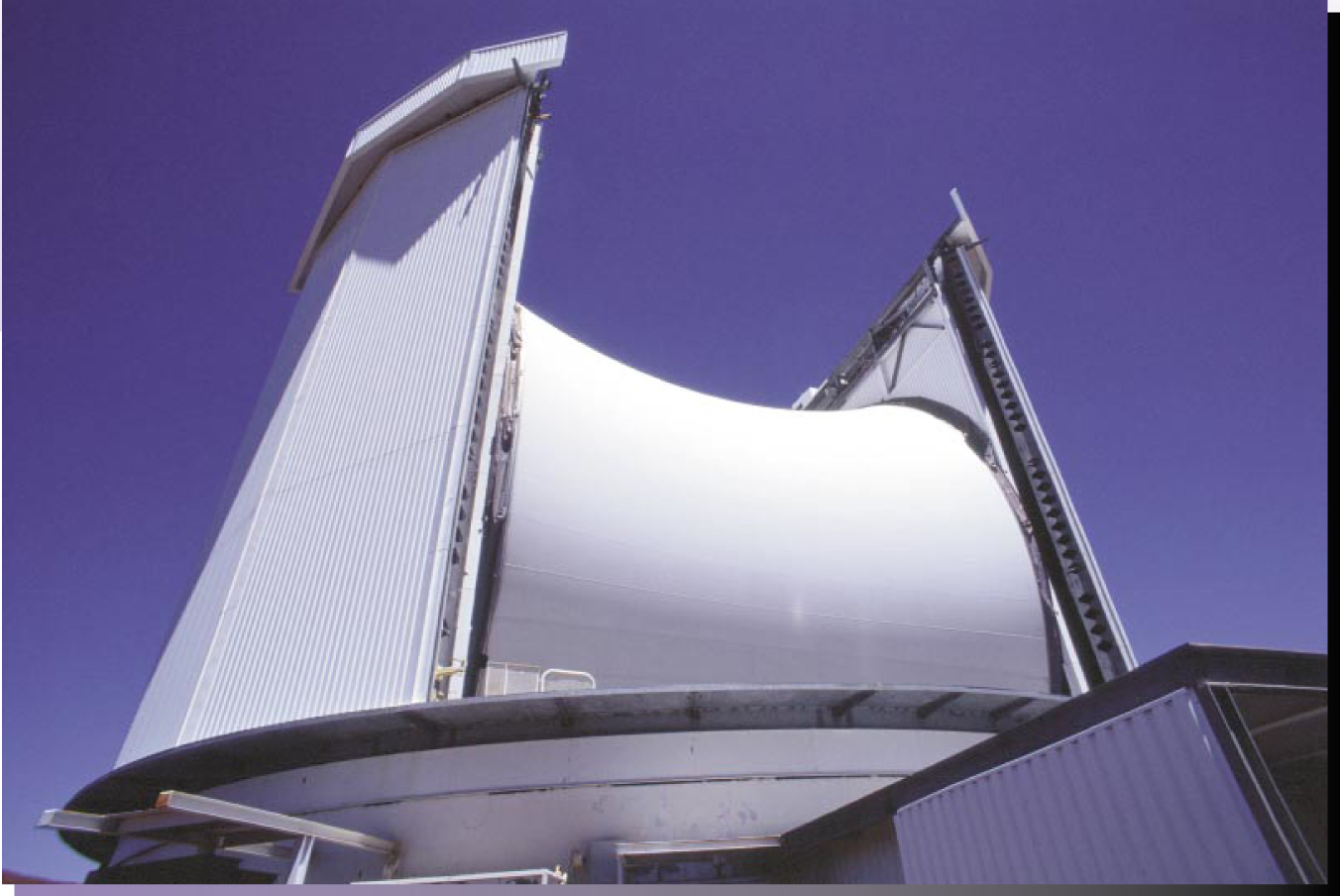
Atmospheric water vapor is the main culprit that makes submillimeter observations difficult. The water absorbs submillimeter radiation and allows astronomers to peer only through certain wavelength windows. The window that includes 850 µm is relatively clear; observations through the window at 450 µm are considerably more challenging. To minimize the effects of atmospheric absorption, the SCUBA array is located at an altitude of 14 000 feet on Hawaii’s Mauna Kea. It comprises more than 100 bolometers; with such a large quantity of individual detectors, the device can generate maps quickly. SCUBA operates at a temperature of 80 mK and its impressive sensitivity is a result of that low-temperature operation. The next-generation SCUBA-2 array, with its more than 10 000 bolometers, is already in the works. Scheduled for delivery to the Maxwell telescope (shown in figure 3) by the end of 2005, SCUBA-2 should provide a factor of at least 100 improvement in speed over its predecessor, along with increased sensitivity.

Figure 3. The James Clerk Maxwell Telescope on Hawaii’s Mauna Kea. The 15-meter telescope detects radiation in the submillimeter band and houses SCUBA, the Submillimetre Common-User Bolometric Array.
(Courtesy of Nik Szymanek.)

SCUBA’s observations will soon be supplemented by additional measurements. Caltech’s SHARC II camera, for example, views radiation at 350 and 450 µm. Graduate students crafted the acronym to make clear that the Caltech team hopes to give SCUBA a run for its money. A number of cameras, planned or recently launched, will take submillimeter measurements from observatories borne above Earth’s atmosphere. Perhaps the most ambitious mission is the European Space Agency’s Herschel Space Observatory. Slated for launch in 2007, it should resolve supernova remnants in the 80 to 670 µm range.
The observatory was named for William Herschel (1738–1822), musician, telescope builder, and discoverer of the planet Uranus. He’s also the discoverer of infrared radiation.
References
1. I. Smail, R. J. Ivison, A. W. Blain, Astrophys. J. 490, L5 (1997) https://doi.org/10.1086/311017 ;
D. H. Hughes et al., Nature 394, 241 (1998) https://doi.org/10.1038/28328 ;
A. J. Barger et al., Nature 394, 248 (1998) https://doi.org/10.1038/28338 .2. S. C. Chapman, A. W. Blain, R. J. Ivison, I. R. Smail, Nature 422, 695 (2003) https://doi.org/10.1038/nature01540 .
3. L. Dunne, S. Eales, R. Ivison, H. Morgan, M. Edmunds, Nature 424, 285 (2003) https://doi.org/10.1038/nature01792 .