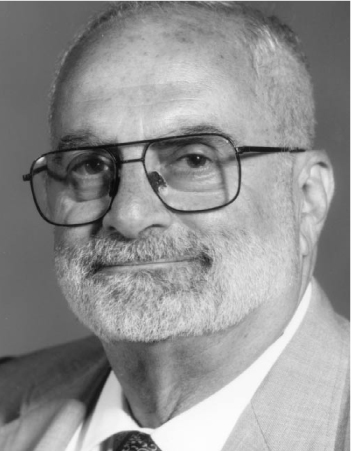
Stern to Head ASA in 2002
DOI: 10.1063/1.2405664
Richard Stern, a professor of applied science and mechanics at Pennsylvania State University, became president-elect of the Acoustical Society of America in June. He will succeed William M. Hartmann as president of the society in 2002.
“Many of our high-school teachers and counselors, and college faculty and advisers consider acoustics to be an old and dying field, with little left to be discovered, and openly say so. Clearly the society must address this issue,” said Stern in a statement to the society. It would take minimal efforts by individual members, he added, to achieve far-reaching benefits for ASA and the field of acoustics.
Stern received his PhD in physics from UCLA in 1964. After a year at Imperial College, London, he returned to UCLA, where his research involved measuring the velocity of sound in bone, using sound to fight autoimmune diseases, and investigating the interaction of sound with the lattice structure of rare earth metals. In 1984, Stern moved to Penn State, where he now serves as associate director of the Applied Research Laboratory and teaches graduate acoustics courses.
William A. Yost, director of the Parmly Hearing Institute and dean of the graduate school at Loyola University of Chicago, also took office in June, as ASA’s vice president-elect. He will succeed Janet M. Weisenberger next year. Elected to the ASA executive committee were Whitlow W. L. Au , chief scientist at the Marine Mammal Research Program of the Hawaii Institute of Marine Biology, and Winifred Strange, a professor at the Graduate Center of Speech and Hearing Sciences of the City University of New York. Both Au and Strange will serve three-year terms.