Special report: Bush budget boosts funding for physical sciences in FY 2007; NSF, DOE, and NIST would all do well
DOI: 10.1063/1.2207036

When he gaveled the House Committee on Science to order in mid-February to listen to Bush administration officials testify about the proposed fiscal year 2007 science budget, Representative Sherwood Boehlert (R-NY) began by saying, “It’s a rare thing to think of a budget hearing as a time of celebration, but I think that that’s how we should view this morning’s proceedings.” With a budget that proposes big increases for three science research agencies—the Department of Energy’s Office of Science, NSF, and NIST—those advocating more spending on basic research were indeed celebrating.
A few days before sending his budget proposal to Congress, President Bush announced his “American Competitiveness Initiative,” saying he was committing $5.9 billion in FY 2007 to “increase investments in research and development, strengthen education, and encourage entrepreneurship.” As part of the initiative, he promised to double federal spending on basic research over 10 years and announced the big boosts to the three research agencies.
The size of the increases for the favored three—14% for the Office of Science, 8.3% for NSF, and 18% for NIST laboratories—caught even well-connected science advocates in Washington by surprise, but the president’s sudden enthusiasm for basic research did not come out of the blue. In October 2005, the “Gathering Storm” report was released by the National Academy of Sciences, and before that about a dozen other studies indicated that US science education and basic research were in trouble. The administration began to pay attention when the reports cast the problem in economic and national security terms.
“The nation’s leaders in industry and higher education have been calling for such an investment because they see it as a must if the US is to retain its competitive edge,” Boehlert said at the hearing. “One might say there has been a gathering storm of lobbying on this subject, and an increasing number of leaders have issued thundering statements about the need to rethink our research and education and energy policies.”
While Boehlert was pleased, he was also cautious. He was concerned about the lack of administration funding for education programs at NSF, he said, and noted that the annual attempt by the White House to kill or dramatically scale back the Advanced Technology Program (ATP) and the Manufacturing Extension Program (MEP) at NIST “ain’t gonna fly.” He concluded by saying, “We’re not going to declare victory and go home. Rather, we need to think of it this way: We’ve won the battle, now it’s time to win the war.”
The FY 2007 budget is good for physics and most of the physical sciences. But an analysis done by the Democratic staff of the science committee noted that “the devil is in the details” when one looks more broadly at the budget. “Specifically, NASA and NIH funding would remain essentially flat, and [National Oceanic and Atmospheric Administration] R&D for oceanic and atmospheric research would decline by 8%,” the staff report says. Although NIST laboratories would receive an 18% increase, the institute’s “overall research funding would decrease by 23%.”
“In short,” the report concludes, “science that is not part of the president’s American Competitiveness Initiative is cut in order to balance the increases at NSF, NIST and DOE. So what one hand giveth, the other taketh away. This budget appears to cut science to fund science.”
If this budget proposal follows the patterns of the past few years, Congress will reshuffle the money to make sure some of its favored programs receive decent funding. Because of the enormous budget deficit, plus spending on Iraq and the war on terrorism, there is very little new money in the budget. To reorder science funding to reflect their priorities, not the administration’s, members of Congress may also be forced to cut science to fund science.
National science foundation R&D programs
| FY 2005 actual | FY 2006 estimate | FY 2007 request | FY 2006–07 percent change | |
|---|---|---|---|---|
| (millions of dollars) |
||||
| NSF total | 5482 | 5581 | 6020 | 7.9 |
| NSF R&D | 4102 | 4175 | 4523 | 8.3 |
| Research and related activities (R&RA) | ||||
| Mathematical and physical sciences (MPS) | ||||
| Mathematical sciences | 200 | 199 | 206 | 3.2 |
| Astronomical sciences | 195 | 200 | 215 | 7.7 |
| Physics | 225 | 233 | 249 | 6.6 |
| Chemistry | 179 | 181 | 191 | 5.7 |
| Materials research | 240 | 243 | 257 | 6.0 |
| Multidisciplinary activities | 30 | 30 | 32 | 9.2 |
| Total MPS | 1069 | 1085 | 1150 | 6.0 |
| Geosciences (GEO) | ||||
| Atmospheric sciences | 215 | 216 | 227 | 5.0 |
| Earth sciences | 137 | 140 | 152 | 8.7 |
| Ocean sciences | 291 | 288 | 307 | 6.5 |
| Innovation and collaborative education and research | 54 | 58 | 59 | 0.3 |
| Total GEO | 697 | 703 | 745 | 6.0 |
| Engineering | 557 | 581 | 629 | 8.2 |
| Biological sciences | 577 | 577 | 608 | 5.4 |
| Computer and Information Science and Engineering (CISE) | ||||
| Computer and network systems | 132 | 142 | 163 | 15.2 |
| Computer-communications foundations | 91 | 105 | 123 | 16.5 |
| Information and intelligent systems | 92 | 104 | 119 | 15.1 |
| Information technology research | 174 | 146 | 122 | –16.6 |
| Total CISE | 490 | 496 | 527 | 6.1 |
|
Shared cyberinfrastructure
|
123 | 127 | 182 | 43.5 |
| Office of International Science and Engineering | 43 | 35 | 41 | 17.6 |
| US polar programs | ||||
| Polar research programs |
278 | 323 | 371 | 14.8 |
| Antarctic logistical support | 70 | 67 | 68 | 1.3 |
| Total polar programs | 349 | 389 | 438 | 12.5 |
|
Arctic Research Commission |
1 | 1 | 1 | 23.9 |
| Social, behavioral, and economic sciences | 197 | 200 | 214 | 6.9 |
| Integrative activities | 131 | 137 | 131 | –4.2 |
| Budget authority adjustment | –5 | 0 | 0 | — |
| Total R&RA | 4230 | 4331 | 4666 | 7.7 |
| Major research equipment and facilities | 174 | 191 | 240 | 26.0 |
| Education and human resources | 841 | 797 | 816 | 2.5 |
| Salaries and expenses | 223 | 247 | 282 | 14.2 |
| National Science Board | 4 | 4 | 4 | –1.0 |
| Inspector general | 10 | 11 | 12 | 4.4 |
Figures are rounded to the nearest million. Changes are calculated from unrounded figures.
New organization in 2005. Some CISE activities transferred to new offices.
FY 2006 and FY 2007 numbers include transfer of polar icebreaking responsibilities from Coast Guard.
Currently funded in polar programs, the FY 2007 budget proposes a separate line item.
National science foundation R&D programs
NSF R&D |
4102 |
4175 |
4523 |
8.3 |
Research and related activities (R&RA) |
||||
Mathematical and physical sciences (MPS) |
||||
Mathematical sciences |
200 |
199 |
206 |
3.2 |
Astronomical sciences |
195 |
200 |
215 |
7.7 |
Physics |
225 |
233 |
249 |
6.6 |
Chemistry |
179 |
181 |
191 |
5.7 |
Materials research |
240 |
243 |
257 |
6.0 |
Multidisciplinary activities |
30 |
30 |
32 |
9.2 |
Total MPS |
1069 |
1085 |
1150 |
6.0 |
Geosciences (GEO) |
||||
Atmospheric sciences |
215 |
216 |
227 |
5.0 |
Earth sciences |
137 |
140 |
152 |
8.7 |
Ocean sciences |
291 |
288 |
307 |
6.5 |
Innovation and collaborative education and research |
54 |
58 |
59 |
0.3 |
Total GEO |
697 |
703 |
745 |
6.0 |
Engineering |
557 |
581 |
629 |
8.2 |
Biological sciences |
577 |
577 |
608 |
5.4 |
Computer and Information Science and Engineering (CISE) |
||||
Computer and network systems |
132 |
142 |
163 |
15.2 |
Computer-communications foundations |
91 |
105 |
123 |
16.5 |
Information and intelligent systems |
92 |
104 |
119 |
15.1 |
Information technology research |
174 |
146 |
122 |
–16.6 |
Total CISE |
490 |
496 |
527 |
6.1 |
Shared cyberinfrastructure |
123 |
127 |
182 |
43.5 |
Office of International Science and Engineering |
43 |
35 |
41 |
17.6 |
US polar programs |
||||
Polar research programs |
278 |
323 |
371 |
14.8 |
Antarctic logistical support |
70 |
67 |
68 |
1.3 |
Total polar programs |
349 |
389 |
438 |
12.5 |
Arctic Research Commission |
1 |
1 |
1 |
23.9 |
Social, behavioral, and economic sciences |
197 |
200 |
214 |
6.9 |
Integrative activities |
131 |
137 |
131 |
–4.2 |
Budget authority adjustment |
–5 |
0 |
0 |
— |
Total R&RA |
4230 |
4331 |
4666 |
7.7 |
Major research equipment and facilities |
174 |
191 |
240 |
26.0 |
Education and human resources |
841 |
797 |
816 |
2.5 |
Salaries and expenses |
223 |
247 |
282 |
14.2 |
National Science Board |
4 |
4 |
4 |
–1.0 |
Inspector general |
10 |
11 |
12 |
4.4 |
Figures are rounded to the nearest million. Changes are calculated from unrounded figures.
New organization in 2005. Some CISE activities transferred to new offices.
FY 2006 and FY 2007 numbers include transfer of polar icebreaking responsibilities from Coast Guard.
Currently funded in polar programs, the FY 2007 budget proposes a separate line item.
And the number underlying the administration’s proposal for basic and applied research, even given the big boosts for NSF, NIST, and DOE, is an overall decrease of 3.4%, according to analysts with the American Association for the Advancement of Science. The decrease marks the third year in a row that basic and applied research funding would drop. An overview of the numbers provides a sketch of what the administration is proposing.
-
▸ The proposed FY 2007 R&D portfolio would increase $2.6 billion, or 1.9%, to $137.0 billion. That is just short of the projected 2.2% increase in inflation, meaning that in real terms the “total federal R&D portfolio would decline for the first time since 1996 after flattening out the last few years,” according to AAAS analysts. Development would be the clear winner in the R&D equation, with increases for weapons development at DOD and space vehicles at NASA dominating the funding picture.
-
▸ Although NSF, NIST, and DOE do well, other nondefense R&D would see flat funding or cuts. NIH, after watching its budget double over the five-year period that ended in 2005, would see its funding remain at FY 2006 levels of $28.6 billion. The Environmental Protection Agency’s R&D budget would fall 7.2% to $557 million, while NOAA’s budget at the Department of Commerce would drop 6.3% to $578 million. The R&D budget in the US Geological Survey falls 4.7% to $532 million. In the Department of Homeland Security, the R&D portfolio would decrease 10.3%.
-
▸ Defense R&D would do well, with a proposed overall increase of 2.2%, just at the rate of inflation. DOD weapons systems development would increase by 7% to a new high of $62.9 billion, according to the AAAS, but there would be cuts in the three DOD categories of basic research, applied research, and technology development.
Department of energy R&D programs
| FY 2005 actual | FY 2006 estimate | FY 2007 request | FY 2006–07 percent change | |
|---|---|---|---|---|
| (millions of dollars) |
||||
| DOE total | 24 345 | 23 563 | 23 557 | 0.0 |
|
DOE R&D |
8620 | 8721 | 9047 | 3.7 |
| Science R&D programs | ||||
| High-energy physics (HEP) total | 723 | 717 | 775 | 8.1 |
| Proton accelerator-based physics | 391 | 375 | 377 | 0.4 |
| Research | 78 | 76 | 80 | 4.4 |
| University research | 46 | 46 | 48 | 4.8 |
| National laboratory research | 31 | 30 | 31 | 2.9 |
| University service accounts | 1 | 1 | 1 | 28.7 |
| Facilities | 313 | 299 | 297 | –0.6 |
| Tevatron operations and improvements | 237 | 216 | 216 | 0.0 |
| Large Hadron Collider projects & support | 62 | 60 | 60 | –0.1 |
| AGS operations | 1 | 1 | 1 | 0.0 |
| Other facilities | 13 | 22 | 20 | –8.3 |
| Electron accelerator-based physics | 135 | 117 | 117 | 0.4 |
| Research | 26 | 24 | 25 | 4.5 |
| University research | 15 | 15 | 16 | 3.6 |
| National laboratory research | 11 | 8 | 9 | 5.1 |
| Facilities | 109 | 94 | 93 | –0.7 |
| Nonaccelerator physics | 56 | 48 | 59 | 23.4 |
| Theoretical physics | 50 | 48 | 52 | 8.0 |
| Advanced technology R&D (accelerators and detectors) | 90 | 128 | 159 | 24.2 |
| Construction | 1 | 0 | 10 | — |
| Nuclear physics total | 395 | 367 | 454 | 23.7 |
| Medium-energy nuclear physics | 119 | 109 | 123 | 13.1 |
| Research | 32 | 36 | 41 | 11.9 |
| University research | 15 | 16 | 18 | 14.2 |
| National laboratory research | 16 | 16 | 17 | 9.1 |
| Other research | 0 | 5 | 6 | 13.6 |
| Operations | 87 | 72 | 82 | 13.7 |
| Heavy-ion nuclear physics | 170 | 160 | 198 | 23.3 |
| Research | 29 | 34 | 42 | 24.4 |
| University research | 12 | 12 | 14 | 16.8 |
| National laboratory research | 17 | 18 | 23 | 26.1 |
| Other research | 0 | 4 | 5 | 40.3 |
| Operations (primarily RHIC) | 141 | 126 | 155 | 23.1 |
| Low-energy nuclear physics | 75 | 68 | 84 | 23.0 |
| Research | 50 | 45 | 55 | 20.6 |
| University research | 19 | 17 | 19 | 11.5 |
| National laboratory research | 24 | 23 | 30 | 32.1 |
| Other research | 7 | 6 | 6 | 2.3 |
| Operations (primarily ATLAS and HRIBF) | 25 | 23 | 29 | 27.6 |
| Nuclear theory | 31 | 28 | 35 | 25.6 |
|
Construction |
0 | 2 | 15 | 633.3 |
| Fusion energy sciences total | 267 | 288 | 319 | 10.9 |
| Science | 148 | 157 | 154 | –1.7 |
| Facility operations | 90 | 104 | 122 | 17.4 |
| Enabling R&D | 29 | 27 | 43 | 58.8 |
| Basic energy sciences (BES) total | 1084 | 1135 | 1421 | 25.2 |
| Materials sciences | 621 | 738 | 1004 | 36.1 |
| Chemical sciences, geosciences, and energy biosciences (CGEB) | 232 | 221 | 268 | 21.7 |
| National user facilities operations (funding is contained within the materials sciences and CGEB budgets) | ||||
| Advanced Light Source, LBNL | 45 | 43 | 50 | 16.4 |
| Advanced Photon Source, ANL | 100 | 96 | 109 | 13.3 |
| National Synchrotron Light Source, BNL | 37 | 36 | 41 | 12.6 |
| Center for Nanophase Materials Sciences, ORNL | 0 | 18 | 19 | 7.4 |
| Center for Integrated Nanotechnologies, SNL/LANL | 0 | 12 | 19 | 61.3 |
| Molecular Foundry, LBNL | 0 | 8 | 19 | 136.9 |
| Center for Nanoscale Materials, ANL | 0 | 3 | 19 | 448.3 |
| Stanford Synchrotron Radiation Laboratory, SLAC | 32 | 25 | 36 | 40.7 |
| High Flux Isotope Reactor, ORNL | 47 | 43 | 52 | 19.1 |
| Radiochemical Engineering Development Ctr, ORNL | 45 | 0 | 0 | 0.0 |
| Intense Pulsed Neutron Source, ANL | 17 | 15 | 19 | 19.6 |
| Manuel Lujan Jr Neutron Scattering Ctr, LANL | 10 | 10 | 11 | 5.8 |
| Spallation Neutron Source, ORNL | 38 | 101 | 171 | 69.7 |
| Combustion Research Facility, SNL | 6 | 6 | 7 | 8.9 |
| National Synchrotron Light Source-II, BNL | 1 | 0 | 25 | — |
| Linac Coherent Light Source, SLAC | 0 | 3 | 16 | 357.1 |
| Linac for LCLS | 0 | 30 | 40 | 34.7 |
| Construction | 230 | 176 | 148 | –15.9 |
| Advanced scientific computing research (ASCR) | 226 | 235 | 319 | 35.8 |
| Biological and environmental research | 567 | 580 | 510 | –12.0 |
| Fossil energy R&D | 448 | 479 | 330 | –31.1 |
| National Nuclear Security Administration (NNSA) total | 3954 | 4040 | 3951 | –2.2 |
| Weapons activities R&D, total | 2962 | 2959 | 2908 | –1.7 |
| Science campaigns | 277 | 277 | 264 | –4.7 |
| Advanced simulation and computing | 698 | 600 | 618 | 3.0 |
| Inertial confinement fusion | 537 | 544 | 451 | –17.0 |
| All other weapons R&D | 1450 | 1539 | 1575 | 2.3 |
| Nonproliferation and verification | 220 | 322 | 272 | –15.5 |
| Naval reactors | 772 | 759 | 771 | 1.6 |
| Radioactive waste management | 68 | 80 | 56 | –30.0 |
Figures are rounded to the nearest million. Changes are calculated from unrounded figures.
Includes energy supply and conservation R&D funding.
Includes funding for the 12 GeV Continuous Electron Beam Accelerator Facility upgrade at TJNAF, and the Electron Beam Ion Source project at BNL.
Department of energy R&D programs
DOE total |
24 345 |
23 563 |
23 557 |
0.0 |
DOE R&D |
8620 |
8721 |
9047 |
3.7 |
Science R&D programs |
||||
High-energy physics (HEP) total |
723 |
717 |
775 |
8.1 |
Proton accelerator-based physics |
391 |
375 |
377 |
0.4 |
Research |
78 |
76 |
80 |
4.4 |
University research |
46 |
46 |
48 |
4.8 |
National laboratory research |
31 |
30 |
31 |
2.9 |
University service accounts |
1 |
1 |
1 |
28.7 |
Facilities |
313 |
299 |
297 |
–0.6 |
Tevatron operations and improvements |
237 |
216 |
216 |
0.0 |
Large Hadron Collider projects & support |
62 |
60 |
60 |
–0.1 |
AGS operations |
1 |
1 |
1 |
0.0 |
Other facilities |
13 |
22 |
20 |
–8.3 |
Electron accelerator-based physics |
135 |
117 |
117 |
0.4 |
Research |
26 |
24 |
25 |
4.5 |
University research |
15 |
15 |
16 |
3.6 |
National laboratory research |
11 |
8 |
9 |
5.1 |
Facilities |
109 |
94 |
93 |
–0.7 |
Nonaccelerator physics |
56 |
48 |
59 |
23.4 |
Theoretical physics |
50 |
48 |
52 |
8.0 |
Advanced technology R&D (accelerators and detectors) |
90 |
128 |
159 |
24.2 |
Construction |
1 |
0 |
10 |
— |
Nuclear physics total |
395 |
367 |
454 |
23.7 |
Medium-energy nuclear physics |
119 |
109 |
123 |
13.1 |
Research |
32 |
36 |
41 |
11.9 |
University research |
15 |
16 |
18 |
14.2 |
National laboratory research |
16 |
16 |
17 |
9.1 |
Other research |
0 |
5 |
6 |
13.6 |
Operations |
87 |
72 |
82 |
13.7 |
Heavy-ion nuclear physics |
170 |
160 |
198 |
23.3 |
Research |
29 |
34 |
42 |
24.4 |
University research |
12 |
12 |
14 |
16.8 |
National laboratory research |
17 |
18 |
23 |
26.1 |
Other research |
0 |
4 |
5 |
40.3 |
Operations (primarily RHIC) |
141 |
126 |
155 |
23.1 |
Low-energy nuclear physics |
75 |
68 |
84 |
23.0 |
Research |
50 |
45 |
55 |
20.6 |
University research |
19 |
17 |
19 |
11.5 |
National laboratory research |
24 |
23 |
30 |
32.1 |
Other research |
7 |
6 |
6 |
2.3 |
Operations (primarily ATLAS and HRIBF) |
25 |
23 |
29 |
27.6 |
Nuclear theory |
31 |
28 |
35 |
25.6 |
Construction |
0 |
2 |
15 |
633.3 |
Fusion energy sciences total |
267 |
288 |
319 |
10.9 |
Science |
148 |
157 |
154 |
–1.7 |
Facility operations |
90 |
104 |
122 |
17.4 |
Enabling R&D |
29 |
27 |
43 |
58.8 |
Basic energy sciences (BES) total |
1084 |
1135 |
1421 |
25.2 |
Materials sciences |
621 |
738 |
1004 |
36.1 |
Chemical sciences, geosciences, and energy biosciences (CGEB) |
232 |
221 |
268 |
21.7 |
National user facilities operations (funding is contained within the materials sciences and CGEB budgets) |
||||
Advanced Light Source, LBNL |
45 |
43 |
50 |
16.4 |
Advanced Photon Source, ANL |
100 |
96 |
109 |
13.3 |
National Synchrotron Light Source, BNL |
37 |
36 |
41 |
12.6 |
Center for Nanophase Materials Sciences, ORNL |
0 |
18 |
19 |
7.4 |
Center for Integrated Nanotechnologies, SNL/LANL |
0 |
12 |
19 |
61.3 |
Molecular Foundry, LBNL |
0 |
8 |
19 |
136.9 |
Center for Nanoscale Materials, ANL |
0 |
3 |
19 |
448.3 |
Stanford Synchrotron Radiation Laboratory, SLAC |
32 |
25 |
36 |
40.7 |
High Flux Isotope Reactor, ORNL |
47 |
43 |
52 |
19.1 |
Radiochemical Engineering Development Ctr, ORNL |
45 |
0 |
0 |
0.0 |
Intense Pulsed Neutron Source, ANL |
17 |
15 |
19 |
19.6 |
Manuel Lujan Jr Neutron Scattering Ctr, LANL |
10 |
10 |
11 |
5.8 |
Spallation Neutron Source, ORNL |
38 |
101 |
171 |
69.7 |
Combustion Research Facility, SNL |
6 |
6 |
7 |
8.9 |
National Synchrotron Light Source-II, BNL |
1 |
0 |
25 |
— |
Linac Coherent Light Source, SLAC |
0 |
3 |
16 |
357.1 |
Linac for LCLS |
0 |
30 |
40 |
34.7 |
Construction |
230 |
176 |
148 |
–15.9 |
Advanced scientific computing research (ASCR) |
226 |
235 |
319 |
35.8 |
Biological and environmental research |
567 |
580 |
510 |
–12.0 |
Fossil energy R&D |
448 |
479 |
330 |
–31.1 |
National Nuclear Security Administration (NNSA) total |
3954 |
4040 |
3951 |
–2.2 |
Weapons activities R&D, total |
2962 |
2959 |
2908 |
–1.7 |
Science campaigns |
277 |
277 |
264 |
–4.7 |
Advanced simulation and computing |
698 |
600 |
618 |
3.0 |
Inertial confinement fusion |
537 |
544 |
451 |
–17.0 |
All other weapons R&D |
1450 |
1539 |
1575 |
2.3 |
Nonproliferation and verification |
220 |
322 |
272 |
–15.5 |
Naval reactors |
772 |
759 |
771 |
1.6 |
Radioactive waste management |
68 |
80 |
56 |
–30.0 |
Figures are rounded to the nearest million. Changes are calculated from unrounded figures.
Includes energy supply and conservation R&D funding.
Includes funding for the 12 GeV Continuous Electron Beam Accelerator Facility upgrade at TJNAF, and the Electron Beam Ion Source project at BNL.
AGS, Alternating Gradient Synchrotron. ANL, Argonne National Laboratory. ATLAS, a Torroidal LHC Apparatus. BNL, Brookhaven National Laboratory. HRIBF, Hollifield Radioactive Ion Beam Facility. LANL, Los Alamos National Laboratory. LBNL, Lawrence Berkeley National Laboratory. ORNL, Oak Ridge National Laboratory. RHIC, Relativistic Heavy Ion Collider. SNL, Sandia National Laboratories. TJNAF, Thomas Jefferson National Accelerator Facility.
-
▸ Multi-agency R&D initiatives continue, but with essentially flat funding. The National Nanotechnology Initiative would drop 1.8% to $1.3 billion, primarily because DOD has removed congressionally mandated FY 2006 earmarked programs from its FY 2007 request. (The “earmarks” dispute between the administration and Congress remains contentious, with both branches of government insisting they have the authority to set spending priorities in the federal budget. When congressional representatives don’t like the administration’s budget choices, they often earmark money specifically for a favored program.) The networking and information technology R&D initiative would increase by 2.4% to $3.1 billion. The climate-change science program would increase by 0.2% after decreasing significantly in FY 2006 because of cuts in NASA’s space-based environmental observations program.
-
▸ Federal research investments are decreasing as a share of the US economy, even as other countries are increasing their science investments. This growing imbalance was noted in the NAS “Gathering Storm” report, and the AAAS noted that after exceeding 1% in recent years, the ratio of federal research investments to gross domestic product “is in free fall” down to its projected FY 2007 level of 0.4%. The European Union has set a goal of having government research investments reach 3% of GDP by 2010, and both China and South Korea are boosting their government research spending by 10% annually.
The science budget must wend its way through more than 20 House and Senate committees, and while it clearly has a higher priority than in past years, the budget that comes out of Congress near the end of the year will look significantly different from the way it does now. Both Republicans and Democrats on the House science committee have issued detailed reports on what they like and don’t like in the president’s proposal. Most of their concerns are with specific programs in individual agencies. Those concerns, and the following agency highlights, set the parameters for the budget battles that will take place during the next few months.
National Science Foundation. NSF is the third-largest federal supporter of physical science research, behind DOE and NASA, and is the second-largest source of funds for R&D at colleges and universities, behind NIH. For the physical sciences and engineering, according to AAAS, NSF funds more than 40% of university-based research.
NSF would see its overall R&D increase 8.3% to $4.5 billion after several years of flat funding. Physical sciences research would jump 6% to $1.2 billion, and most of the foundation’s research directorates would see increases of between 5% and 9%.
NSF’s research and related activities (R&RA) account, which funds almost all of the foundation’s basic and applied research, would increase 7.7% to $4.7 billion. While most of the directorates get the 5% to 9% increases, the new office of cyberinfrastructure, created out of the computer and information science and engineering directorate, would increase 44% to $182 million. The office of polar programs, which provides support to and funds research at both the North and South Poles, would receive $438 million, an increase of 12.5%. In FY 2007, however, NSF is supposed to pay the US Coast Guard $57 million as part of a transfer of icebreaking responsibilities to NSF from the Coast Guard.
The major research equipment and facilities construction account (MREFC) would increase 26.0%, or $50 million, to $240 million. In FY 2007, money would allow the funding of eight projects, two of them new starts. Construction of the Atacama Large Millimeter Array, EarthScope, IceCube, and the Scientific Ocean Drilling Vessel would continue. The National Ecological Observatory Network would receive construction funding, and the South Pole Station Modernization project would resume after being halted because of a lack of money. The new starts would be the Alaska Region Research Vessel, a $56 million replacement for the current arctic research vessel; and the Ocean Observatories Initiative, a $14 million project to build an integrated ocean-observing network.
NSF’s major research instrumentation account would receive $90 million, an increase of $1.6 million. The funding is for competitively awarded research instrumentation grants to institutions for equipment that would be too costly to be funded through standard NSF research awards. NSF’s total investment in R&D facilities and equipment would be $437 million, up $80 million from current funding.
The education and human resources program at NSF would receive a 2.5% increase to $816 million, still well below the $945 million the programs had in 2004. Much of the loss of funding is due to an administration effort to end NSF’s participation in the math and science partnership (MSP) program with the Department of Education. Over the objections of Rep. Vern Ehlers (R-MI) and others, the administration has been trying to move the program entirely to the education department.
Department of Energy. The biggest winner in the president’s competitiveness agenda is the DOE’s Office of Science. The office would see its R&D budget increase 14.4% to $3.8 billion. Every program in the office would increase by at least 8%, with the nuclear physics program that has been chronically underfunded receiving a 23.7% boost. There would be a 36% increase for computing research, a 25% increase for basic energy sciences, and a 31% increase for life-sciences research. Although the science budget is up significantly, the total DOE budget remains flat at $23.6 billion. According to the AAAS, much of the money to fund the science increases would come from a shift of nearly $1 billion in projected savings from completed environmental cleanups in Colorado, Ohio, and elsewhere. Within the energy R&D programs and DOE, increases in renewable energy programs for solar power, biomass energy, and hydrogen would be offset by cuts in fossil energy R&D and conservation programs. Overall, energy R&D funding would decrease by 4.8% to $1.3 billion.
NASA R&D programs
| FY 2005 actual | FY 2006 estimate | FY 2007 request | FY 2006–07 percent change | |
|---|---|---|---|---|
| (millions of dollars) |
||||
| NASA total | 16 196 | 16 623 | 16 792 | 1.0 |
| NASA R&D | 10 618 | 11 295 | 12 202 | 8.0 |
| R&D programs | ||||
| Science, aeronautics, and exploration (SAE) | 9051 | 9721 | 10 524 | 8.3 |
| Science, total | 5502 | 5254 | 5330 | 1.5 |
| Solar system exploration | ||||
| Discovery | 183 | 146 | 162 | 11.0 |
| New Frontiers | 211 | 148 | 155 | 4.6 |
| Technology | 129 | 57 | 73 | 28.0 |
| Deep space mission systems | 258 | 255 | 247 | –3.0 |
| Solar system research | 351 | 327 | 274 | –16.2 |
| Mars exploration | 588 | 650 | 700 | 7.7 |
| Solar system exploration total | 1721 | 1582 | 1610 | 1.8 |
| The universe | ||||
| Navigator | 179 | 146 | 128 | –12.0 |
| James Webb Space Telescope | 295 | 364 | 443 | 21.7 |
| Hubble Space Telescope | 303 | 269 | 337 | 25.4 |
| Stratospheric Obs. for Infrared Astronomy | 72 | 48 | 0 | –100.0 |
| Gamma-Ray Large Area Space Telescope | 111 | 126 | 85 | –32.2 |
| Discovery | 95 | 138 | 101 | –26.7 |
| Explorer | 57 | 85 | 68 | –20.8 |
| Universe research | 322 | 306 | 307 | 0.3 |
| International Space Station | 18 | 13 | 20 | 50.8 |
| Beyond Einstein | 24 | 14 | 21 | 50.0 |
| The universe, total | 1475 | 1508 | 1509 | 0.1 |
| The Earth–Sun system | ||||
| Earth systematic missions | 264 | 164 | 302 | 84.2 |
| Living with a star | 201 | 239 | 226 | –5.4 |
| Solar terrestrial probes | 116 | 94 | 84 | –10.9 |
| Explorer program | 149 | 130 | 73 | –43.5 |
| Earth system science pathfinder | 111 | 142 | 161 | 13.8 |
| Multimission operations | 288 | 267 | 265 | –1.0 |
| Earth–Sun research | 921 | 882 | 878 | –0.4 |
| Applied sciences | 82 | 95 | 51 | –46.2 |
| Education and outreach | 24 | 23 | 23 | 2.6 |
| Earth–Sun technology | 152 | 127 | 146 | 14.9 |
| The Earth–Sun system, total | 2306 | 2164 | 2211 | 2.2 |
| Exploration systems | ||||
| Constellation systems | 422 | 1734 | 3058 | 76.4 |
| Exploration systems | 899 | 693 | 646 | –6.7 |
| Human systems | 888 | 624 | 275 | –56.0 |
| Exploration systems total | 2209 | 3050 | 3978 | 30.4 |
| Aeronautics research | 962 | 884 | 724 | –18.1 |
| Cross-agency support programs | 378 | 534 | 492 | –7.8 |
| Exploration capabilities | ||||
| International Space Station | 1591 | 1753 | 1811 | 3.3 |
| Space shuttle | 5049 | 4778 | 4057 | –15.1 |
| Space and flight support | 474 | 339 | 367 | 8.2 |
| Exploration capabilities total | 7114 | 6870 | 6235 | 9.2 |
Figures are rounded to the nearest million. Changes are calculated from unrounded figures.
NASA R&D programs
NASA total |
16 196 |
16 623 |
16 792 |
1.0 |
NASA R&D |
10 618 |
11 295 |
12 202 |
8.0 |
R&D programs |
||||
Science, aeronautics, and exploration (SAE) |
9051 |
9721 |
10 524 |
8.3 |
Science, total |
5502 |
5254 |
5330 |
1.5 |
Solar system exploration |
||||
Discovery |
183 |
146 |
162 |
11.0 |
New Frontiers |
211 |
148 |
155 |
4.6 |
Technology |
129 |
57 |
73 |
28.0 |
Deep space mission systems |
258 |
255 |
247 |
–3.0 |
Solar system research |
351 |
327 |
274 |
–16.2 |
Mars exploration |
588 |
650 |
700 |
7.7 |
Solar system exploration total |
1721 |
1582 |
1610 |
1.8 |
The universe |
||||
Navigator |
179 |
146 |
128 |
–12.0 |
James Webb Space Telescope |
295 |
364 |
443 |
21.7 |
Hubble Space Telescope |
303 |
269 |
337 |
25.4 |
Stratospheric Obs. for Infrared Astronomy |
72 |
48 |
0 |
–100.0 |
Gamma-Ray Large Area Space Telescope |
111 |
126 |
85 |
–32.2 |
Discovery |
95 |
138 |
101 |
–26.7 |
Explorer |
57 |
85 |
68 |
–20.8 |
Universe research |
322 |
306 |
307 |
0.3 |
International Space Station |
18 |
13 |
20 |
50.8 |
Beyond Einstein |
24 |
14 |
21 |
50.0 |
The universe, total |
1475 |
1508 |
1509 |
0.1 |
The Earth–Sun system |
||||
Earth systematic missions |
264 |
164 |
302 |
84.2 |
Living with a star |
201 |
239 |
226 |
–5.4 |
Solar terrestrial probes |
116 |
94 |
84 |
–10.9 |
Explorer program |
149 |
130 |
73 |
–43.5 |
Earth system science pathfinder |
111 |
142 |
161 |
13.8 |
Multimission operations |
288 |
267 |
265 |
–1.0 |
Earth–Sun research |
921 |
882 |
878 |
–0.4 |
Applied sciences |
82 |
95 |
51 |
–46.2 |
Education and outreach |
24 |
23 |
23 |
2.6 |
Earth–Sun technology |
152 |
127 |
146 |
14.9 |
The Earth–Sun system, total |
2306 |
2164 |
2211 |
2.2 |
Exploration systems |
||||
Constellation systems |
422 |
1734 |
3058 |
76.4 |
Exploration systems |
899 |
693 |
646 |
–6.7 |
Human systems |
888 |
624 |
275 |
–56.0 |
Exploration systems total |
2209 |
3050 |
3978 |
30.4 |
Aeronautics research |
962 |
884 |
724 |
–18.1 |
Cross-agency support programs |
378 |
534 |
492 |
–7.8 |
Exploration capabilities |
||||
International Space Station |
1591 |
1753 |
1811 |
3.3 |
Space shuttle |
5049 |
4778 |
4057 |
–15.1 |
Space and flight support |
474 |
339 |
367 |
8.2 |
Exploration capabilities total |
7114 |
6870 |
6235 |
9.2 |
Figures are rounded to the nearest million. Changes are calculated from unrounded figures.
Department of defense R&D programs
| FY 2005 actual | FY 2006 estimate | FY 2007 request | FY 2006–07 percent change | |
|---|---|---|---|---|
| (millions of dollars) |
||||
| DOD total R&D | 70 269 | 72 485 | 74 076 | 2.2 |
| Research, development, test and evaluation (RDT&E) | ||||
| Total basic research (6.1) | 1485 | 1470 | 1422 | –3.3 |
| US Army | ||||
| In-house independent research | 23 | 21 | 19 | –8.6 |
| Defense research sciences |
164 | 174 | 138 | –20.7 |
| University research initiatives | 83 | 77 | 69 | –11.0 |
| University and industry research centers | 100 | 100 | 86 | –14.0 |
| Force health protection | 22 | 0 | 0 | 0.0 |
| Total US Army | 393 | 372 | 312 | –16.2 |
| US Navy | ||||
| University research initiatives | 89 | 87 | 73 | –15.4 |
| In-house independent research | 19 | 17 | 16 | –8.4 |
| Defense research sciences | 370 | 371 | 367 | –1.2 |
| Total US Navy | 478 | 475 | 455 | –4.0 |
| US Air Force | ||||
| Defense research sciences | 246 | 241 | 250 | 3.6 |
| University research initiatives | 116 | 109 | 108 | –1.1 |
| High-energy laser research | 12 | 12 | 12 | –0.1 |
| Total US Air Force | 374 | 363 | 370 | 2.1 |
| Defense agencies | ||||
| DTRA university strategic partnership program | 0 | 0 | 5 | — |
| Defense research sciences | 165 | 133 | 151 | 13.0 |
| National defense education program | 2 | 10 | 20 | 93.0 |
| Government–industry cosponsorship of university research | 7 | 10 | 0 | –100.0 |
| DEPSCoR | 14 | 12 | 10 | –22.9 |
| Chemical and biological defense research | 52 | 94 | 99 | 5.1 |
| Total defense agencies | 240 | 260 | 284 | 9.1 |
| Applied research (6.2) | 4788 | 5168 | 4478 | –13.4 |
| Advanced technology development (6.3) | 6768 | 6603 | 5183 | –21.5 |
| Total science and technology (6.1–6.3) | 13 041 | 13 242 | 11 083 | –16.3 |
|
Other RDT&E |
55 785 | 57 804 | 62 073 | 7.4 |
| Total RDT&E | 68 826 | 71 046 | 73 156 | 3.0 |
| Medical research | 523 | 537 | 131 | –75.7 |
| Other appropriations | 920 | 902 | 789 | –12.5 |
Figures are rounded to the nearest million. Changes are calculated from unrounded figures.
Much of the funding for DARPA, the Defense Advanced Research Projects Agency, is contained in defense research sciences funding for the military services. DARPA’s budget would increase 10.6% to $3.3 billion.
Includes RDT&E categories 6.4 through 6.7.
Department of defense R&D programs
DOD total R&D |
70 269 |
72 485 |
74 076 |
2.2 |
Research, development, test and evaluation (RDT&E) |
||||
Total basic research (6.1) |
1485 |
1470 |
1422 |
–3.3 |
US Army |
||||
In-house independent research |
23 |
21 |
19 |
–8.6 |
Defense research sciences |
164 |
174 |
138 |
–20.7 |
University research initiatives |
83 |
77 |
69 |
–11.0 |
University and industry research centers |
100 |
100 |
86 |
–14.0 |
Force health protection |
22 |
0 |
0 |
0.0 |
Total US Army |
393 |
372 |
312 |
–16.2 |
US Navy |
||||
University research initiatives |
89 |
87 |
73 |
–15.4 |
In-house independent research |
19 |
17 |
16 |
–8.4 |
Defense research sciences |
370 |
371 |
367 |
–1.2 |
Total US Navy |
478 |
475 |
455 |
–4.0 |
US Air Force |
||||
Defense research sciences |
246 |
241 |
250 |
3.6 |
University research initiatives |
116 |
109 |
108 |
–1.1 |
High-energy laser research |
12 |
12 |
12 |
–0.1 |
Total US Air Force |
374 |
363 |
370 |
2.1 |
Defense agencies |
||||
DTRA university strategic partnership program |
0 |
0 |
5 |
— |
Defense research sciences |
165 |
133 |
151 |
13.0 |
National defense education program |
2 |
10 |
20 |
93.0 |
Government–industry cosponsorship of university research |
7 |
10 |
0 |
–100.0 |
DEPSCoR |
14 |
12 |
10 |
–22.9 |
Chemical and biological defense research |
52 |
94 |
99 |
5.1 |
Total defense agencies |
240 |
260 |
284 |
9.1 |
Applied research (6.2) |
4788 |
5168 |
4478 |
–13.4 |
Advanced technology development (6.3) |
6768 |
6603 |
5183 |
–21.5 |
Total science and technology (6.1–6.3) |
13 041 |
13 242 |
11 083 |
–16.3 |
Other RDT&E |
55 785 |
57 804 |
62 073 |
7.4 |
Total RDT&E |
68 826 |
71 046 |
73 156 |
3.0 |
Medical research |
523 |
537 |
131 |
–75.7 |
Other appropriations |
920 |
902 |
789 |
–12.5 |
Figures are rounded to the nearest million. Changes are calculated from unrounded figures.
Much of the funding for DARPA, the Defense Advanced Research Projects Agency, is contained in defense research sciences funding for the military services. DARPA’s budget would increase 10.6% to $3.3 billion.
Includes RDT&E categories 6.4 through 6.7.
High-energy physics would receive an 8.1% increase to $775 million, a sum that would allow operating times to be sustained at Fermilab, SLAC, and other facilities. It would also allow an increase in support for the Large Hadron Collider in Switzerland, and double the DOE contribution to $60 million for the development of the International Linear Collider. The US contribution to the ITER international fusion project would increase from $19 million to $60 million, and would maintain funding for the domestic fusion programs at current levels. The basic energy science program at DOE would get a 25% increase to $1.4 billion. The largest increase within that budget would be $171 million, including $71 million for operation of the Spallation Neutron Source at Oak Ridge, Tennessee. There would also be construction money for the Linac Coherent Light Source in California, and increased funding for DOE’s five nanoscale research facilities. Basic hydrogen research would get $50 million, a $17 million increase.
DOE’s defense R&D would drop 2.1% to $4.0 billion. The weapons activities programs, which fund stockpile stewardship science, would receive $6.4 billion. About half of that money is for R&D. DOE has requested $28 million for FY 2007 for the reliable replacement warhead project, a five-year, $98 million project begun in 2005 as an alternative to the robust nuclear earth penetrator program.
NASA. When NASA administrator Michael Griffin appeared before the House science committee in February to explain NASA’s 2007 budget, Rep. Boehlert quickly let him know the space agency’s budget would be a tough sell on Capitol Hill. “This budget is bad for space science, worse for Earth science, perhaps worse still for aeronautics,” said Boehlert. NASA would receive $16.8 billion in FY 2007, a 1% increase over the FY 2006 budget and less than the rate of inflation.
When the Moon–Mars program was announced by Bush two years ago, NASA produced a five-year budget plan to achieve the president’s goal. The plan included increases for many of the space agency’s science and research programs. In his testimony before the House committee, however, Griffin said that plan is no longer financially viable and instead by 2010 the NASA science budget will be cut by $3.1 billion, or 17%, compared to projections the agency made in its FY 2006 budget request.
The FY 2007 proposal requests a 1.5% increase to $5.3 billion for science programs, but the increase masks funding shifts away from basic science. Some research, such as biological research on the International Space Station (ISS), has been eliminated or, in the case of Earth science, drastically scaled back. NASA’s cosmology program, “Beyond Einstein,” is under review.
Under the FY 2007 proposal, no space science missions would be launched between 2009 and 2012. On the delayed list is the Space Interferometry Mission, designed to map stars with unprecedented accuracy and search for planets slightly larger than Earth; and the James Webb Space Telescope , which requires a doubling of its $4.5 billion budget if the project is to be completed.
On the canceled or deferred list are the 1.8-meter outrigger telescopes designed to bolster the twin 10-meter Keck telescopes in Hawaii; the Terrestrial Planet Finding project; the Laser Interferometer Space Antenna, intended to search for gravitational waves; Constellation-X, which would study black holes; and two Mars missions, the Mars Sample Return Mission and the Mars Telecommunications Orbiter. The Stratospheric Observatory for Infrared Astronomy, a 2.5-meter infrared telescope built into a Boeing 747 plane, is being reviewed because it is behind schedule and has no funding in the 2007 budget.
Department of homeland security R&D programs
| FY 2005 actual | FY 2006 estimate | FY 2007 request | FY 2006–07 percent change | |
|---|---|---|---|---|
| (millions of dollars) |
||||
| DHS total | 31 722 | 33 185 | 35 390 | 6.6 |
| Total DHS R&D | 1240 | 1281 | 1149 | –10.3 |
|
Border and transportation security |
178 | 0 | 0 | — |
| Domestic Nuclear Detection Office | 0 | 0 | 328 | — |
| Science and technology | ||||
| Biological countermeasures | 363 | 376 | 337 | –10.4 |
| NBACC construction |
35 | 0 | 0 | — |
| Chemical countermeasures | 53 | 94 | 83 | –11.7 |
| Explosives countermeasures | 20 | 44 | 87 | 98.8 |
| Radiological and nuclear countermeasures |
123 | 209 | 0 | –100.0 |
| Threat awareness | 66 | 43 | 40 | –6.4 |
| Standards | 40 | 35 | 22 | –36.1 |
| R&D for DHS agencies | 55 | 79 | 89 | 11.9 |
| University and fellowships | 70 | 62 | 52 | –16.7 |
| Emerging threats |
11 | 8 | 0 | –100.0 |
| Rapid prototyping | 76 | 35 | 19 | –43.9 |
| Counter MANPADS |
61 | 109 | 5 | –95.5 |
| SAFETY Act | 10 | 7 | 5 | –32.0 |
| Interoperable communications | 21 | 26 | 30 | 13.3 |
| Critical infrastructure | 27 | 40 | 15 | –61.8 |
| Cybersecurity | 18 | 17 | 23 | 37.5 |
| R&D consolidation | 0 | 99 | 0 | –100.0 |
| Budget authority adjustment | –4 | –20 | 0 | –100.0 |
| Science and technology total | 1043 | 1262 | 806 | –36.1 |
| Coast Guard | 19 | 19 | 15 | –21.1 |
All figures are rounded to the nearest million. Changes are calculated from unrounded figures.
The FY 2006 budget consolidated TSA R&D within the Science and Technology budget.
Construction funds for the National Biodefense Analysis and Countermeasures Center.
Radiation and nuclear countermeasures transferred to the domestic nuclear detection office in 2007.
Emerging threats and rapid prototyping are being consolidated into a new emergency and prototypical technology program in 2007.
Counter MANPADS are funds to develop a system to defend commercial airliners against attacks from small antiaircraft missiles.
Department of homeland security R&D programs
DHS total |
31 722 |
33 185 |
35 390 |
6.6 |
Total DHS R&D |
1240 |
1281 |
1149 |
–10.3 |
Border and transportation security |
178 |
0 |
0 |
— |
Domestic Nuclear Detection Office |
0 |
0 |
328 |
— |
Science and technology |
||||
Biological countermeasures |
363 |
376 |
337 |
–10.4 |
NBACC construction |
35 |
0 |
0 |
— |
Chemical countermeasures |
53 |
94 |
83 |
–11.7 |
Explosives countermeasures |
20 |
44 |
87 |
98.8 |
Radiological and nuclear countermeasures |
123 |
209 |
0 |
–100.0 |
Threat awareness |
66 |
43 |
40 |
–6.4 |
Standards |
40 |
35 |
22 |
–36.1 |
R&D for DHS agencies |
55 |
79 |
89 |
11.9 |
University and fellowships |
70 |
62 |
52 |
–16.7 |
Emerging threats |
11 |
8 |
0 |
–100.0 |
Rapid prototyping |
76 |
35 |
19 |
–43.9 |
Counter MANPADS |
61 |
109 |
5 |
–95.5 |
SAFETY Act |
10 |
7 |
5 |
–32.0 |
Interoperable communications |
21 |
26 |
30 |
13.3 |
Critical infrastructure |
27 |
40 |
15 |
–61.8 |
Cybersecurity |
18 |
17 |
23 |
37.5 |
R&D consolidation |
0 |
99 |
0 |
–100.0 |
Budget authority adjustment |
–4 |
–20 |
0 |
–100.0 |
Science and technology total |
1043 |
1262 |
806 |
–36.1 |
Coast Guard |
19 |
19 |
15 |
–21.1 |
All figures are rounded to the nearest million. Changes are calculated from unrounded figures.
The FY 2006 budget consolidated TSA R&D within the Science and Technology budget.
Construction funds for the National Biodefense Analysis and Countermeasures Center.
Radiation and nuclear countermeasures transferred to the domestic nuclear detection office in 2007.
Emerging threats and rapid prototyping are being consolidated into a new emergency and prototypical technology program in 2007.
Counter MANPADS are funds to develop a system to defend commercial airliners against attacks from small antiaircraft missiles.
Department of commerce (NOAA and NIST) R&D programs
| FY 2005 actual | FY 2006 estimate | FY 2007 request | FY 2006–07 percent change | |
|---|---|---|---|---|
| (millions of dollars) |
||||
| National Oceanic and Atmospheric Administration R&D | ||||
| Total | 646 | 617 | 578 | –6.3 |
| NIST R&D | ||||
| Total | 446 | 424 | 451 | 6.4 |
|
Scientific and Technical Research Services (STRS) |
311 | 324 | 383 | 18.3 |
| Advanced Technology Program R&D | 105 | 52 | 0 | –100.0 |
|
Construction of research facilities |
30 | 48 | 68 | 41.7 |
Figures are rounded to the nearest million. Changes are calculated from unrounded figures.
STRS includes NIST’s laboratories.
Excludes congressional earmarks of $43 million in FY 2005 and $126 million in FY 2006.
Department of commerce (NOAA and NIST) R&D programs
National Oceanic and Atmospheric Administration R&D |
||||
Total |
646 |
617 |
578 |
–6.3 |
NIST R&D |
||||
Total |
446 |
424 |
451 |
6.4 |
Scientific and Technical Research Services (STRS) |
311 |
324 |
383 |
18.3 |
Advanced Technology Program R&D |
105 |
52 |
0 |
–100.0 |
Construction of research facilities |
30 |
48 |
68 |
41.7 |
Figures are rounded to the nearest million. Changes are calculated from unrounded figures.
STRS includes NIST’s laboratories.
Excludes congressional earmarks of $43 million in FY 2005 and $126 million in FY 2006.
The biggest cuts would affect aeronautics and space operations, which include the space shuttle and most activities related to the International Space Station. Aeronautics research was cut 18% to $724 million, while the space operations budget was cut 9.2% to $6.2 billion. Exploration systems, which includes research and development for the Crew Exploration Vehicle, the shuttle replacement, and spacecraft missions to Mars, would increase 30% to $4 billion.
“NASA simply cannot afford to do everything that our many constituencies would like us to do,” said Griffin in his testimony. “We must set priorities, and we must adjust our spending to match those priorities.”
Department of Defense. Defense R&D spending would reach record highs in the FY 2007 budget proposal with an increase of 2.2% to $74.1 billion. As has been the case through much of the Bush administration, the defense R&D increase would go entirely to weapons development programs; funding of basic and applied research would decline sharply. Overall, DOD science and technology funding, which includes funding for basic and applied research, technology development, and medical research, would drop $2.6 billion, or 18.6%.
Basic research would fall 3.3% to $1.4 billion, and applied research would drop 13.4% to $4.5 billion. The Defense Advanced Research Projects Agency, however, would see its budget increase 10.6% to $3.3 billion. The missile defense agency, which was cut in FY 2006, would rebound with a 21.2% increase to $9.3 billion.
Department of Homeland Security. The overall DHS budget continues to grow, with a 6.6% increase to $35.4 billion proposed for FY 2007, but the department’s R&D funding would drop for the first time. The R&D portfolio would shrink by 10.3%, and because the department is continuing its focus on getting technology into the field to fight terrorism, basic and applied research could drop by 20%, according to AAAS analysts.
Trying to sort out the overall state of research at DHS is complicated by a reshuffling of programs. Coast Guard R&D is in DHS, but is kept separate from the rest of the department’s research accounts. The Transportation Security Administration moved to the DHS science and technology directorate last year, bringing with it $95 million. But in FY 2007 the radiological and nuclear countermeasures research portfolio would leave the directorate and go to a new domestic nuclear detection office program.
Biological countermeasures would receive $337 million, a decrease of 10.4%, but it would remain as DHS’s largest research program. One of the larger initiatives, the “counter MANPADS” program to develop a defensive system for commercial airliners against shoulder-fired rockets, would drop from $109 million to $5 million, which would mark the end of the development phase and the beginning of the prototype deployment.
NIST and NOAA. Research at NIST laboratories, like funding for DOE’s Office of Science, was one of the programs chosen by the administration to receive a big increase as part of the competitiveness initiative. “Intramural research”—the research at NIST’s core laboratories—would increase 18% to $383 million. Construction funding for NIST facilities, something that has been on the institute’s wish list for a long time, would increase 42% to $68 million. That includes $12 million for construction expenses at the NIST Center for Neutron Research in Gaithersburg, Maryland, and $10 million for much-needed maintenance on NIST’s laboratory facilities in Boulder, Colorado. Much of the money for increasing NIST research is offset by cuts in the ATP and MEP programs.
NOAA would see its budget cut by 6.3% to $578 million, most of that from the elimination of congressional earmarks. The National Weather Service would get a 4% increase to $881.9 million, and the oceanic and atmospheric research program would see an 8.2% cut.

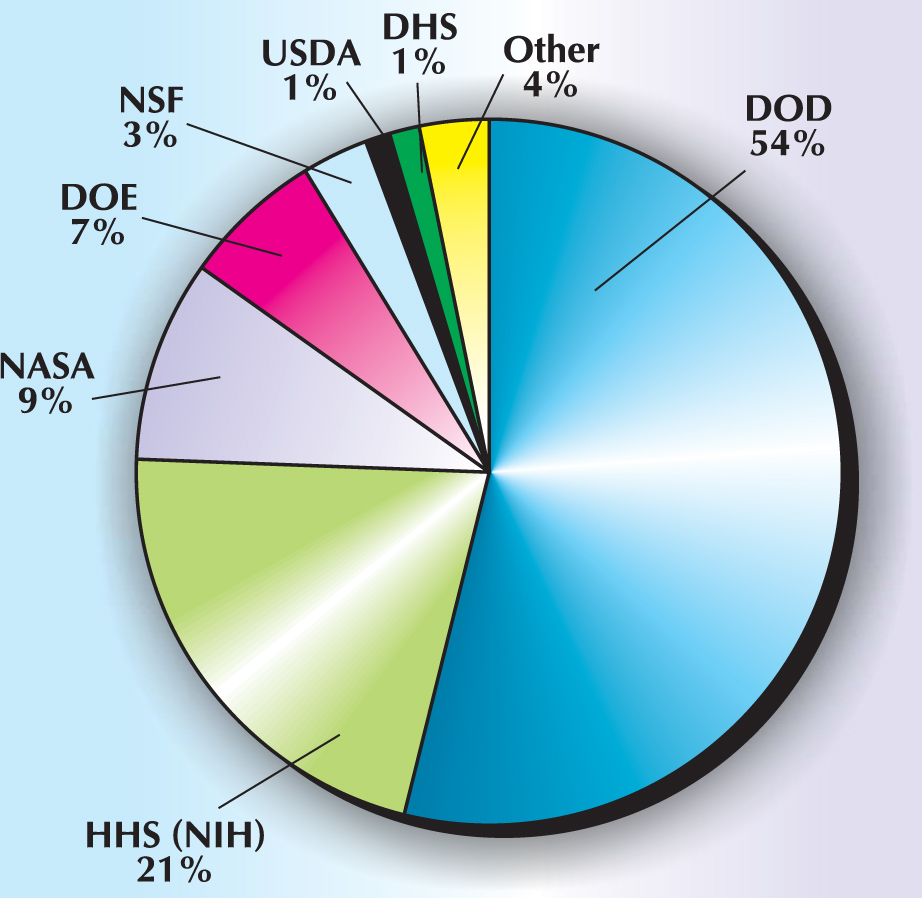
Where Bush’s R&D money would go. The Department of Defense is again the largest recipient of federal R&D money in the administration’s fiscal year 2007 budget. Overall, DOD R&D would increase $1.6 million, or 2.2%, to $74.1 billion, with the entire defense increase going to weapons development. Defense science and technology funding, which includes basic, applied, and medical research as well as technology development, would be cut by 18.6% to $11.2 billion, according to AAAS analysts. The National Institutes of Health would remain flat at $28.6 billion. NASA would receive an 8% increase, and virtually all of the increase would go to developing new manned space vehicles. The Department of Energy’s Office of Science would receive more than a 14% increase, a sharp turnaround after several years of flat or declining budgets. Nuclear physics would receive a 23.7% boost, alleviating operating problems at several of the national laboratories. NSF and NIST would also receive significant increases to their basic science and research programs. The Department of Homeland Security science funding would fall by 10.3% due to both budget cuts and reorganization.


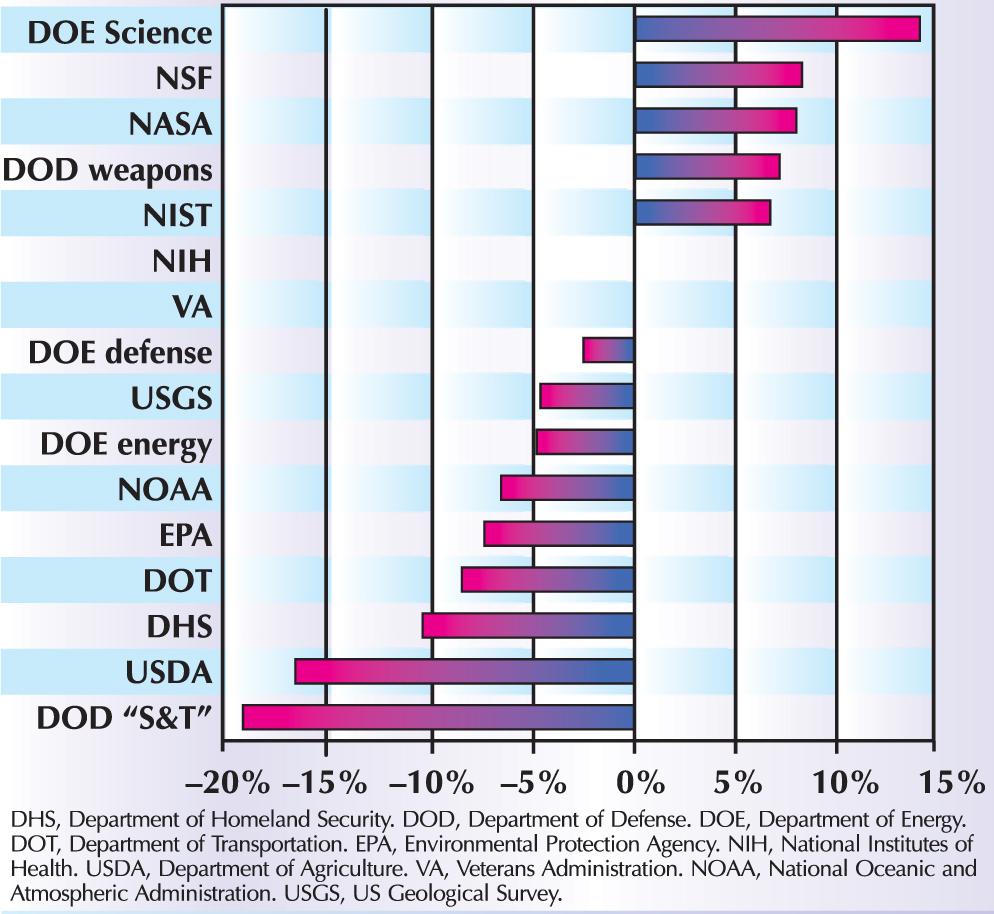
Winners and losers in Bush’s science funding. The physical sciences are the big winners in the proposed fiscal year 2007 budget, with presidential science adviser John Marburger acknowledging to Congress that there “has been recognition by the administration of the critical nature of research as the foundation to our nation’s economic competitiveness.” DOD weapons spending increases in the FY 2007 proposal. Nondefense spending would increase in the Department of Energy’s Office of Science, up 14%; NSF, up 8.3%; and NIST, up 6.5%. NASA R&D increases 8% but science programs at the space agency actually face cuts. Although the proposed federal R&D portfolio is a record $137 billion, almost a 2% increase, several agencies and research programs would stay flat or take a hit. NIH would remain flat after declining slightly last year. The Environmental Protection Agency’s R&D would drop 7.2%; the National Oceanic and Atmospheric Administration would fall 6.3%; US Geological Survey funding would fall 4.7%; Department of Agriculture R&D would drop 16.5%; Department of Homeland Security R&D would decrease 10.3%; and DOD research programs would fall 18.6%.

More about the authors
Jim Dawson, American Center for Physics, One Physics Ellipse, College Park, Maryland 20740-3842, US .
Paul Guinnessy, American Center for Physics, One Physics Ellipse, College Park, Maryland 20740-3842, US . pguinnes@aip.org