Sound research aids the deaf
DOI: 10.1063/1.2207032

When Sasha was adopted at age six, her new parents were warned that she was profoundly deaf. Three years later, Sasha runs around the house like any nine-year-old, and she can hear her parents, thanks to a cochlear implant under the skin behind her ear. An external microphone and processor pick up sound, convert it to electric impulses, and transmit it to the implant, which activates 16 electrodes that stimulate the auditory nerve. The brain then processes the signals as sound. More than 100 000 people worldwide have been fitted with such implants since the 1980s. New advances promise to make implants safer to install and more sensitive to sound.
A traditional implant consists of a bunch of wires encased in silicon, “a bit like a thick strand of spaghetti,” says Soli Sigfrid, an expert on hearing at the House Ear Institute in Los Angeles. The most exciting areas of cochlear research, he says, are in bilateral, hybrid, and smaller implants. Bilateral implants would go on both ears, so the wearer could process sound in stereo. Hybrid implants would restore hearing at high frequencies for people who can still hear low frequencies. And reducing the size makes devices easier to install.
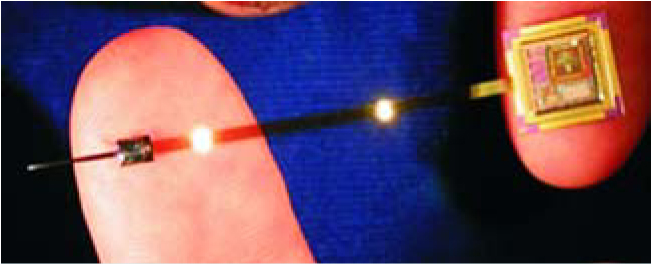
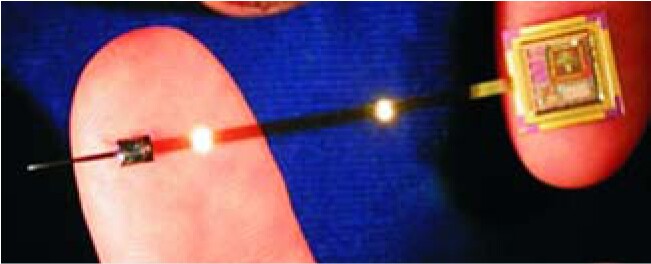
A group of engineers at the University of Michigan is developing an implant that is about half the size of current models and has up to 128 electrodes on a ribbon-like thin film. As with today’s implants, the electrodes feed into the snail-shaped cochlea of the inner ear, but in the Michigan design the electrodes go deeper, making lower frequencies accessible. “More [electrodes] mean greater tonal range and better frequency perception,” says the Michigan group’s Kensall Wise, “and the implant’s flexibility will minimize damage to existing hearing.” The new implant would help wearers cope with background noise, hear nuances in music, and understand tonal languages, such as Chinese. (Visit http://www.physicstoday.org for audio samples comparing sound perception for new and old cochlear implants and normal hearing.)
The ribbon-like implants do have a couple of weaknesses, Sigfrid says. “The thin-film electrode is like putting a surgical knife next to the nerve.…And the fluid in the inner ear is conductive.…Putting the electrodes too close together may cause interference.” To avoid damaging the nerve, says Wise, position sensors are integrated onto the ribbon. “With the position sensors, doctors can see, on a screen, a silhouette of the ribbon against the shape of the cochlea.” The idea is to eventually have the sensors control the insertion tool to automatically navigate around any obstacles, he says. Currently the implant is being tested on guinea pigs and cats. “The technique is promising,” says William Yost, a professor in hearing sciences at Loyola University in Chicago, “but it’s still some way off from being tested in humans.”
Researchers at Advanced Bionics in Sylmar, California, are focusing on upgrading the software in the processors of cochlear implants to improve a wearer’s sound perception by exploiting interference between electrodes. The advantage of that approach is being able to upgrade existing implants without surgery.
“Ultimately the goal is to make a device that is fully implantable under the skin,” says Sigfrid. “That’s still down the road a bit.”

Thin-film-based cochlear implants may enhance hearing.
UNIVERSITY OF MICHIGAN
More about the authors
Paul Guinnessy, American Center for Physics, One Physics Ellipse, College Park, Maryland 20740-3842, US . pguinnes@aip.org