Sodium Detected in the Atmosphere of an Extrasolar Planet
DOI: 10.1063/1.1480770
For years, planetary scientists have been scouring the heavens in search of planets outside our own solar system. One very long-term goal is to discover a twin to our planet Earth and to search for biological features in its atmospheric spectrum. A shorter-term goal is to understand planetary formation processes more generally.
Since the first sighting of an extrasolar planet in 1995, the search has netted nearly 80 planets, but we know little more about them than their minimum masses and their orbital parameters. 1 It’s been tough enough to glean that much information, which in most cases has been inferred from the tiny, periodic wobble that the planet’s orbital motion produces in the Doppler shift of its parent star. It’s far tougher to detect the planet’s atmospheric constituents. But now a team of researchers 2 has managed to detect atmospheric sodium atoms in a planet orbiting a star known as HD 209458, which has about the mass of the Sun. Like most extrasolar planets seen to date, the planet orbiting HD 209458 is a gas giant, similar in size to Jupiter, but its orbit—only 1/25 that of Earth’s—is much tighter.
Neutral sodium atoms don’t tell as much about the chemistry and composition of a planetary atmosphere as do molecules such as carbon monoxide and water, but sodium is easier to detect. The observation opens the door to further discovery. “Seeing sodium atoms is a proof-of-concept,” said Timothy Brown of the National Center for Atmospheric Research (NCAR) in Boulder, Colorado, and a member of the team that found the sodium. “With a little more precision, we are confident that we can look for carbon monoxide and water.”
Eclipsing a star
The sodium signal was teased out of data taken with the Hubble Space Telescope’s imaging spectrograph by a collaboration of four researchers: David Charbonneau of Caltech, NCAR’s Brown, Robert Noyes of the Harvard-Smithsonian Center for Astrophysics, and Ronald Gilliland of the Space Telescope Science Institute.
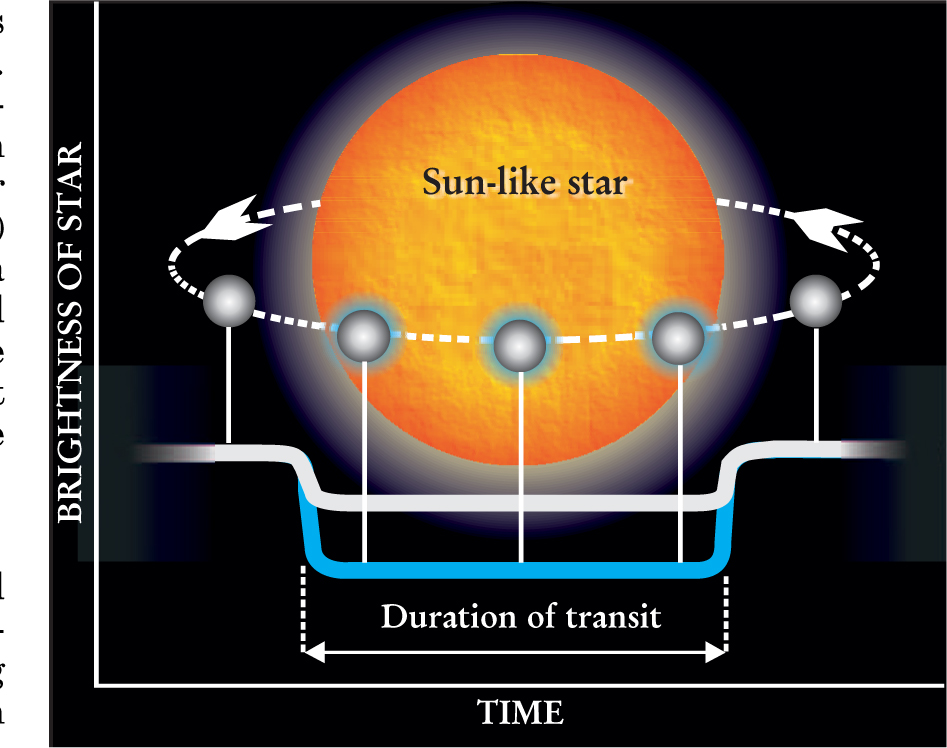
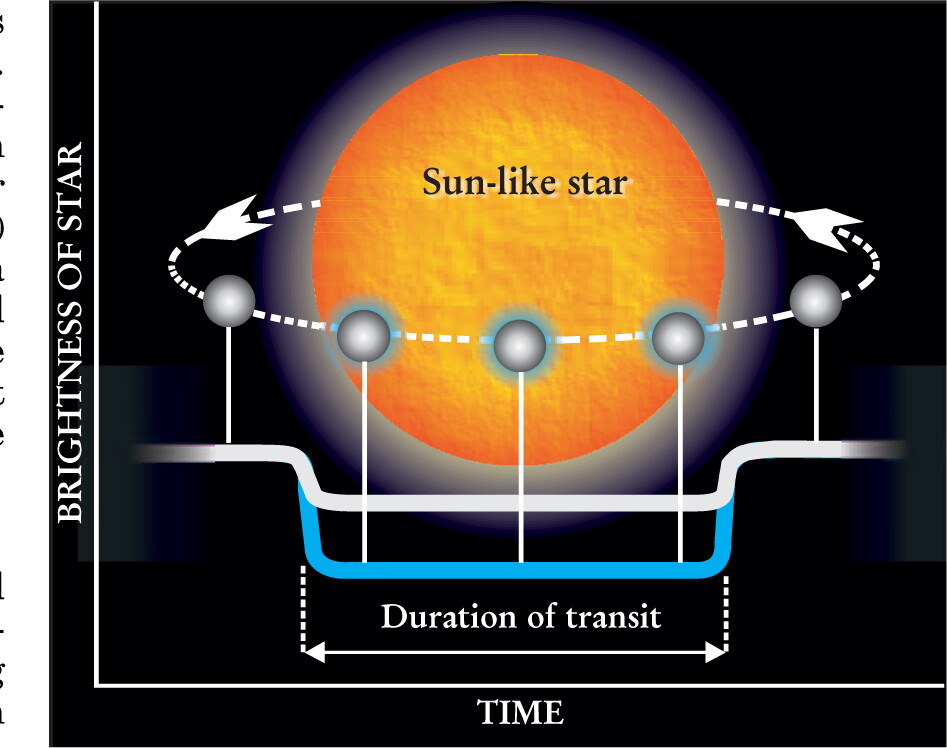
The team used a technique that requires a planet to pass between its parent star and an observer, as illustrated in figure 1. With such an orbital path, the planet blocks part of the light as it moves in front of its star. Fortunately, one planet among the 80-odd extrasolar planets sighted to date fits the bill. 3,4 That’s the one in orbit about HD 209458. The relatively short year of this planet, only 3.5 days, is a convenient observational period.

Brightness of a star fades as an orbiting planet (gray) passes in front of it (see dip in the horizontal white line). The sodium atoms in the planet’s atmosphere reduce the brightness still further (blue line with dip) at wavelengths near 589 nm. This schematic exaggerates the spectral absorptions. The dip in the white line is just 1.5% of the total brightness; the blue dip is an additional 0.02%.
(Courtesy of the Space Telescope Science Institute.)
Researchers should be able to measure the absorption of stellar light by the planet’s atmosphere as the planet transits its star. In principle that sounds easy enough: Just look for a dip in the stellar spectrum at the wavelength of a sodium absorption line during the planet’s transit of the star. (The experimenters targeted the prominent atomic sodium doublet near 589 nm.) But the planet’s atmosphere takes only the tiniest nibble out of the star’s spectral lines. The biggest chunk in the sodium absorption spectrum comes from the sodium atoms in the star itself. An additional piece is cut out by the bulk of the planet as it crosses the stellar face, blocking light at all wavelengths.
The stellar flux integrated over all wavelengths (white line with a dip in figure 1) goes down by only about 1.5% during the planetary transit. The flux at sodium wavelengths (blue line) should drop during transit by an additional few hundredths of 1% because of absorption by sodium atoms in the planetary atmosphere, or so modelers had predicted 5–7 before the recent measurement. Despite the obvious challenge, Charbonneau and colleagues thought the line would be observable.
The team measured the spectrum of HD 209458 during three planetary transits in the spring of 2000. Because the experimenters were trying to detect such a small signal, they had to be very careful of biases. One of these was a possible spurious signal caused by the wavelength-dependent variation in stellar intensity from the star’s center to its periphery. Another was wavelength-dependent instrument sensitivity.
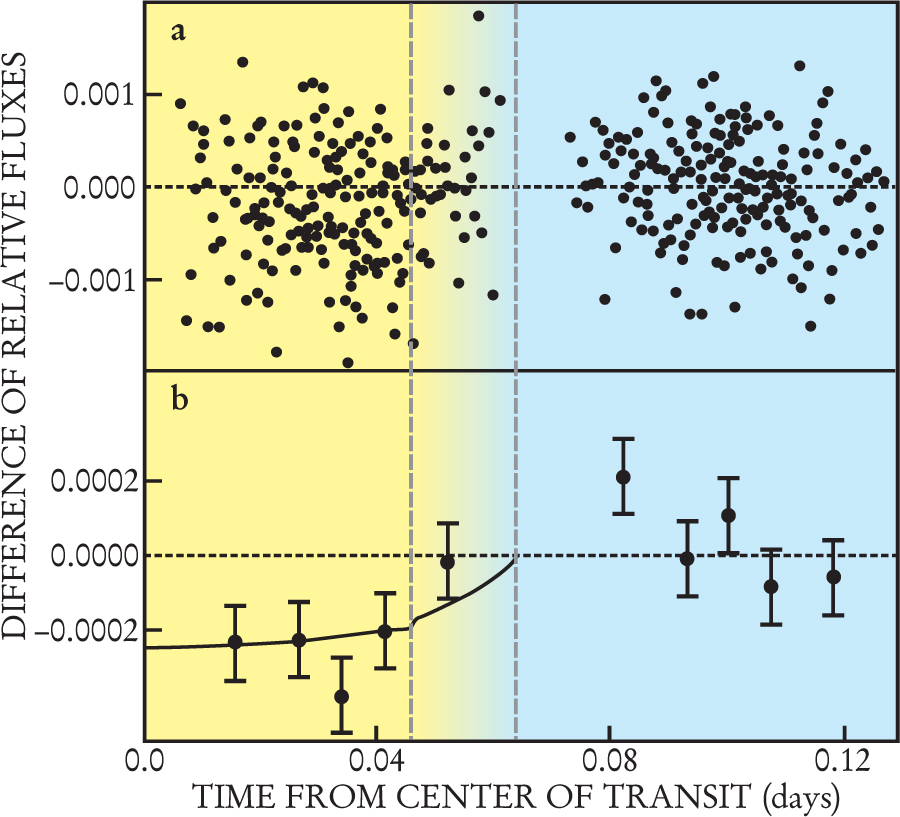
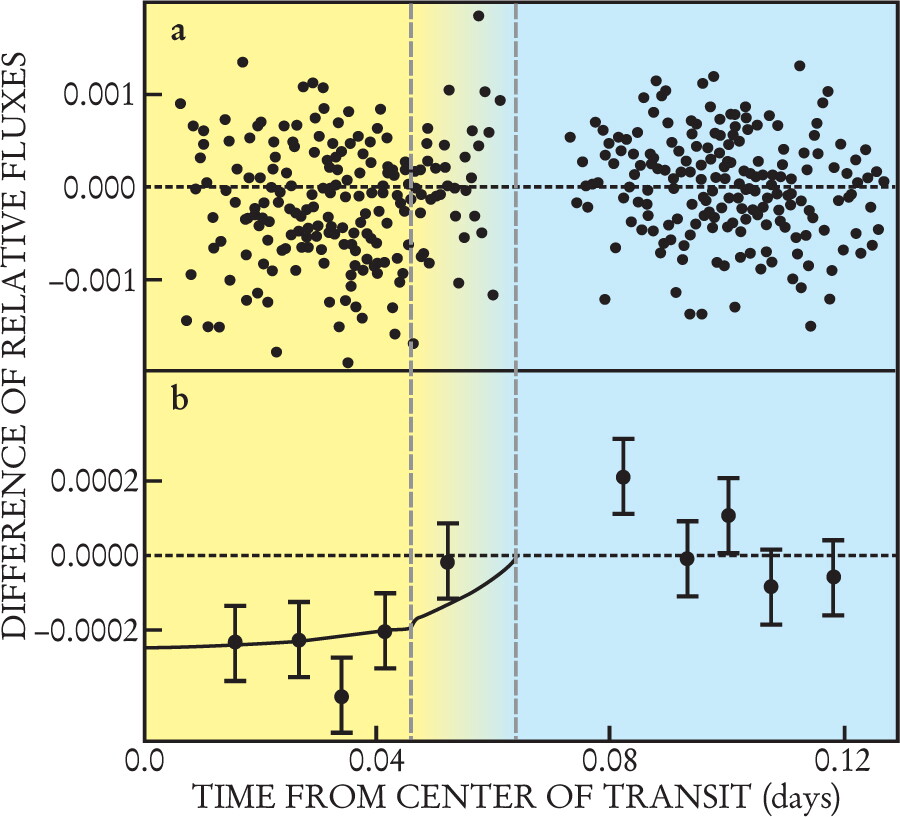
Once the researchers were assured that such biases produced sufficiently small effects, they took the number of photon counts in a window around the sodium doublet and subtracted the average number of counts seen in the adjacent wavelength bands. The counts at sodium wavelengths were, as expected, slightly below the average of the sidebands during the planetary transit, as seen in figure 2.

Sodium absorption is seen when the stellar flux averaged over all wavelengths is subtracted from the flux in the sodium window. (a) Difference of relative flux versus time. (b) When binned in time, the data show that sodium absorption is 2 × 10⁻⁴ of the total stellar flux when the planet is passing in front of the star (yellow background) and zero when it is not (blue background).
(Adapted from ref. 2.)
Not enough sodium atoms
The measured dip in photon flux due to sodium absorption was (2.32 ± 0.57) × 10−4, expressed as a fraction of the total stellar flux. That value is in the ballpark of the predictions made by modelers beforehand, 5–7 but is only about a third of what was expected.
So what could be wrong? “Lots of things,” reply the modelers, who are already going back and tweaking their initial assumptions. To make their earlier predictions, they had assumed that the gaseous planet would have the same metallic abundances as the parent star. They had also calculated the fraction of sodium present as atomic species, based on the temperature deduced from the known distance of the planet from the star. The low observed sodium absorption might mean that the planet had less sodium than its star to begin with, that the sodium had been ionized or had formed molecular compounds, or that the planet has high clouds, which block all wavelengths, causing the atmospheric sodium absorption to be an even smaller fraction of the total.
The sodium observations have provided a first data point on extrasolar planetary atmospheres. “Now we can try to constrain our models,” commented one of the modelers, Sara Seager of the Institute for Advanced Study. With so many variables, however, it will take many more than one data point.
Close-in gas giants
Most extrasolar planets identified to date bear little resemblance to Earth. They all tend to be gaseous giants, with masses about that of Jupiter. Like the planet around HD 209458, a significant number orbit quite close to their parent stars. They are not a representative sample of the universe, because the method of identification—Doppler spectroscopy—skews the selection toward planets in tighter orbits. Recent Doppler discoveries have found giant planets in orbits more similar to Jupiter’s. But to detect planets much less massive than Jupiter and more like Earth will require other techniques.
NASA’s Kepler satellite, due to be launched in about five years, will use a different search tactic to look specifically for planets similar to our own. 8 Kepler will train its sights on 100 000 stars for four years, hoping to see any Earth-sized planets that happen to transit these stars.
Other experiments and missions now being planned will look for such atmospheric constituents as water vapor and methane in the extrasolar planets that have already been spotted. These molecules are expected to show up in the near infrared. Some searches will continue to use ground-based rather than space-based telescopes. With the ground-based instruments, you get a larger observing area, but you then have to weed out the very large background of terrestrial atmospheric absorption.
Looking at the differential absorption during a stellar transit isn’t the only way to identify atmospheric constituents, according to Jonathan Lunine of the University of Arizona. One alternative is to use interferometry to look directly at the planet, especially if the planet is far enough from its star. Typically, the planet is obscured by the bright starlight, but an interferometer could be configured to let experimenters cancel out the rays directly from the star and look at the light reflected off the planet’s surface or at its thermal emission. Another approach is to directly block the starlight using a coronagraph.
References
1. See http://www.exoplanets.org .
2. D. Charbonneau, T. M. Brown, R. W. Noyes, R. L. Gilliland, Astrophys. J. (in press).
3. D. Charbonneau, T. M. Brown, D. W. Latham, M. Mayor, Astrophys. J. 529, L45 (2000).
4. G. W. Henry, G. W. Marcy, R. P. Butler, S. S. Vogt, Astrophys. J. 529, L41 (2000).
5. S. Seager, D. D. Sasselov, Astrophys. J. 537, 916 (2000).
6. T. M. Brown, Astrophys. J. 553, 1006 (2001).
7. W. B. Hubbard, J. J. Fortney, J. I. Lunine, A. Burrows, D. Sudarsky, P. A. Pinto, Astrophys. J. 560, 413 (2001).
8. See http://www.kepler.arc.nasa.gov .