Secondary, Undergraduate Physics in Crisis in UK
DOI: 10.1063/1.1428432

The refrain is familiar, but the volume is up: UK secondary schools desperately need physics teachers, and university physics departments should broaden their reach in undergraduate education. So says the Institute of Physics (IOP) in a report released last month on undergraduate physics in the UK, Physics—Building a Flourishing Future.
The facts are grim: Many UK physics schoolteachers are not trained in physics; undergraduate students lack the math skills they need for physics; and more than 10 university physics departments have folded in the past decade.
All that despite job options for physics graduates in, for example, financial analysis, engineering, environmental science, energy technology, and intellectual property law. Employers told the IOP that they seek physics graduates for their problemsolving skills and their “ability to argue on [their] feet,” but that they’d like to see better communicating skills and teamwork.
Because of its findings, the IOP will look into developing teaching materials to help university physics departments catch students up in math, and it’s calling for departments to partner with schools to sow seeds of scientific curiosity in the young. Such activities go on already, of course, but the idea is to increase their impact. Says Derek Raine, an astrophysicist at the University of Leicester, “They’re the sort of things that happen once everyone sees everyone else is doing it. They’re given status by IOP promoting them.”
The report also says the government should recognize market forces and pay physics teachers more. The government knows there is a crisis in secondary schools—some have even taken to recruiting teachers from abroad. “They’re hearing this for the nth time,” says IOP President Peter Williams. “We hope to get their attention that, in physics, it’s particularly acute.”
The IOP vows to push for recognition of the MPhys—a combined bachelor’s/master’s degree that takes just four years to complete—within the emerging Bologna framework of mutually compatible higher-education systems in Europe (see Physics Today, May 2001, page 21 ).
The number of physics majors has remained flat over the past 15 years, while total university enrollment has skyrocketed. Physics should cast a wider net by offering new interdisciplinary degrees that cross with chemistry, computer sciences, and other fields, the report says. Such degrees could feed the job pipeline, help stop more departments from closing, and attract students who like physics but are weak in math. “Within the context that up to half the population goes into higher education, we should look at physics as part of the general culture, not just as training for professional physicists,” says Raine. “We should also question why the gender balance and ethnic mix of physics students is unrepresentative.”
By and large, physicists who have read the report say it holds no real surprises. They applaud the idea of creating new degrees, though they wonder where the additional cash and staff to do that will come from. And they are skeptical that the government will cough up enough funding to improve conditions for teachers so that the profession can compete with the more lucrative careers available to physicists. The IOP report calls for a study leading to specific recommendations by next year as to what sorts of new degrees to launch, who should pay for them, and where they should be offered. And, says Williams, the IOP will evaluate the costs involved in rejuvenating the teaching pool. “We can’t keep hemorrhaging as far as our secondary schools are concerned. Something must be done.”

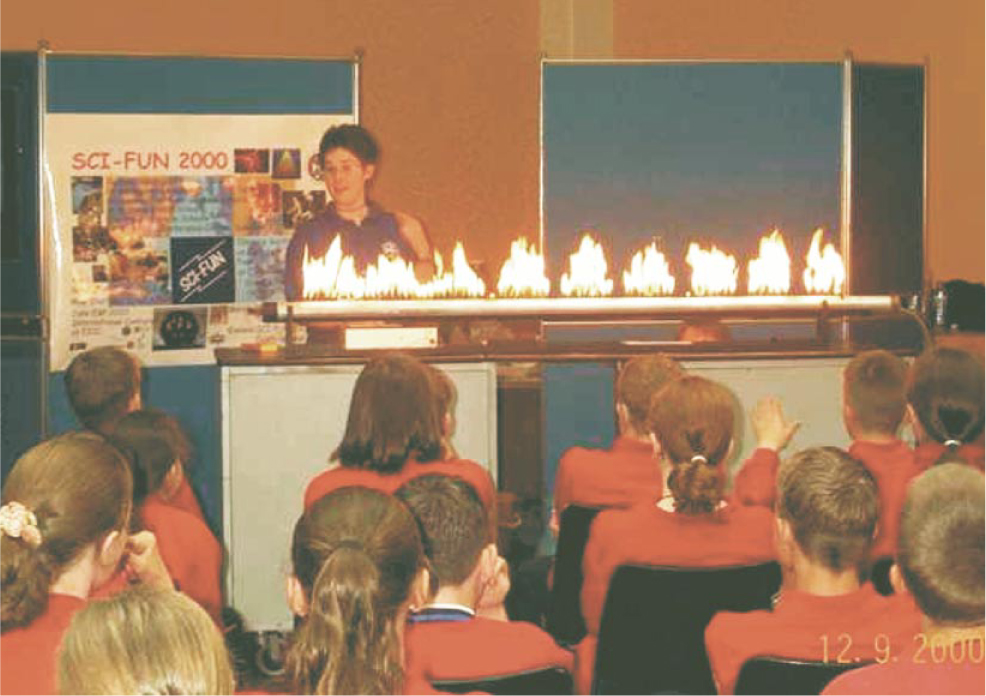
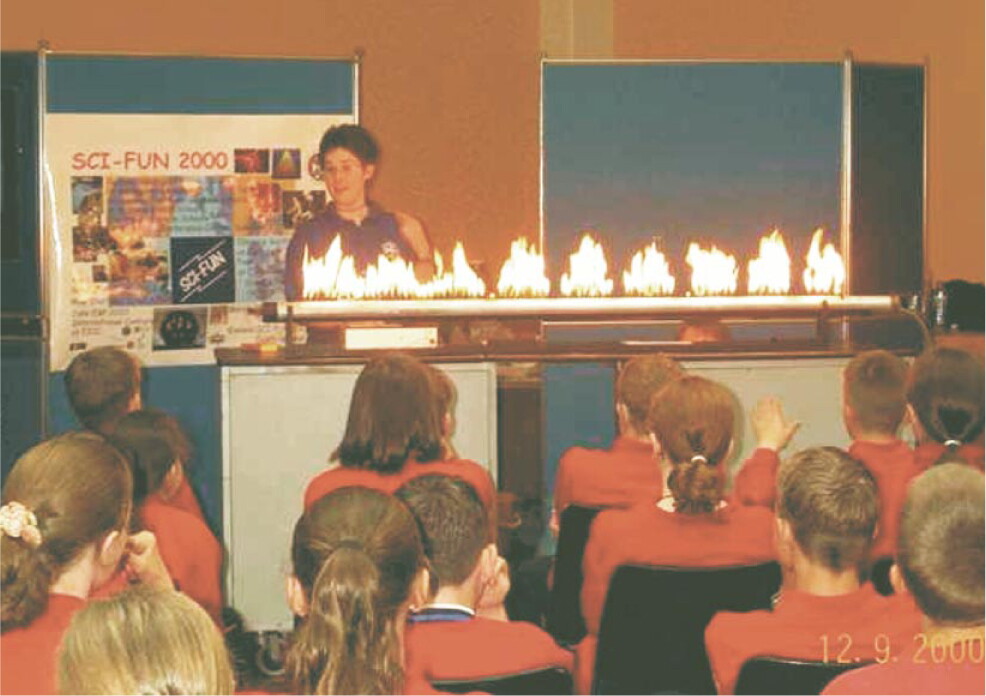
Science road show: The University of Edinburgh takes science demonstrations to schools around Scotland, aiming both to capture kids’ imaginations and to give university students a taste of teaching. Here, flame height corresponds to pressure in a standing sound wave.
SCI-FUN, UNIVERSITY OF EDINBURGH
More about the authors
Toni Feder, American Center for Physics, One Physics Ellipse, College Park, Maryland 20740-3842, US . tfeder@aip.org