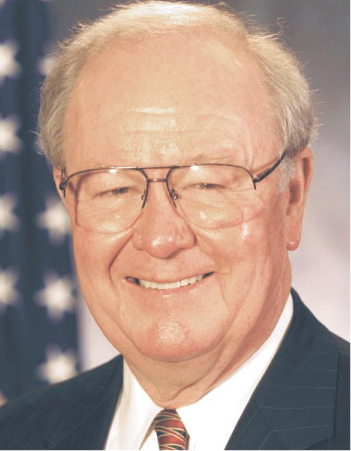
Searching for Scientists With Management Skills, McQueary Builds DHS Science Directorate
DOI: 10.1063/1.1603071
In early April, on his first full day on the job as the undersecretary for science and technology at the new Department of Homeland Security, Charles McQueary was on Capitol Hill testifying before both House and Senate committees on how he would spend $803 million in R&D money. A couple of weeks later he was back on the hill, detailing the programs being developed for a DHS cybersecurity center. In between, he hired staff and dealt with a host of headaches as he worked to create his portion of the massive new government agency.
“I’m a problem solver,” said the former president of General Dynamics Advanced Technology Systems. “You never know what the future holds in terms of what terrorists could do to us, but I think this [developing technology to protect against terrorism] is a series of engineering problems.”
McQueary, a PhD engineer from the University of Texas at Austin, said he has extensive experience building management teams during his years at General Dynamics, AT&T Bell Laboratories, and Lucent Technologies. “I’ve had some pretty significant success in doing that in the past and I’m looking forward to doing the same thing here,” he said.
In an interview with Physics Today less than two months after he was sworn in, McQueary discussed his views of the role of science in countering terrorism, including the role of national laboratories, the technology needed, and how the public should view the risk of a terrorist attack.
PT Science at the Department of Defense (DOD) is typically defined in terms of weapons research. At the Department of Energy (DOE), it is primarily energy related, and at the National Institutes of Health, disease related. What is your definition for science at the Department of Homeland Security?
McQUEARY Fundamentally, we’re interested in counterterrorism measures that deal with chemical, biological, nuclear, radiological [weapons], and high explosives, as well as cybersecurity. So those six areas of scientific endeavor, and anything that would touch upon those items to help us do a better job of protecting the country, would be important to us. Another piece that is not directly a counterterrorism issue is one of standards. We have the responsibility for developing standards for units that will be deployed as we go forward. It’s helpful to have the people who are buying equipment, the people at the state and local level, to have something they can rely upon. We recently signed a memorandum of understanding with NIST and we will continue to work closely with them as we develop these standards.
PT There was some confusion in the legislation establishing DHS about the role of the national laboratories. How will you use the labs in developing technology to counter terrorism?
McQUEARY We have a memorandum of understanding with DOE on our relationship with the labs, and it gives us free access—I should say open access—to work with these labs in order to establish our homeland security agenda. That work is under way and several of the labs I’ve visited already have strong homeland security research programs under way and in development. We are not going to select one lab as being the lead lab, however. What we intend to do, the way we’re referring to it, is have a national laboratory and that laboratory is made up of elements of each of the major national laboratories. We feel that we need the inputs from all the labs and to establish one in the lead position when there is not a good reason for doing that creates the potential for conflicts that I think each of the labs has an equal stature.
PT How will you use lab scientists?
McQUEARY We have a few labs people who are on two- to four-year assignments here in the science and technology directorate [in Washington, DC]. There are a half dozen or so scientists from several of the labs here. But when we go to the labs for work, the scientists remain laboratory employees, doing work for us.
PT Much of the antiterrorism technology involves sophisticated chemical, biological, and radiological sensors and related screening and detection devices. How much of that is off-the-shelf technology and how are you approaching the development of new equipment?
McQUEARY We are looking for things where sufficient work has been done to bring a device to a prototype stage so we have confidence we could put it in the field and do the next stage of testing with the anticipation that we could go forward into full-scale development. We’re in a very embryonic stage of that right now. In fact, a lot of energy, including a lot of my own time, is being spent on making sure that we have a reasonable understanding of what’s available, not only within the labs, but also from private industry as well as universities. So I’ve not been in a mode of “Lets rush to start fielding something that we find” until we get at least a little better understanding of what kind of capabilities exist there. It was my view that taking a small number of months, certainly no more than six, to determine exactly what kind of capability we have could serve us well as we prepare to decide actually what we’re going to be putting in the field.
PT Which research areas are strongest, and which need more work?
McQUEARY I think we’ve made reasonable progress in the radiological detector area, as well as the nuclear detector areas. But I don’t mean for a moment to suggest that I think that we’re finished with either of those. But we do have reasonable capability already at our borders in those two areas. The area where I think we need additional work is on timeliness of information that comes from biological detectors. It takes a while to be able to do the assay and make the determination that a biological attack has actually occurred. We need to make the detection and do the assay quickly, and we need to be able to provide the alarm that something has happened. Because, particularly in a biological attack, you do not have a lot of time in order to be able to plan what the response is going to be should such an attack occur. So that’s the area where some scientific breakthrough—I should say engineering breakthrough—is needed.
PT Your directorate has a group called the Department of Homeland Security Advanced Research Projects Agency, modeled on the Defense Department’s Defense Advanced Research Projects Agency (DARPA). What will DHSARPA do?
McQUEARY First of all, that organization will be largely the focus with universities and private industry. It will be where their work will be conducted. So think of what we do as being comprised of the federal labs, private industry, and universities. So the contract work that gets done by private industry and universities will largely be managed through DHSARPA. Initially we will not have a lot of [basic research] capability, simply because our interest is in making changes early on to make a big difference. As we progress further into having the S&T group well established, I’d think to see some expansion into the fundamental research. But we need some solutions today, rather than what can come out of the scientific research area spread over the next few years.
But we will be spending some money in the fundamental research area. An area that we already know we’re interested in is one of the sociological side of what makes a terrorist.
PT Does that mean you have sociologists on your staff?
McQUEARY No. We will not have a large staff. When this science and technology unit is at full staff, I’m guessing we’re going to be in the 200-people range, probably a little less. So our jobs will be to manage programs that will be conducted in the labs, industry, and universities. And that means we need to have scientifically trained people who have strong program management skills.
PT So you would use university researchers to develop sociological profiles of terrorists?
McQUEARY That’s exactly right. I’ve had some groups come in to see me already to discuss how they would approach this. The University of Chicago is one that’s been in to see me. They bring a number of different disciplines together, including the religious aspect of the study.
PT There is always concern over restrictions on university research, on classified research, and prepublication review. What are your views on those issues?
McQUEARY I come from a background, having worked with DOD, in which in some cases we could keep the technology unclassified, but what became classified was the particular application. So I would certainly envision trying to maintain a similar view in what we do in the DHS. We need to make sure that we do have free and open research to the maximum extent that we can. At the same time, I would hasten to say there are probably areas of scientific research where the scientific community ought to try to come up with standards for itself. We are not going to be putting out lots of standards for research or classification guidelines, because so much of the research is done internationally. To put an imposition just on our own science and technology would not be a good idea.
PT You’ve talked about establishing an academic center for antiterrorism research. Is that progressing?
McQUEARY Yes it is. We haven’t chosen a university. In fact we don’t even have a short list at this point. What we’ve done is engage the American Association for the Advancement of Science, the American Association of Universities, and NSF to help us identify where potential centers might be. We expect to develop a shortened list, and then have a request for proposals that would go out to see if those on the list are interested in bidding. The original legislation [establishing DHS] called for there to be only one center, but the legislation was subsequently changed, and I think for the better, because it is difficult for me to imagine one university having the full breadth of capability we need from a homeland security standpoint. There will be more than one, and less than ten. It’s a matter of looking at the scientific coverage, and it is from that that we’ll decide how many we need. We will have the first one selected by November.
PT Do the centers have to be strictly university based, or can they be coalitions of several organizations?
McQUEARY What I’m finding is a phenomenon where universities, private industry, and in some cases government labs that happen to be in the same location are getting together to identify how to work collaboratively to help us solve the homeland security issues. And if you have organizations that get together and form a coalition, that could reduce the number [of centers] we need because they could cover a broader spectrum than what one university could do by itself. I’m happy to see places that are moving out and helping to decide what needs to be done because, quite frankly, we don’t have all of the smarts here in Washington. I’m anxious to have all of these great minds helping us work the issue.
PT As a scientist, you have a different view of risk assessment than the general public. How do you talk to the public about the risk of terrorism?
McQUEARY What I do when I stand before people is ask the question, “What is your personal expectation of DHS?” We have policemen, firemen, and emergency responders in the country, yet we’re not able to provide perfect protection for people. The DHS is never going to be able to provide perfect protection for every single American citizen. So there are variations, or gradations, in the risk assessment. The way I think about it is, What is the ease of accomplishment for someone who would do us harm, and also the weight of the damage that could be done by whatever it is people might use to attack us.
Everybody wants 100% assurance and that’s why I think it’s important that we in the DHS help frame the expectation that people should have from us. I’m not saying that because I think we haven’t got a major responsibility, because we do. But there are some things that we just cannot do. You take somebody, as we saw, with a rifle here in Washington. You can create a great deal of uncertainty and havoc when you have something like that, and DHS doesn’t have a plan that says we’re never going to have that kind of incident again.

DHS
More about the authors
Jim Dawson, American Center for Physics, One Physics Ellipse, College Park, Maryland 20740-3842, US .