Science envoys five years on
DOI: 10.1063/PT.3.2744
In a June 2009 speech in Cairo, Egypt, in which he promised “a new beginning” for US relations with the Muslim world, President Obama announced the creation of a new effort in science diplomacy: science envoys. Their role, Obama said, would be “to collaborate on programs that develop new sources of energy, create green jobs, digitize records, clean water, [and] grow new crops.” Since then, the Arab Spring took place, the program has been broadened to include non-Muslim states, and 13 scientists and engineers have served as science envoys to 30 nations.
The results of their travels can be measured in the scientist-to-scientist contacts established, lectures delivered, and meetings held with high-level officials. The envoys did not come bearing funding for research. In at least two cases, however, they helped to pave the way for closer bilateral science and technology relationships with the US.
“Every envoy we’ve sent out has been remarkably successful,” says Jonathan Margolis, deputy assistant secretary of state for science, space, and health. “They get access to heads of scientific institutions and access to heads of the government entities responsible for their scientific ecosystem. They get exceptional press coverage,” which generates popular interest.
The envoys serve one-year terms but generally spend only a few weeks in their assigned countries. Margolis says they “are incredibly helpful in the State Department’s efforts to build bilateral science and technology relationships with any number of countries.” They’re especially useful “in countries where we have a new relationship that’s just getting started, or in a relationship that’s been on the books but maybe hasn’t been as productive.”
Ongoing involvement
Bruce Alberts was one of the original three envoys (see Physics Today, January 2010, page 23 ). Since his term expired in 2011, Alberts, former president of the National Academy of Sciences (NAS) and editor-in-chief of Science, has continued to travel to Indonesia to promote collaborations on his own; he will make his seventh and eighth visits in 2015. Alberts says he was skeptical of the envoy idea at first; he recalled his experience at a State Department–sponsored meeting on scientific collaborations with South Africa in the late 1990s. “Many people on both sides spent weeks preparing an elaborate formal agreement and in the end, the US could not come through on their end of the partnership because they could not get the anticipated resources from the relevant agencies,” he says.
But a staffer at the White House Office of Science and Technology Policy came up with $200 000 from a State Department scientific cooperation fund to support Alberts’s efforts before he left for Indonesia. After consultation with a group of leading Indonesian scientists, the money was spent to organize a program that brought together 40 selected US scientists in their mid to late 30s and 40 Indonesians of similar age in a three-day multidisciplinary “Frontiers of Science” symposium. Three more gatherings have since been held in Indonesia, and a fifth is scheduled for this year. Each was organized by a committee of six young scientists from each nation. Past sessions have addressed marine and geothermal energy, big data, natural disaster mitigation, and a wide variety of life-sciences topics.
The Frontiers program is patterned after annual bilateral workshops that the NAS has long sponsored in conjunction with the science academies of China, Germany, India, and Japan. Attendees are encouraged to apply for Partnerships for Enhanced Engagement in Research grants for collaborations with their US colleagues. The grants are funded by the US Agency for International Development (USAID), the National Institutes of Health, and NSF.
Alberts says the program causes a “random collision of ideas” among scientists within and across Indonesia and the US. In May he will again travel to Indonesia, to help inaugurate a national young academy (NYA) there. Patterned after a 15-year-old program originating in Germany (www.globalyoungacademy.org ), the NYA will empower a group of young Indonesian scientists to work together on an issue of their choice that is important to their nation’s future.
Although Indonesia is the world’s fourth most populated nation, Alberts notes the country devotes a scant 0.06% of its gross domestic product to research, compared with about 2.8% in the US. That meager funding is mostly allocated to government labs and institutions, which are home to very few of the country’s top scientists, he says. In December, however, the government announced plans to begin a new merit-based grant program, with an initial goal of awarding 100 per year. Overseen by the Indonesian Academy of Sciences, the program will have Indonesian and US reviewers.
A Malaysian NSF
Former NSF director Rita Colwell, who has carried out infectious-disease research since 1975, was a science envoy to Malaysia, Vietnam, and Bangladesh. She met with the prime ministers of each of the three nations and urged NSF to assign an employee for three months to help Malaysian officials set up that country’s own agency to support investigator-initiated research. Malaysia has a serious brain-drain problem, and a source of merit-based funding will help retain scientists, she says. Colwell also helped the US negotiate an S&T agreement with Malaysia, says Margolis.
Bernard Amadei, a University of Colorado professor who founded the nonprofit organization Engineers Without Borders, visited Pakistan three times as a science envoy. Two-thirds of Pakistan’s 120 million people subsist on less than $2 a day, and the country has major water, food, and energy needs. “My role was to look at existing collaborations between the US and Pakistan in S&T, provide an assessment of those collaborations, and start some new ones,” he says.
With help from the US embassy, NSF, USAID, and the NAS, Amadei last year organized a technology entrepreneurship conference in Pakistan that drew 300 young scientists and engineers. A weeklong technology commercialization training course was held in conjunction with the conference. Three young Pakistani master’s and PhD degree recipients were chosen to receive expert advice on developing business plans to commercialize technologies they had developed.
Fresh from being named an envoy in December, University of Oregon chemistry professor Geraldine Richmond spent 17 days in January visiting Thailand and Vietnam. She returned to Indochina again in early March to visit Cambodia, Laos, and Thailand. While promoting scientific interactions among those nations, plus Myanmar, Richmond intends to work to help women scientists throughout the region to be successful in their research, teaching, and scientific leadership as she has in the US through the COACh (formerly known as the Committee on the Advancement of Women Chemists) program that she started in 1997. Richmond has already held workshops in Thailand covering publishing, grant proposal writing, leadership, and other topics. Dieu Lan, a faculty member at Hue University in Vietnam, says that Richmond promised to return there if Dieu translated her COACh materials into Vietnamese.

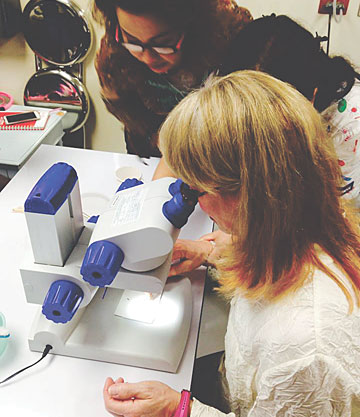
Science envoy Geraldine Richmond (foreground) visits the Armed Forces Research Institute of Medical Sciences, a research joint venture between the US and Royal Thai armies that has contributed to the development of every antimalarial drug ever made.
US DEPARTMENT OF STATE

The State Department has a particular interest in the five nations through which the Mekong River flows, Richmond says. The river is essential for both drinking water and agriculture. And USAID’s mission in Bangkok needs expert advice on the most effective use of its S&T funds.
Richmond says there is room for strengthened collaboration with Thailand in materials science, climate change, water resources, agriculture, and infectious disease. Vietnam, with a 3444-km coastline, has a particular interest in mitigating sea-level rise and other impacts of climate change. “In southeast Asia, you can truly see significant changes in weather patterns, torrential rains, and flooding. There is more of a sense of urgency to address the issues,” she says.
Envoy to the oceans
Jane Lubchenco, former administrator at the National Oceanic and Atmospheric Administration, became the first thematic envoy in December. Her appointment as envoy to the oceans grew out of last year’s Our Ocean Conference hosted by Secretary of State John Kerry. (See Physics Today, August 2014, page 20 .)
In traveling among Pacific islands, Lubchenco says she will identify opportunities for strengthened scientific interactions “with a handful of developing countries” yet to be selected. “I intend to use my position to be a spokesperson for a healthy ocean and shine a spotlight on exciting new scientifically based approaches that can provide food security; alleviate poverty; achieve more resilient coastal communities; and result in healthy communities, profitable businesses, and healthy ocean ecosystems,” she says.
Arun Majumdar’s experience as founding director of the Advanced Research Projects Agency–Energy was largely responsible for his December appointment as an envoy to Poland and the Baltic states. The four nations, each bordering on Russia, share concerns about their energy supplies. Majumdar, now a Stanford University engineering professor, visited Poland in late February to listen and learn how he might help. “It’s the second trip where you can add value,” he says.
Margolis credits former MIT president and science envoy Susan Hockfield with helping deepen the S&T relationship with Turkey. In April 2013 she helped expedite a range of bilateral collaborations in seismology and basic research. Hockfield couldn’t be reached for this story, but Margolis said that her experience with the technology commercialization process was of particular interest to officials at several universities and at the Scientific and Technological Research Council of Turkey.
The vast majority of the bilateral S&T cooperation agreements the US has in place with 60 nations do not come with resources attached. But the agreements set the terms under which US S&T funding agencies engage in and fund collaborative efforts. “NASA alone has thousands of cooperative agreements. NIH has thousands. If they had to negotiate the terms of every agreement, such as access, data exchange, IP [intellectual property] rights, scientific instrument exchange, and taxation, it would be a cumbersome procedure,” Margolis says.
Improvements suggested
Amadei says the envoys program should be expanded. “I think it has so much potential, and we are just looking at the tip of the iceberg here.”
Alberts, however, finds problems with the program: “All these things take time, which is why a one-year appointment as a science envoy is too short.” And being assigned to cover as many as five countries in a year can make an envoy “pretty meaningless,” he adds. He attributes his positive experience in Indonesia largely to the propitious stationing of two American Association for the Advancement of Science fellows at the USAID mission to Jakarta. Unfortunately, he says, none of the 89 other USAID missions has an explicit S&T track in its strategic plan.
A State Department spokesperson says envoys are now assigned no more than three countries, and that no changes are planned for the program.
Even with a single country, one person isn’t enough to cover all the bases, Alberts notes. Indeed, at the invitation of the US Embassy, former National Cancer Institute director Harold Varmus joined Alberts during one of his visits to help launch an ongoing US– Indonesian antismoking collaboration. And Roger Beachy, director of the World Food Center at the University of California, Davis, has made multiple visits to work with Indonesian biotechnology companies on genetically modified organisms.
More about the authors
David Kramer, dkramer@aip.org