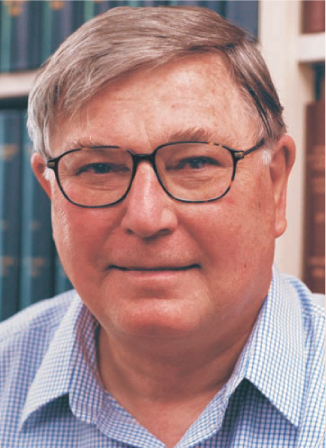
Sargent Is New Vice President for AAS
DOI: 10.1063/1.4809654
On 2 June 2004, Wallace L. W. Sargent, Ira S. Bowen Professor of Astronomy at Caltech, will take office as vice president of the American Astronomical Society.
Sargent attended the University of Manchester in the UK, where he earned a BSc in physics in 1956, an MSc in theoretical astrophysics in 1957, and his PhD, also in theoretical astrophysics, in 1959. After completing his PhD, he became a research fellow at Caltech. Between 1966 and 1981, he worked his way up in Caltech’s division of physics, mathematics, and astronomy, from assistant professor to the named professorship he now holds. He was a member of the staff at Owens Valley Radio Observatory from 1978 to 1988 and director of the Palomar Observatory from 1997 to 2000.
Sargent says one of the primary functions of the AAS vice president is “to help organize the scientific content of the meetings.” He says he will “maintain a high scientific standard, giving prominence to all fields of astronomy.” A strong advocate of diversity, he adds that “women and minority speakers are particularly important as role models.”
AAS also elected a new secretary, John A. Graham, a staff member in the Department of Terrestrial Magnetism of the Carnegie Institution of Washington; he was AAS vice president from 1984 to 1986. Jill Bechtold (University of Arizona), Karen S. Bjorkman (University of Toledo, in Ohio), and Alan M. Title (Lockheed Martin Advance Technology Center) were elected to three-year terms as councilors, and Melissa McGrath (Space Telescope Science Institute) and Lee G. Mundy (University of Maryland, College Park) became members of the nominating committee.

Sargent