Safeguarding nuclear material may be losing urgency
DOI: 10.1063/PT.3.3105
No improvements have been made in the past two years to on-site physical protections, insider threat prevention, security during transport, control and accounting practices, and incident response measures assessed by the Nuclear Threat Initiative (NTI). The nonprofit organization released its third biennial report card in January in advance of the fourth—and likely last—Nuclear Security Summit to be convened in Washington, DC, later this month.

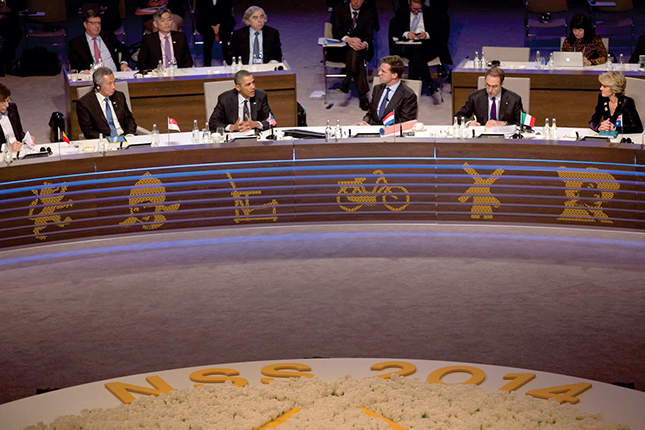
President Obama attends the 2014 Nuclear Security Summit in the Hague, the Netherlands, with other world leaders. Behind him (third from left) is Energy secretary Ernest Moniz.
WHITE HOUSE

The NTI ranks the 24 nations possessing at least 1 kg of weapons-usable nuclear material by how well they secure it. For the third time, Australia, a non-nuclear-weapons state, took first place. Among the five declared nuclear weapons states, France came in 8th place; the US, 10th; the UK, 12th; Russia, 18th; and China, 19th. Among the undeclared nuclear weapons states, Israel was rated 20th, followed by India and Pakistan. North Korea was last.
Some 59 security improvements were made in all 35 categories assessed by the NTI’s Nuclear Security Index in 2014, but only 43 additional improvements have been reported since then. Uzbekistan was the only nation to have rid itself of all its weapons-usable materials during the past two years, compared with seven countries that had done so between 2012 and 2014.
President Obama convened the first of a series of biennial security summits in 2010, after a 2009 Prague speech in which he announced his goal to secure all vulnerable material by 2014. Although that goal is still far from met, each of the summits produced pledges from participating nations that they would take specific steps to better protect their nuclear materials. In 2014, for example, 35 of the 53 national leaders attending the summit in the Hague, the Netherlands, promised to implement and codify International Atomic Energy Agency nuclear security guidelines, to accept periodic peer reviews of their security practices, and to ensure that their nuclear security personnel are “demonstrably competent.” Notably absent from the signatories were Russia, China, India, and Pakistan.
Obama’s commitment to securing nuclear materials appeared to waver when his fiscal year 2015 budget proposed a steep reduction to the Department of Energy program that provides assistance to other nations to round up and secure their materials (see Physics Today, May 2014, page 18 ). Officials explained at the time that the cut was needed to pay for an increase in the department’s nuclear weapons programs.
The nuclear industry will hold an international gathering in Washington in parallel with the upcoming summit. Around 300 executives from 52 nations are expected to attend, says Daniel Lipman, vice president of supplier and international programs at the Nuclear Energy Institute (NEI), the US nuclear industry’s trade association. Notably if predictably absent this year will be Russia. Industry working groups will discuss improving cybersecurity and securing spent fuel, plutonium, and radiological sources. In a first-of-its-kind workshop, industry attendees will join representatives from a range of nongovernmental organizations, both pro- and anti-nuclear, to discuss their common security goals.
Although highly enriched uranium isn’t used in the nuclear power industry, uranium enrichment and civilian spent-fuel reprocessing facilities raise proliferation concerns. Security of nuclear materials during transport is a topic that Chinese and Indian industry representatives have asked to have put on the agenda, Lipman says.
Marvin Fertel, president of the NEI, says that previous industry summits have resulted in exchanges of best practices for handling materials. There is growing recognition of the need for certifications, standards, and best practices for security personnel at facilities, and Fertel says that topic will be addressed.
Given Obama’s central role in convening the summits, no one can say for certain whether this year’s will be the last. Fertel says the industry may well continue to hold its gatherings even absent future governmental summits.
Cooperation or catastrophe
For the first time, this year’s NTI review tackled how well the 45 countries with civil nuclear facilities guarded them from sabotage, including cyberattacks. Finland topped that list, followed by Australia, Canada, and the UK. The US tied for sixth place with Hungary and Sweden. At the report’s unveiling, NTI CEO and former US senator Sam Nunn (D-GA) lamented that nearly half of the countries assessed do not have legal and regulatory requirements in place to shield their civilian nuclear plants from cyberattacks.
Nunn urged world leaders to maintain the momentum that the previous summits created. “My bottom line: Significant progress that deserves applause and at least two cheers has been made, but the world has miles to go before we sleep,” he said. “Progress must be sustainable. We are in a race between cooperation and catastrophe. Our leaders must pick up the pace. They must also pass the baton to their successors.”
Although global stocks of weapons-usable materials have declined in the past two years, trends point to a leveling off or a possible increase in coming years, according to the NTI report. India and Pakistan grew their inventories for civilian and military purposes, and Japan and the UK produced or imported plutonium in the form of spent fuel faster than their reactors consumed it. The Netherlands introduced mixed oxide fuel, which contains plutonium, in a reactor that had previously been fueled with low-enriched uranium. And North Korea’s planned restart of a small reactor and its operation of an enrichment plant point to an increase in materials there.
Japan plans to restart its Rokkasho Nuclear Fuel Reprocessing Facility in the next few years, but in the wake of the Fukushima disaster, the vast majority of the country’s reactors won’t be on line to consume the plutonium fuel that the plant produces. Japan was ranked the most improved country among the two dozen nations possessing a significant amount of weapons-usable materials.
Reactor conversions slow
In a related report, a committee of the National Academies of Sciences, Engineering, and Medicine urged the US government to accelerate conversion of the country’s six remaining weapons-grade uranium-fueled (greater than 90% 235U) research reactors to much lower-enriched fuel. Although those reactors are a proliferation concern, the DOE estimates that it will take 15 years to modify them to accommodate low-enriched (less than 20% 235U) fuel. The reactors are located at MIT, the University of Missouri, NIST, Oak Ridge National Laboratory, and Idaho National Laboratory. In its congressionally mandated report released on 28 January, the academies committee recommended fueling the reactors with 45% 235U until the low-enriched fuel becomes available.
The academies report, Reducing the Use of Highly Enriched Uranium in Civilian Research Reactors, noted that Russia is home to 40% of the world’s remaining such reactors. Collaborations between Russia and the US to convert them have essentially ceased due to the strained relations between the two nations.
More about the authors
David Kramer, dkramer@aip.org