Rydberg excitations power a new single-photon source
DOI: 10.1063/PT.3.1627
Single photons are a key ingredient in quantum communication systems, but producing them reliably is difficult. A laser or other conventional light source can be sufficiently dimmed to produce pulses with an average of one photon each. But some of those pulses will contain no photons, and some will contain two or more, in accordance with a Poisson distribution. The multiphoton pulses are of particular concern when the security of quantum information is at stake: If two identical photons are produced instead of one, one photon can be intercepted by an eavesdropper and the other could continue to its intended recipient, who would be none the wiser about the security breach.
Researchers therefore use various tricks to reduce the number of two-photon events a source produces. The standard measure of their success is g(2)(0), called the second-order intensity correlation function at zero time delay. For a conventional source, g(2)(0) is 1; for a perfect single-photon source, it would be 0. Now Yaroslav Dudin and Alex Kuzmich of Georgia Tech have created a novel single-photon source 1 that exploits the curious interactions of atoms excited to Rydberg states—states with very high principal quantum number n. With it, they’ve measured g(2)(0) values as low as 0.040, the lowest value published to date.
Rydberg interactions
As an atom is excited to higher and higher n, its valence-electron wavefunction expands in radius as n2, and its electric polarizability increases as n7. Through the resulting dipole–dipole interactions, the atom can exert an influence over another atom up to several microns away, a distance that for a ground-state atom would seem vast. In particular, when one atom is excited by a laser to a Rydberg state, it slightly alters the other atom’s energy levels so that the second atom cannot be excited by the same laser to the same state (or to any other).
A 2001 theoretical investigation 2 of that “Rydberg blockade” sparked a broad research effort into the effect, culminating in 2009, when two groups demonstrated the blockade experimentally. 3 (See PHYSICS TODAY, February 2009, page 15 .) Both groups looked at two atoms held in optical traps a few microns apart. But there’s nothing about Rydberg interactions that limits them to just two atoms. In Dudin and Kuzmich’s new experiment with a mesoscopic gas of several hundred rubidium-87 atoms, a single atom in a Rydberg state can influence all the others. As a result, the researchers can reliably excite exactly one atom in the gas, so when they convert the atomic excitation back into light, they get exactly one photon.
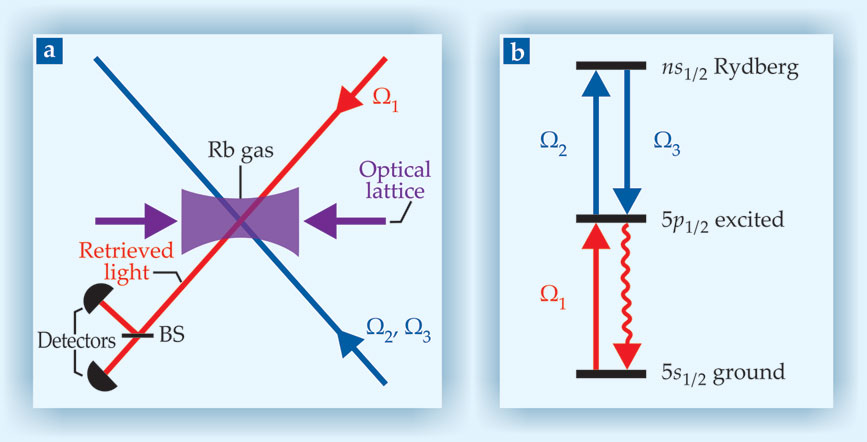
Figure 1 shows a schematic of the experiment. The Rb gas is held in a one-dimensional optical lattice 15 µm wide, where it’s illuminated with two excitation laser pulses: one (Ω1) to excite atoms from the ground state to an intermediate excited state, and the second (Ω2) to promote them from the intermediate state to a specified Rydberg state. After a delay, a readout pulse (Ω3) from the second laser brings any Rydberg atoms back to the intermediate state, from which they return to the ground state by emitting photons. Any such photons are sent through a beamsplitter into one of two detectors. The two-detector setup distinguishes one photon from two. When two (or more) photons are produced, they’ll sometimes register a count in each detector, but a single photon never will. From the fraction of the time that both detectors fire simultaneously, one can deduce the fraction of two-photon events.

Figure 1. (a) Experimental schematic and (b) energy-level diagram. A cold gas of rubidium-87 atoms is trapped in a one-dimensional optical lattice. Two laser pulses, Ω1 and Ω2, promote atoms from the ground state to a Rydberg state by way of an intermediate excited state. A third pulse Ω3, at the same wavelength as Ω2, brings any atoms in the Rydberg state back to the intermediate state. Each photon that those atoms emit as they decay back to the ground state is sent through a beamsplitter (BS) and into one of two detectors. If only one photon is produced at a time, the detectors should never fire simultaneously. (Adapted from ref.

But how does the emitted photon know to go in the direction of the detectors? That’s a consequence of the quantum nature of the system. Only one atom is excited to a Rydberg state, but it’s not known which one: The excitation amplitude spreads across all of the 500 or so possible atoms. If the delay between pulses Ω2 and Ω3 is short enough (less than a microsecond or two) for the atomic excitations to retain their coherent phase relationship, their emission amplitudes constructively interfere along the direction of the original Ω1 pulse, toward the detectors.
That coherence effect also provides a crucial additional suppression of two-photon events. One of the biggest challenges for Dudin and Kuzmich was choosing the right size for their sample. It had to be large enough to couple the retrieved light into a single output mode, but small enough that Rydberg interactions could reach from one end of the gas to the other. As it turned out, the 15-µm trap was not quite small enough to entirely prevent two atoms from being excited to Rydberg states simultaneously. But when two Rydberg excitations are present in the gas, they can interact, disrupt the phase coherence, and prevent either excitation from producing a photon that emerges in the desired direction.
Two-photon suppression
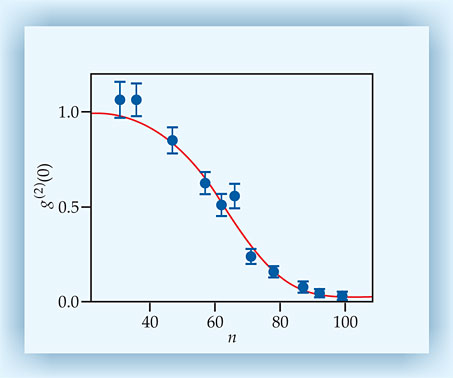
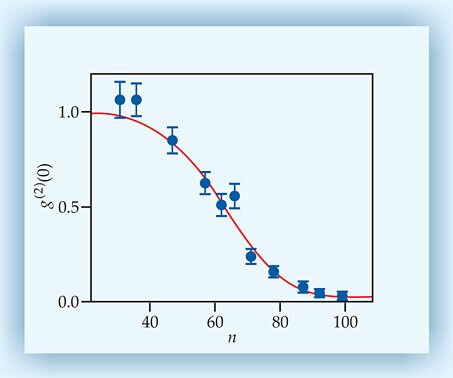
To illustrate the power of the Rydberg interactions, Dudin and Kuzmich repeated the experiment with the Rydberg-excitation laser tuned to different wavelengths, chosen to excite the atoms to states with different n. Figure 2 shows the results. For n less than 40, the valence-electron wavefunctions are too small to influence distant atoms, and g(2)(0) is no better than for a conventional source. But for n near 100, Rydberg interactions are much stronger, and two-photon events are suppressed by a factor of 25.

Figure 2. As the principal quantum number n of the Rydberg state is increased, multiphoton events become rarer. The second-order intensity correlation function, g(2)(0), measures the probability that two photons are produced at the same time, relative to a conventional source’s Poisson distribution. (Adapted from ref.
For any n ≥ 70, the probability of detecting even a single photon in a given repetition was just 2–3%. “That may sound small,” says Kuzmich, “but it’s also better than the other single-photon sources that have been explored for quantum applications.”
Because of background counts in the detectors, even a perfect single-photon source will yield a nonzero measured value of g(2)(0). Dudin and Kuzmich calculate that their detector background rate gives a lower bound for g(2)(0) of 0.025, compared with 0.040, the best value they measured. The researchers are working on increasing the probability of single-photon events, which would lower g(2)(0) further, even with the same detector background rate.
Beyond its usefulness as a single-photon source, Dudin and Kuzmich’s setup may find use in implementing photon–photon quantum gates. Photons are excellent carriers of quantum information, but their reluctance to interact with each other limits their applicability in processing that information. But if a photon could be stored as a Rydberg excitation, made to interact with other Rydberg excitations, and retrieved as a photon, that could overcome the difficulty.
References
1. Y. O. Dudin, A. Kuzmich, Science 336, 887 (2012). https://doi.org/10.1126/science.1217901
2. M. D. Lukin et al., Phys. Rev. Lett. 87, 037901 (2001). https://doi.org/10.1103/PhysRevLett.87.037901
3. E. Urban et al., Nat. Phys. 5, 110 (2009) https://doi.org/10.1038/nphys1178 ;
A. Gaëtan et al., Nat. Phys. 5, 115 (2009).https://doi.org/10.1038/nphys1183
More about the authors
Johanna L. Miller, jmiller@aip.org