Radioisotope Tracers Reveal Extensive Melting in Earth’s Distant Past
DOI: 10.1063/1.2117809
A fundamental assumption underlies our understanding of Earth’s composition: The abundance of elements and isotopes on Earth must reflect the primordial dust, rock, and colliding planetesimals that accumulated to form the planet. Primitive meteorites known as chondrites are thought to best represent that raw material condensed from the solar nebula. Scientists naturally expected the compositions of such meteorites to mirror Earth’s, especially in neodymium and other rareearth elements that are refractory enough to avoid boiling off the planet during its formation.
In the early 1980s, comparisons between the abundance ratios of neodymium isotopes found in chondrites and those measured in mantle samples and magma squeezed from Earth’s midocean ridges seemed to bear out that assumption. Within the bounds of experimental error, 142Nd/144Nd measurements in chondrites and the bulk Earth appeared the same, except for a few anomalous outliers in data from the oldest rock found in Greenland. 1
But mass spectrometry of isotope ratios bordered on the heroic back then, as researchers fought interference from cerium, samarium, and oxygen in their measurements. Prior to isotopic analysis, the essential task is to cleanly extract tiny amounts of the element to be analyzed using solvents that dissolve the ground-up meteorite, a process analogous to what cosmochemist Edward Anders has called “burning down the haystack to find the needle.”
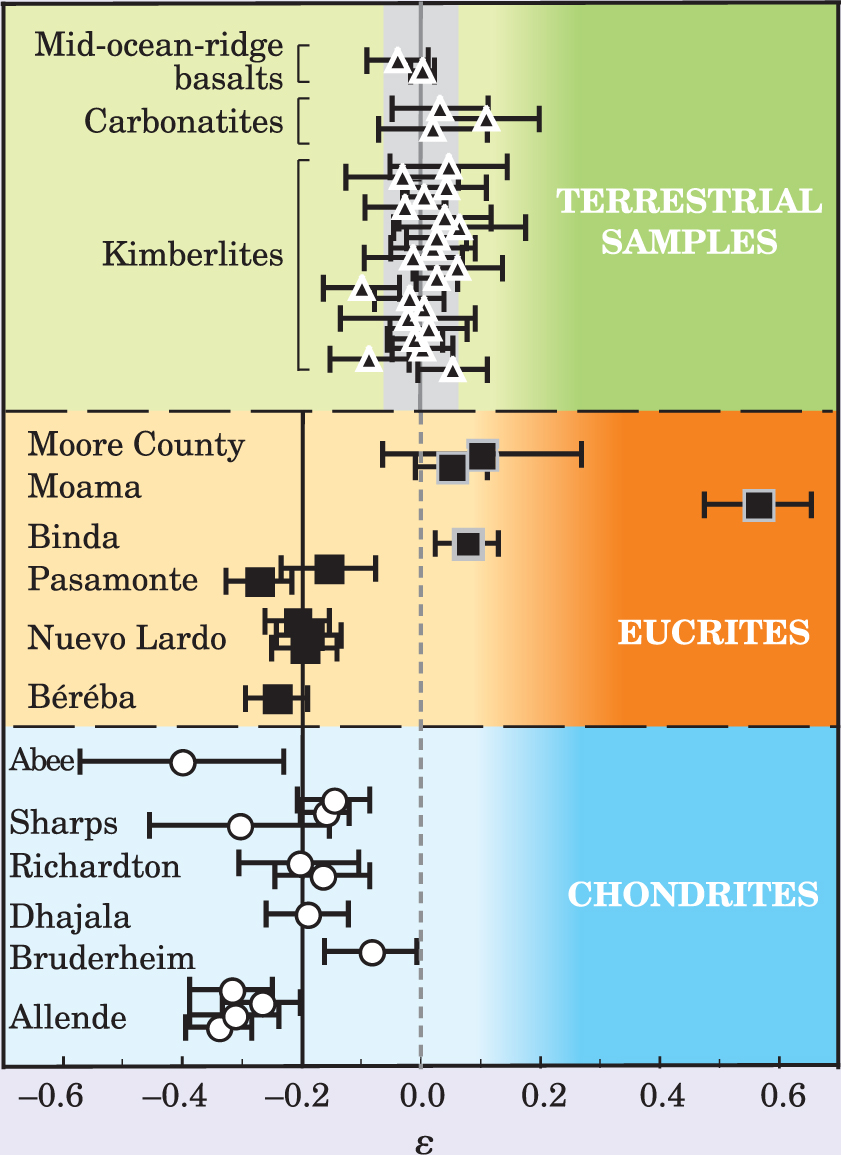
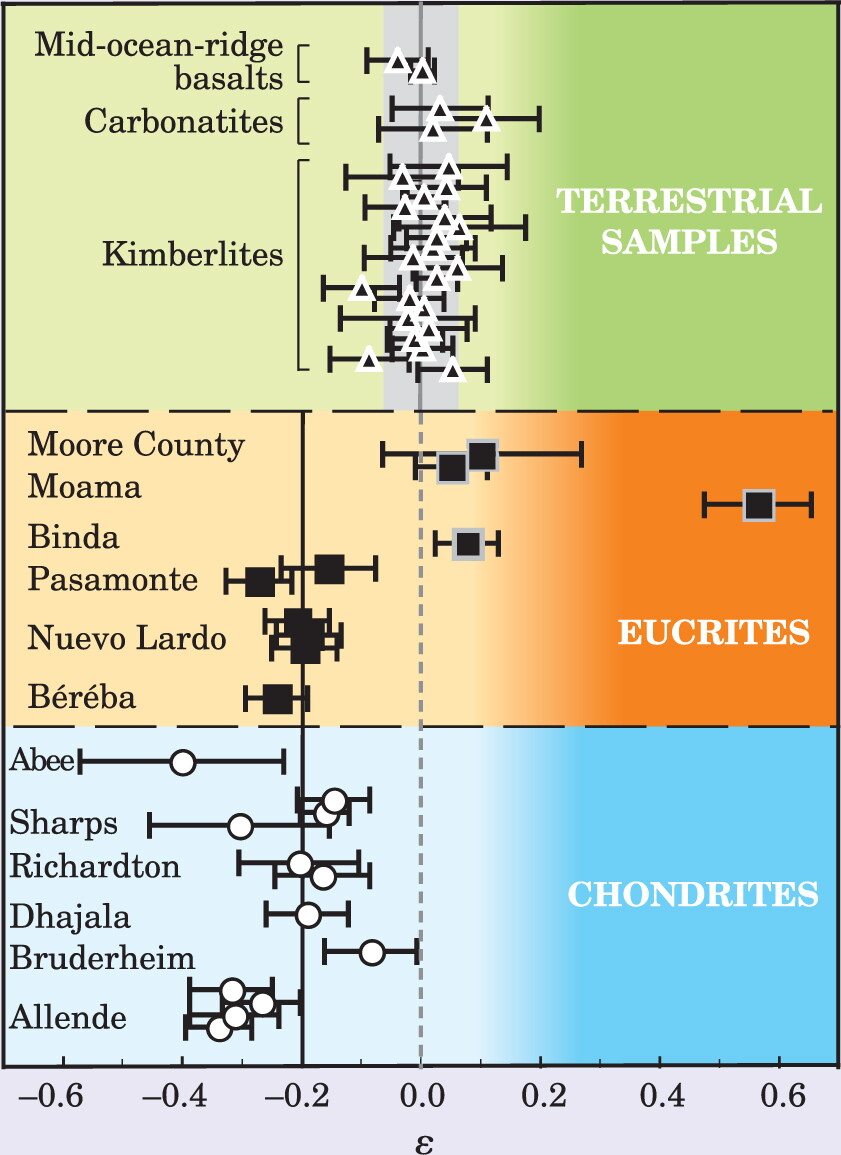
In 2003, working more extensively on the Greenland rocks, 2 Maud Boyet, then at École Normale Supérieure in Lyon, France, and colleagues confirmed that the data deviations reported a decade earlier may not have been so anomalous after all. A few of Earth’s oldest rocks apparently contained a genuine excess of 142Nd as compared to the modern Earth. Her more recent work with Richard Carlson at the Carnegie Institution of Washington, using a markedly improved spectrometer, did more than strengthen the suspicion. It showed something entirely new. The pair’s systematic measurements proved that an excess of 20 parts per million in the 142Nd content is actually ubiquitous in modern terrestrial samples when compared against their new, more precise data for chondrites (see figure 1). 3 That is, the neodymium isotope ratios in nearly all of Earth’s rock—not just a few of the oldest ones—appears to differ from what had long been presumed the standard compositional benchmark.

Figure 1. Differences in the isotopic abundance of neodymium-142. The parameter ε signifies the deviation in parts per 10 000 of the fractional amount of 142-Nd found in chondritic meteorites and eucrites as compared to terrestrial samples. Eucrites are a special type of meteorite—lavas from an asteroid formed just 4 million years after the solar system—and provide an independent check on the chondrite data. Samarium-146 decays to 142Nd with a half-life of 103 million years. The 20 parts-per-million lower signal in chondrites indicates that Earth’s mantle separated into chemically distinct reservoirs before the supply of 146Sm had fully decayed.
(Adapted from ref. 3.)
“When I read their paper, my head just went nuts,” confides Stanley Hart of Woods Hole Oceanographic Institution in Massachusetts. Either Earth was formed from stuff fundamentally different from chondritic meteorites, the building blocks of planets—unlikely, considering the hot, well-mixed conditions in the early solar system—or the part of Earth that geochemists have access to is not representative of Earth as a whole.
To preserve the idea of a chondritic Earth, Boyet and Carlson infer the existence of a hidden reservoir full of rock that is deficient in 142Nd to balance the complementary excess measured in chunks of mantle and volcanic lavas. For years, geochemists have struggled with the notion that a layer of chemically different material may exist between the core and the accessible mantle. Now they have a smoking gun.
Ancient melting
Earth’s oldest rocks date to roughly 4 billion years ago. Little direct evidence exists of what happened on Earth during the 500 million years prior to that time. According to current models, the heat of accretion and the decay of short-lived isotopes such as aluminum-26 during Earth’s first few million years was sufficient to at least partially melt the planet and separate light silicates from heavier metals. Isotopic variations can establish a chronometry for when those events occurred. Partial melting—the thermodynamic preference of “incompatible” elements for selectively dissolving in the melt—redistributes elements according to the size of the atom. For instance, the tungsten-hafnium system helped researchers settle the time scale for when the core formed—no later than 30 million years after the birth of the solar system. Siderophilic (iron-loving) tungsten dissolved into molten iron metal that drained into the core, leaving lithophilic (stone-loving) hafnium in the silicate mantle (see Physics Today, January 2003, page 16 ).
The samarium-neodymium system is similarly well suited for dating events in Earth’s distant past. Samarium-146 decays to 142Nd with a half-life of 103 million years. But unlike 182Hf–182W, both Sm and Nd are lithophilic and remain in the mantle. To relieve lattice distortion, Nd atoms dissolve into the silicate melt more readily than the comparatively smaller Sm atoms. The deviation in the abundance of stable 142Nd from chondritic values that Boyet and Carlson measure signals that the mantle differentiated chemically before the 146Sm vanished.
Fortuitously, another Sm parent isotope (147Sm) decays to another daughter isotope (143Nd) with a half-life of 106 billion years—20 times Earth’s age. Because the abundance of 142Nd correlates with the abundance of 143Nd, Boyet and Carlson could constrain the mantle differentiation to the first 30 million–50 million years of Earth’s history, possibly on the heels of core formation. Had the separation of Sm and Nd occurred later, the rapidly diminishing abundance of 146Sm would require a very high Sm/Nd ratio to produce the observed excess in 142Nd—so high, in fact, that correlated 143Nd abundances would turn out higher than what researchers actually measure in the lavas erupted from midocean ridges. The timing places Earth alongside the Moon and Mars as a body whose early evolution must have been very violent and involved a deep and global magma ocean. How else can one account for the enormous length scales across which the incompatible elements would need to be transported over so short a time to form a primordial crust?
Revising the standard model
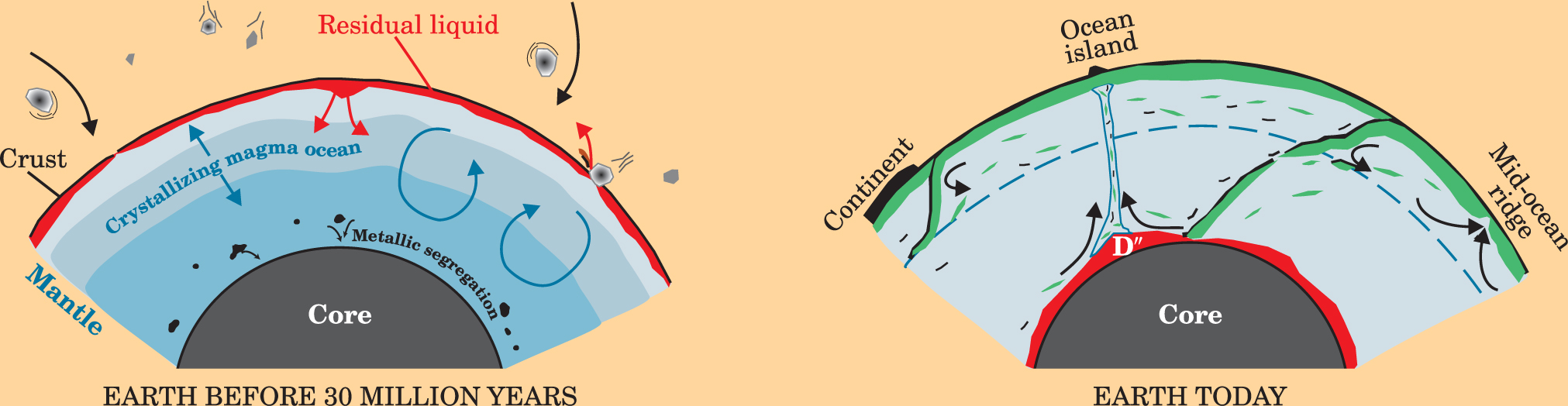
The measurements also prompt a revision in the standard model of mantle geochemistry. Traditionally, geochemists have presumed that the process of crust formation—the percolation of incompatible elements into the melt and their upward transport through cracks and grain boundaries as magma and molten rock—occurs over geological time. Estimates of the amount of mantle that would have to melt to form the continental crust range from a third to half, with the rest viewed as pristine, undepleted rock. But because incompatible elements got distilled into the melt during the first 1% of Earth’s lifetime to form a separate reservoir of material, Boyet and Carlson estimate that nearly all of the mantle has been depleted of melt (see figure 2).

Figure 2. Bombardment from meteors and the presence of short-lived isotopes produced enough heal to turn Earth’s mantle into a deep magma ocean during its first 30 million years, as pictured at left. Maud Boyet and Richard Carlson envision an early molten Earth crystallizing from the base of the mantle upward, with various incompatible elements that melt and subsequently diffuse throughout its layers. In the snapshot at left, the mantle is crystallizing into various structural phases—indicated in shades of blue—with a residual liquid (red) sitting just under a primordial crust. The thick hot crust cools, condenses, loses buoyancy, and sinks. Vigorous thermal convection mixes the composition of the upper and lower mantle. A reservoir of enriched heavy elements distilled from the early magma ocean and crust resides within today’s Earth (pictured at right), possibly within the thin layer at the core–mantle boundary known as D”. That layer, about 2700 km deep, deforms in response to subducting slabs of lithosphere—the rigid part of the tectonic plate (in green) composed of crust and cold viscous mantle—and rising plumes.
(Courtesy of Maud Boyet and Richard Carlson.)

Albrecht Hofmann (Max Planck Institute for Chemistry in Germany) speculates that the hidden reservoir is composed of ancient primordial crust formed out of the solidifying magma ocean. 4 It’s speculative but not unreasonable to imagine that the primordial crust is rich in radioactive elements like thorium, uranium, potassium, and rubidium. Like neodymium, those elements fit poorly into silicate structures and prefer a liquid phase, at least until they cool or recrystallize under pressure. He pro-poses that, by convection, the crust was again subducted into the mantle and somehow became buried on top of Earth’s core.
Isotopic measurements constrain time, not location. But one rationale for that placement, Hofmann argues, is that the early crust may have suffered phase changes in the mantle’s high pressures during subduction. The aluminum content within the crust drives the subduction: Feldspar, the low-density mineral that contains the aluminum, transforms into dense garnet at higher pressure. Heavy elements such as iron and titanium also would be enriched in the crust formed from a magma ocean and would add to the crust’s tendency to sink. Perovskite, the structure typical of silicates in the lower mantle, can accommodate no more than 15% iron. But researchers have recently identified a post-perovskite phase 5 that can accommodate as much as 80% iron in the silicate lattice deep in the mantle where pressures exceed 125 GPa and temperatures reach 2500 K. Silicate structures bloated with so much iron could never rise, no matter how high the temperature.
Seismic tomography indicates that the 200-km-thick region above the core-mantle boundary—the so-called D” layer—is extremely heterogeneous and the most likely location for a deep, dense reservoir. The velocities of seismic waves in that layer differ markedly from those in the region above it, a difference greater than can be attributable to temperature alone. A slight difference in density, though, would inhibit mixing or overturning of the layer with mantle above it (see Physics Today, August 1999, page 21 ). None of the magma that has erupted at Earth’s surface originated in a reservoir low in 142Nd.
A hidden reservoir also helps explain a decades-old discrepancy between the amount of heat geologists can account for by counting radioactive elements within the rocks they can get their hands on and the amount suggested by Earth’s steady cooling, argues Caltech’s David Stevenson. Earth’s heat output from radiogenic elements is estimated at about 20 terawatts, roughly half of the heat currently leaving Earth’s interior. An emerging technique that measures geoneutrinos recorded in large particle-physics detectors found a value consistent with that number and promises to put fundamental constraints on Earth’s radioactive budget. 6 (See page 9.)Boyet and Carlson estimate that the hidden layer, regardless of its size, would contain about 43% of Earth’s uranium, thorium, and potassium. Such a layer would generate about 9 terawatts of heat.
Moreover, the hot radioactive layer acts like a warm blanket around the core, the pair speculate. It could explain why the outer core has remained partly molten this late in Earth’s evolution and continues to generate the geomagnetic field. The deep layer could also be generating the hot spots that feed mantle plumes and create volcanic chains like Hawaii. With such varied implications, it’s no surprise that Woods Hole’s Hart expects “wall-to-wall neodymium-142 work” to emerge in the next couple of years.
References
1. S. B. Jacobsen, G. J. Wasserburg, Earth Planet. Sci. Lett. 67, 137 (1984) https://doi.org/10.1016/0012-821X(84)90109-2
C. L. Harper Jr, S. B. Jacobsen, Nature 360, 728 (1992) https://doi.org/10.1038/360728a0 .2. M. Boyet et al., Earth Planet. Sci. Lett. 214, 427 (2003); https://doi.org/10.1016/S0012-821X(03)00423-0
see also G. Caro et al., Nature 423, 428 (2003) https://doi.org/10.1038/nature01668 .3. M. Boyet, R. Carlson, Science 309, 576 (2005) https://doi.org/10.1126/science.1113634 .
4. I. Tolstikhin, A. W. Hofmann, Phys. Earth Planet. Inter. 148, 109 (2005) https://doi.org/10.1016/j.pepi.2004.05.011 .
5. W. L. Mao et al., Proc. Natl. Acad. Sci. USA 102, 9751 (2005) https://doi.org/10.1073/pnas.0503737102 .
6. T. Araki et al., Nature 436, 499 (2005) https://doi.org/10.1038/nature03980 .