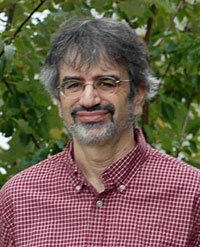
“Science fiction still has the power to thrill me much more than conventional literature ever has,” says Charles Adler, a physics professor at the liberal arts St. Mary’s College of Maryland who is not shy to acknowledge his love affair with the subject that forms the basis of his first book. Wizards, Aliens, and Starships: Physics and Math in Fantasy and Science Fiction (Princeton University Press, 2014) was reviewed by Princeton University mathematician Edward Belbruno in this month’s issue of Physics Today.
Charles Adler
Adler completed his postsecondary degrees, including his PhD in physics, at Brown University in Rhode Island. Before commencing his career in teaching, he was a postdoc at the Naval Research Laboratory in Washington, DC. His research is in the fields of atomic physics and atmospheric optics. He says that many of his 40 research papers were coauthored with undergraduate students.
Physics Today recently caught up with Adler to discuss Wizards, Aliens, and Starships.
PT: How do you square your interest in science fiction with your work as a serious scientist?
Adler: The best science fiction writers try to write their novels the same way in which theoretical physicists think up new theories: play by most of the rules of physics as we know it, but imagine perhaps one or two things a bit different. Because of that, I’m not sure that there is a conflict between loving science fiction and being a scientist. I. I. Rabi said that physicists are the Peter Pans of the human race; in many ways we view the world with the same excitement as children do, and children always have a big dose of fantasy in their worldview. There’s nothing wrong with that as long as you are clear which part is the fantasy.
PT: Similar books have already been written. What prompted you to write this one, and what distinguishes it from the others?
Adler: There are two things: First, it puts the math in. Books like The Physics of Star Trek (by Lawrence Krauss; Basic Books, 2007), or The Physics of Superheroes (by James Kakalios; Gotham Books, 2005), or The Physics of Christmas: From the Aerodynamics of Reindeer to the Thermodynamics of Turkey (by Roger Highfield; Little, Brown and Co, 1998), and so on, typically downplay the mathematics to broaden their appeal. There’s nothing wrong with that, but it makes it harder to separate out the highly speculative, unrealistic stuff from the more likely things. I wanted a book that someone could use as an instruction book if they wanted to write science fiction, but which is also entertaining for the general reader.
Secondly, I considered science fiction written works—novels and short stories— more than movies or TV shows, which are what most other works on this subject concentrate on. The advantage of this is that most serious science fiction authors, especially “hard” science fiction writers, make more of an attempt to get the science right than [is done in movies and TV shows], where the standard can be very low. This lets me focus more on things that are, perhaps, more realistic, or at least more possible, than are presented on a typical Star Trek episode. This isn’t to say that I don’t like science fiction on TV or in the movies; in my blog, “Wizards, Aliens, Starships and More,” I look at them. However, in the book I wanted to concentrate more on what was in print.
PT: In what ways do you think the book succeeds, and fails, as a teaching tool for physics?
Adler: I’ll take the failures first. Like any author, there are places where I goofed up. Little things mostly, like confusing input and output power for an engine when discussing flying cars, and a few others that need to be corrected in the next edition. I also think that my discussions are sometimes too complicated. Another issue is that there are no problems for students in the book, although we put companion problems for the book up on the Princeton University Press website.
I was happiest, and think the book succeeded best, in places where I could appeal to the deepest principles of physics and write, “yes, this is possible,” or “no, that isn’t.” The most fun part of the book to write was the last section on the potential survival of the human race for a googol years. Do I think we’ll really last that long? Of course not, but in wildly speculating like that I could write about some truly big ideas—Dyson spheres, highly advanced civilizations, and the ultimate fate of the universe—while tying things to well-known physics.
PT: The reviewer mentions your discussion of “disapparation.” Can you summarize how you conceived of the physics and math needed to evaluate that concept?
Adler: Disapparation, or teleportation, is one of those deeply problematic ideas one encounters in science fiction. My discussion of it stemmed from two earlier writings: Larry Niven’s essay “The Theory and Practice of Teleportation” and the first Star Trek novel ever written, Spock Must Die (James Blish; Spectra, 1985). That novel opens with Dr. McCoy and Scotty discussing the philosophical issue of whether someone who has used the transporter is the same person as before they used it. I don’t think he or she is. The transporter, and most conventional teleporters in science fiction, tears you apart before transporting your atoms somewhere else and putting them back together. To my mind, that first stage seems like murder… I just don’t think it’s possible.
Niven tried to rationalize a workaround by postulating a teleportation device that worked by somehow inducing macroscopic objects to quantum tunnel from one point to another one. My discussion was meant to show that this was unlikely because of the size of Planck’s constant, but I also discuss that there are macroscopic phenomena that are dependent on fundamental quantum behavior even though h is so small, so that maybe—although I doubt it very much—there might be some hope of teleportation via some weird quantum mechanism.
PT: Have you seen the new movie Interstellar starring Matthew McConaughey and Anne Hathaway and inspired by the work of theoretical physicist Kip Thorne? And do you discuss interstellar travel, black holes, or wormholes in your book? (See the Physics Todayreview of Interstellar here.)
Adler: I have a chapter on faster-than-light travel, time travel, black holes, and wormholes—it is strongly indebted to Kip Thorne’s work on the subject. To the best of my knowledge, he’s the first physicist to suggest a remotely plausible method for faster-than-light travel. In general, I think it’s good for scientists to get involved with TV shows and movies; David Saltzberg, a UCLA physicist, is the science consultant for the TV show The Big Bang Theory, which is why the show gets the science so right so often.
In answer to the rest of the question, I saw the movie and have mixed feelings about it. I don’t know how directly Dr. Thorne was involved with it, but the director and writers clearly paid some attention to science. The use of relativity, especially of time dilation, was handled very well, and is an integral part of the plot. Some of the space travel, especially past the wormhole, seems not to have been thought out very carefully, and there’s one bad misuse of Newton’s third law toward the end. I’ll let the readers spot it for themselves rather than spoiling it.
I will spoil one thing, which is that my biggest disappointment was the deus ex machina ending, which seemed to throw out the window the careful science that had characterized much of the rest of the movie.
PT: What is one concept in fantasy or science fiction from your youth that has become a reality, or will be so soon?
Adler: One odd one is the smartphone. Larry Niven and Jerry Pournelle had characters in the novel The Mote in God’s Eye (Pocket Books, 1974) carrying around these communication devices connected to a central computer which they could store videos, sound, and images on, do calculations, and call other people with, and that fit into your pocket. It was pretty much a throwaway concept in the book; Niven wrote in an article in Galaxy magazine that he and Pournelle wanted to make sure that the characters could always pull up any information that they needed whenever they wanted it, so they thought up a device to let them do it. There are a bunch of other small things—automatic doors, electric cars (just now becoming viable!), the beginnings of genetic engineering applications in medicine.
What I find more interesting are the things that didn’t happen, the top of the list being cheap, easy space travel for the masses. Others are artificial intelligence, commercially viable fusion energy, and flying cars. It’s interesting how we got the things that no one anticipated and didn’t get what everyone was expecting, at least as far as science fiction norms went.
PT: What books are you currently reading?
Adler: I’m reading The Magician’s Land (Viking Press, 2014) by Lev Grossman, the third and final book in his Magicians trilogy. It’s a wonderful fantasy story; he clearly knows something about physics. My kids and I are reading Rick Riordan’s The Blood of Olympus (Disney–Hyperion, 2014), which is the final book in the Heroes of Olympus series. No serious science in them, but the author knows his Greek and Roman myths cold. As far as future reading goes, one of these days I’d like to be reading a science fiction or fantasy novel I wrote myself.