Proposed sea vessel offers science on the drift
DOI: 10.1063/PT.3.2239
Half ship, half submarine, the 58-meter-tall SeaOrbiter aims to simultaneously be a floating laboratory, a hangar for underwater vehicles, and a training base for aquanauts. Based in France, the project has a specific objective to “enable [researchers and explorers] to live underwater for long periods of time,” says oceanographer Ariel Fuchs, executive director of the project. The oceanic research and exploration vessel took more than 12 years to plan. Construction is scheduled to begin this spring and, including integration of the initial scientific and communications equipment, is expected to cost $52 million and take 12 to 18 months. The maiden voyage—from Nantes near the Atlantic coast of France to Monaco on the Mediterranean—is scheduled for the spring of 2016.
The project is sponsored by a mix of commercial and other nongovernmental partners from around the world and managed by experts from the ocean- and space-exploration communities. SeaOrbiter can accommodate up to 22 crew members, who will rotate every three to four months. Annual operation costs are estimated at $3.4 million. An international scientific committee led by physicist Charles Kennel, director emeritus of the Scripps Institution of Oceanography, will be responsible for choosing and prioritizing the vessel’s scientific missions and instrumentation.
Fuchs concedes that the project, whose partners include watchmaker Rolex and defense contractor European Aeronautic Defense and Space, faces a “struggle against skepticism, [particularly] from French academics who have differing visions and who don’t necessarily appreciate the politics of privately sponsored science expeditions.” And few potential private partners want to “invest in an adventure that is so exploratory, scientific, and educational,” he adds.

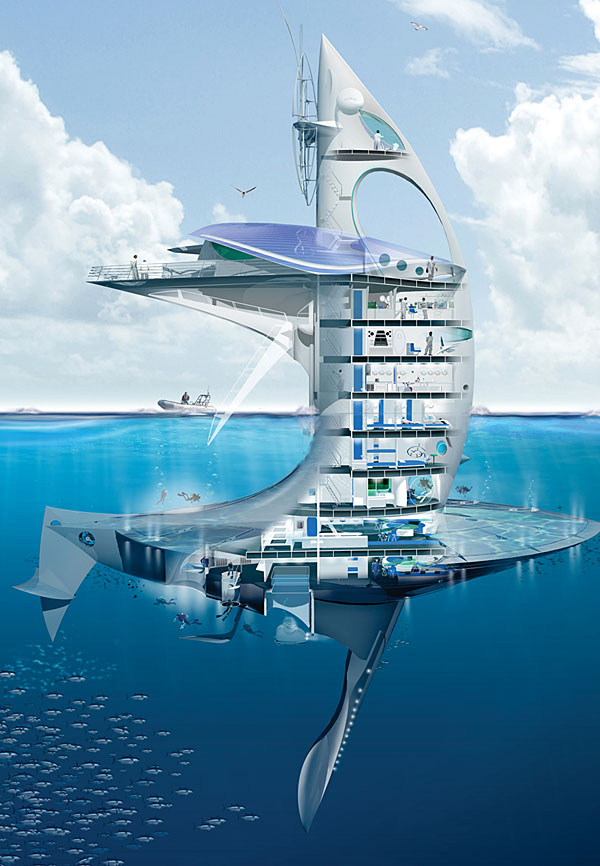
From above and below the waterline, SeaOrbiter will give scientists firsthand access to the ocean–atmosphere interplay.
SEAORBITER/JACQUES ROUGERIE

Attracted by the Eye
The brainchild of French architect and ocean explorer Jacques Rougerie, SeaOrbiter’s design places 6 of its 10 levels, including all living quarters, below the waterline. The underwater levels also include a hangar for autonomous and manned underwater vehicles. The pressure of the lowest level, 12 meters below the waterline, can be adjusted to match deep-sea pressures. That feature allows deep-sea explorers and astronauts simulating space exploration to live for prolonged periods at deep-sea conditions and avoid the health risks of returning too quickly to atmospheric pressure.
Situated above the waterline are avian- and marine-life observation decks, meteorological instruments, and multidisciplinary research labs. Near the top of the vessel is SeaOrbiter’s “Eye,” a lookout post and public communications platform. At the end of last year, the project team launched a crowdfunding campaign to raise €325 000 ($440 000) to fund the Eye’s construction. Fuchs says the campaign’s goals are to attract both additional funding partners and the public’s interest.
Like unmanned research buoys moving on the ocean current, SeaOrbiter can “operate in drift mode,” quietly conducting science with minimal disturbance to its environment, says SeaOrbiter operations director William Todd, who also leads the NASA Extreme Environment Mission Operations program. The vessel’s energy demands will be provided by a wind turbine, a solar panel, wave-energy converters, and algae-based biofuel generators.
Sea-level climatology
SeaOrbiter will be outfitted with active and passive acoustic and optical instrumentation and other sensors to measure the ocean’s physical properties. (For more on ocean sensing, see the article by Tom Sanford, Kathie Kelly, and David Farmer in Physics Today, February 2011, page 24 .) Much of the science will be focused on “climate problems and issues of global warming on the ocean,” says Fuchs. Scientists aboard SeaOrbiter can continuously measure such air–ocean interfacial properties as CO2 concentration, marine-aerosol concentration, and heat and gas flux. According to a report written by the Kennel-led science committee, such data can supplement oceanographic-satellite and research-buoy observations used to model the climate and the global carbon cycle. Other investigations envisioned for SeaOrbiter include physiological and psychological studies of aquanauts and ocean-floor mapping for mineral exploration.
“During the 1960s, both space and our oceans were seen as the new frontiers for exploration,” says NASA oceanographer Gene Carl Feldman. He has conducted historical research on the PX-15/Ben Franklin, a privately sponsored research submarine whose mission, led by Swiss deep-sea explorer Jacques Piccard, coincided with, and was largely overshadowed by, the Apollo 11 Moon-landing mission. “My hope is that SeaOrbiter can help rekindle the dream of long-term exploration of our oceans,” Feldman says.