Projected R&D Cuts Alarm Science Community
DOI: 10.1063/1.1801862
At the 8 July press conference during which the Union of Concerned Scientists unleashed its latest broadside of charges claiming misuse and abuse of science within the Bush administration, a reporter asked UCS Board Chairman Kurt Gottfried if the complaints didn’t really stem from a perceived lack of federal funding for much of science. After all, the reporter said, Office of Science and Technology Policy Director John Marburger has repeatedly pointed to record R&D spending by the administration.
Gottfried suggested that the reporter carefully look through the UCS report. “I believe … you will find that the word ‘funding’ doesn’t appear,” he said. The issue, he continued, is the distortion of science, not its funding.
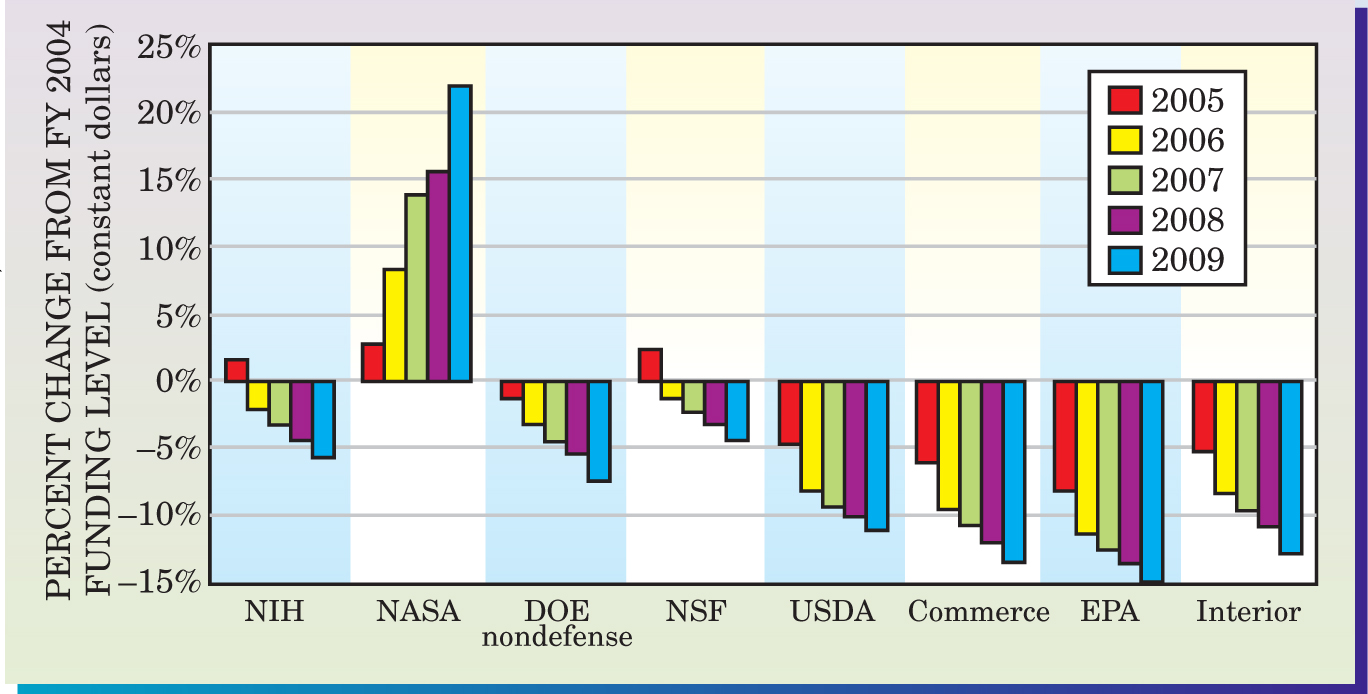
Although that is true of the UCS report, there is wide-spread concern in the science community about the administration’s funding of the sciences—particularly the physical sciences. Henry Kelly, president of the Federation of American Scientists (FAS), said that concern was heightened even further by an American Association for the Advancement of Science (AAAS) analysis of the administration’s science funding projections. That analysis, based on numbers in an Office of Management and Budget (OMB) memo leaked to the media in late May, portrays a bleak five years for almost all nondefense science funding and, according to several scientists, has played a role in mobilizing many in the scientific community against the administration.
The AAAS analysis states its key finding this way: “The Bush Administration’s plan to reduce the federal deficit in half over the next five years would cut R&D funding for 9 out of the 12 largest R&D funding agencies in real terms over the next five years, with the steepest cuts in [fiscal year] 2006 after this year’s election.” Administration officials say the projections don’t accurately reflect future budget requests. An OSTP official pointed to FY2002 projections for science agencies that showed FY 2005 numbers that were significantly lower than the administration actually proposed in its latest budget. Despite the administration’s claims, the AAAS analysis concludes that if the OMB guidelines are followed, “nondefense R&D outside NASA and DHS [Department of Homeland Security] would decline steeply in FY 2006 unless there is either a change in the White House or a major change in Bush Administration policy.”
Some of the AAAS highlights reveal the nature of the proposed cuts, all adjusted for expected inflation:
The nondefense R&D portfolio, excluding NASA and DHS increases, would fall by 6. 7%.
Over the five-year period, National Institutes of Health funding—which was doubled between 1998 and 2003—would fall by 5. 8%.
The Office of Science R&D budget at the Department of Energy, flat for the past four years, would fall 9. 5%. Intense efforts by physicist Burton Richter and other American Physical Society members over the past two years to boost that funding were credited by Energy Secretary Spencer Abraham with “avoiding a doomsday scenario.”
The NSF budget would see a slight boost in FY 2005, but by 2009 would fall by 4. 7%.
“If you look at the AAAS research forecast,” Kelly said, “basically everything takes a knock except NASA, homeland security, and defense, and even in defense the basic research funds are under attack. There really is a legitimate concern about whether the pipeline is continuing to be filled. You have to look to the future and ask, Are we jeopardizing our leadership—not this year, but two years from now, or a decade from now?”

AAAS, BASED ON OMB DATA