President Obama’s FY 2016 R&D budget would surpass spending caps
DOI: 10.1063/PT.3.2746
For his penultimate year in office, President Obama proposes to shrug off the austerity that has dominated federal spending politics for the past few years and instead attend to what he believes to be urgent needs in national infrastructure, R&D, advanced manufacturing, and other areas.
The White House 2016 budget request would provide $146 billion government-wide for R&D, an $8 billion, or 6%, increase from 2015 enacted levels. Of that funding, $67 billion is for basic and applied research, a $2 billion, or 3%, increase from 2015 enacted levels. The basic research request is $33 billion, also a 3% increase from current-year funding. The request includes $69 billion for nondefense R&D and $77 billion for defense R&D.
But to make his proposal happen, or for any increases at all to become law, the president will need to convince the Republican-controlled Congress to scrap the mandatory, across-the-board cuts on discretionary spending that lawmakers enacted four years ago. For fiscal year 2014, and again in the current year, the White House and Congress agreed to add billions to the spending caps established in the Budget Control Act of 2011. Without similar action, the caps, known as sequestration, will return with a vengeance.
The caps due to resume in FY 2016 “do not provide sufficient resources for national security, domestic investments, and core Government functions that are required to ensure the Nation is achieving its full potential in a growing economy,” cautioned a report issued on 2 February by the White House Office of Management and Budget (OMB) to the president and Congress. It also said, however, that the president’s budget would restore funding to required levels.
In the report, whose delivery coincided with the release of Obama’s budget proposal, OMB director Shaun Donovan warned Congress that if lawmakers don’t act, federal agencies will be forced to cut their FY 2016 budgets by $90 billion from this year’s level—$36.6 billion, or 4.1%, from nondefense programs and $54 billion, or 10.7%, from defense. If past experience is any guide, the fiscal drama between the executive and legislative branches is likely to play out up to, or beyond, the 1 October deadline.
In announcing Obama’s R&D budget proposal, his science adviser, John Holdren, said the president was investing in America’s future, which, “among other things, includes investing in innovation, in the infrastructure, and transforming information into wide benefit.” But he cautioned that in the current budget climate, “not everything that is desirable is affordable.”
The proposed R&D increases are unevenly distributed among agencies. The National Institutes of Health, for example, which accounts for roughly half of nondefense R&D spending, would grow by just 3.2% from its FY 2015 level, despite biomedical research advocates’ persistent complaints that, with the exception of a two-year respite afforded by the American Recovery and Reinvestment Act, the NIH budget has been declining in real terms ever since a vaunted five-year budget doubling was completed 12 years ago.

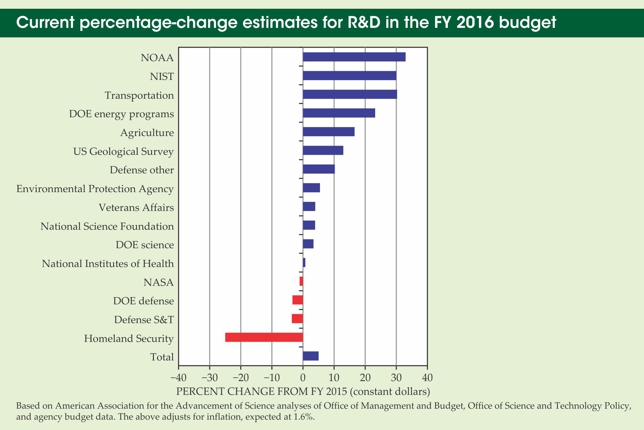
Federal funding for R&D would increase by 6% under President Obama’s fiscal year 2016 budget request. The request would devote $67 billion to basic and applied research, a 3% increase from the FY 2015 level. Defense-related R&D would total $77 billion, while the nondefense request is $69 billion. By agency, year-to-year changes would vary sharply, from the 33% increase for the National Oceanic and Atmospheric Administration to a 25.8% decrease at the Department of Homeland Security. The request includes $7.4 billion for clean-energy-related research, mainly at the Department of Energy. DOE’s basic research budget would rise 5.4%.

The Department of Energy’s R&D, on the other hand, would increase 19%, while the much smaller R&D programs at the National Oceanic and Atmospheric Administration would surge 33%. Department of Homeland Security programs would plummet 25.8% compared with the administration’s FY 2015 request.
Among the administration’s R&D priorities is manufacturing, for which it requests a total of $2.4 billion, mostly at the Department of Defense, DOE, NSF, NIST, and NASA. That includes $350 million to create seven new manufacturing innovation institutes to join the nine previously established. (See Politics and Policy, 13 October 2014 , on Physics Today’s website.) Ultimately, the administration wants to fund 45 such institutes, but the remaining ones would be financed through a proposed new mandatory spending account, a budgetary mechanism that Congress has consistently rejected. Obama’s manufacturing programs also include R&D on robotics and a materials genome program that aims to speed the development of new materials designed for specific applications.
The administration continues to draw attention to the three main sources of federal support for the physical sciences: DOE’s Office of Science, NSF, and NIST’s laboratory programs. Obama initially committed to doubling the budgets of those programs over 10 years, as did the George W. Bush administration, but neither president provided the annual increases needed to accomplish that goal. That pledge quietly disappeared with the FY 2015 budget request. Collectively, the budgets of those three programs would increase by $700 million, or 5.3%, to $13.9 billion in FY 2016.
The National Nanotechnology Initiative, which involves 20 federal agencies, would total $1.5 billion, unchanged from its FY 2015 level. The $3 billion requested government-wide for science, technology, engineering, and mathematics (STEM) education represents a 3.6% increase from the current year.
Other government-wide administration spending priorities include the 13-agency US Global Change Research Program, for which $2.7 billion is requested. That is $200 million above this year’s spending. Some $7.4 billion is requested for clean energy R&D, three-quarters of which would go to DOE.
Following are some highlights of the request for agencies that fund the bulk of R&D in the physical sciences.
Department of Energy
As the largest federal funder of physical sciences, DOE would see its R&D funding increase 19.2%, according to Physics Today’s analysis. By far the biggest increase in the department is for the energy efficiency and renewable energy (EERE) programs, which would rise 42.3%, to $2.7 billion. Within EERE, the budget increases funding by 32% above 2015 levels for alternative vehicle and fuel technologies, by 60% for energy efficiency and advanced manufacturing activities, and by 41% for innovative renewable-power projects. Congress has routinely slashed the administration’s requests for EERE programs.
Funding for the national security R&D programs of DOE’s National Nuclear Security Administration would move up 4.8%, to roughly $3.1 billion. But the inertial-fusion program would decline by 2.1%. The Mixed Oxide Fuel Fabrication Facility at the Savannah River Site in South Carolina would receive $345 million, the same as the current year. Energy secretary Ernest Moniz told reporters that DOE is following a congressional directive to continue the construction of the facility while the department awaits the results of an external analysis of potentially lower-cost alternatives to disposing of DOE’s surplus weapons plutonium. The administration last year proposed to mothball the well-over-budget plant.
The department has identified six research focus areas that are relevant to multiple program offices. Those crosscutting programs are subsurface science and engineering, grid modernization, energy–water nexus, exascale computing, cybersecurity, and supercritical carbon dioxide technology. Collectively, they account for $1.2 billion in R&D, and each is coordinated by the programs and the national laboratories that perform the research.
The Office of Science, which funds basic, nonweapons research, would move up 5.4%, to more than $5.3 billion. Each of its individual programs would get an increase except fusion energy sciences, which would drop 10.2%. Patricia Dehmer, acting director of the Office of Science, told reporters that Congress had increased the FY 2015 request and that the FY 2016 figure is a little higher than what the administration asked for in 2015. The $150 million requested for ITER, the international project to build a fusion reactor, is the same as last year, as the administration awaits a new project cost and schedule baseline due for completion this summer, she said. (See Physics Today,February 2014, page 20 .)
Included in the nuclear-physics budget is $100 million for constructing the Facility for Rare Isotope Beams at Michigan State University. That is a $10 million increase from the current year. The 12-GeV upgrade of the Continuous Electron Beam Accelerator Facility at Jefferson Lab would get $7 million, as the project nears its scheduled completion. Construction funding for the Linac Coherent Light Source II at SLAC would increase 35.3%, to $200 million.
The high-energy physics request includes $20 million for the Long- Baseline Neutrino Facility, which will evaluate transformations in muon neutrinos in a beam originating at Fermilab and traveling to a detector in South Dakota 1300 km away. In addition to $16 million in construction funds—up $4 million from the current year—another $4 million is requested for modifying the preliminary design to accommodate international participation in the project. The goal is to “achieve enhanced scientific capability through non-DOE contributions,” according to budget documents. (See the story on page 22 .)
The high-energy request also includes $40 million for construction of the Muon to Electron Conversion Experiment at Fermilab, a $15 million increase from the current year. Civil construction of the experiment, which will utilize a proton beam to produce muons and determine whether those muons can change into electrons, is scheduled to begin this year.
A 15% increase in the budget for advanced scientific computing research would support new research and partnerships working toward exascale computing. The leadership computing facilities at Argonne and Oak Ridge National Laboratories are scheduled for upgrades to the 75–200 petaflops range beginning in 2017.
More than $900 million of the Office of Science request is for basic research on clean-energy projects.
The administration proposes a new carbon capture and storage demonstration plant that will address natural-gas-fired electricity generation. At the same time, FutureGen, a long-stalled, cost-shared, coal-fired demonstration plant meant to capture and sequester CO2 underground, was abandoned. Federal funding from the American Recovery and Reinvestment Act was set to expire in October, and litigation and other problems with the project will prevent use of the money before that deadline.
In another bid to accelerate commercial deployment of carbon capture and storage and spur development of new carbon-reducing technologies, the administration proposes two new tax credits. One would authorize $2 billion in refundable investment tax credits for electricity-generating plants that install carbon capture technology to permanently store CO2. The second proposal would provide for qualifying facilities a 20-year, refundable sequestration tax credit of $10 per metric ton if they use the captured CO2 beneficially (such as in enhanced oil recovery), or $50 per ton if they permanently store the CO2.
The Advanced Research Projects Agency–Energy, which supports research on high-risk, potentially high-payoff clean-energy technologies, would receive $325 million, 16.1% more than in the current year.
The $270 million requested for the electricity delivery and energy reliability program is $123 million, or 83.8%, above the FY 2015 level. The increase would step up grid modernization efforts and add $52 million for R&D on increasing grid cybersecurity.
The budget request includes $248 million to resume operations at the Waste Isolation Pilot Plant in New Mexico following last year’s shutdown of the underground transuranic waste repository after a fire and a radiation leak. Full-scale operations at the plant won’t occur until 2017, Moniz said.
| Department of Energy R&D programs | |||
|---|---|---|---|
| FY 2015 actual | FY 2016 request | FY 2015–16 percent change | |
| (millions of dollars)* | |||
| Total DOE | 27 403 | 29 924 | 9.2 |
| DOE R&D | 11 068 | 13 196 | 19.2 |
| Office of Science | 5 068 | 5 340 | 5.4 |
| Total high-energy physics (HEP) | 766 | 788 | 2.9 |
| Energy frontier experimental physics | 148 | 155 | 4.7 |
| Research | 79 | 79 | 0.1 |
| Facilities | 54 | 57 | 5.4 |
| Projects | 15 | 19 | 26.7 |
| Intensity frontier experimental physics | 264 | 247 | −6.4 |
| Research | 55 | 56 | 1.3 |
| Facility operations and experimental support | 165 | 158 | −4.5 |
| Projects | 44 | 34 | −23.3 |
| Cosmic frontier experimental physics | 107 | 119 | 11.6 |
| Research | 49 | 50 | 1.5 |
| Facility operations and experimental support | 12 | 10 | −10.9 |
| Projects | 46 | 59 | 28.4 |
| Theoretical and computational physics | 59 | 60 | 1.7 |
| Research | 58 | 58 | 0.1 |
| Theory | 50 | 50 | −0.1 |
| Computational HEP | 8 | 8 | 1.0 |
| Projects | 1 | 2 | 100.0 |
| Advanced technology R&D (accelerators and detectors) | 120 | 115 | −4.1 |
| Research | 90 | 83 | −7.3 |
| HEP general accelerator R&D | 45 | 40 | −12.2 |
| HEP directed accelerator R&D | 23 | 21 | −4.7 |
| Detector R&D | 22 | 22 | — |
| Facility operations and experimental support | 30 | 32 | 5.6 |
| Accelerator stewardship | 10 | 14 | 40.0 |
| Construction | 37 | 56 | 51.6 |
| Long-Baseline Neutrino Facility | 12 | 16 | 33.3 |
| Muon to Electron Conversion Experiment | 25 | 40 | 60.0 |
| SBIR/STTR | 21 | 21 | 1.6 |
| Total nuclear physics | 595 | 625 | 4.9 |
| Medium-energy nuclear physics | 151 | 158 | 4.7 |
| Research | 36 | 38 | 7.7 |
| Operations | 97 | 100 | 3.1 |
| SBIR/STTR and other | 18 | 19 | 7.1 |
| Heavy-ion nuclear physics | 200 | 211 | 5.7 |
| Research | 34 | 36 | 7.5 |
| Operations (primarily RHIC) | 166 | 175 | 5.3 |
| Low-energy nuclear physics | 75 | 80 | 6.1 |
| Research | 48 | 52 | 7.7 |
| Operations | 27 | 28 | 3.1 |
| Nuclear theory | 43 | 46 | 7.2 |
| Isotope development and production | 20 | 22 | 9.1 |
| Construction | 106 | 107 | 0.9 |
| CEBAF upgrade | 16 | 7 | −54.5 |
| Facility for Rare Isotope Beams | 90 | 100 | 11.1 |
| Total fusion energy sciences | 467 | 420 | −10.2 |
| Burning plasma science: Foundations | 216 | 192 | −11.2 |
| Burning plasma science: Long pulse | 39 | 31 | −20.6 |
| Discovery plasma science | 62 | 47 | −24.2 |
| ITER | 150 | 150 | — |
| Total basic energy sciences | 1 733 | 1 849 | 6.7 |
| Materials sciences | 352 | 362 | 3.0 |
| Chemical sciences, geosciences, and energy biosciences | 304 | 311 | 2.3 |
| Energy frontier research centers | 100 | 110 | 10.0 |
| Energy innovation hubs | 39 | 39 | — |
| Total scientific user facility operations | 877 | 922 | 5.1 |
| Advanced Light Source, LBNL | 60 | 63 | 4.5 |
| Advanced Photon Source, ANL | 125 | 130 | 4.5 |
| National Synchrotron Light Source, BNL | 5 | 0 | −100.0 |
| National Synchrotron Light Source II, BNL | 90 | 110 | 21.7 |
| Center for Nanophase Materials Sciences, ORNL | 23 | 24 | 4.5 |
| Center for Integrated Nanotechnologies, SNL/LANL | 21 | 22 | 4.5 |
| Molecular Foundry, LBNL | 26 | 28 | 4.5 |
| Center for Nanoscale Materials, ANL | 23 | 24 | 4.5 |
| Center for Functional Nanomaterials, BNL | 20 | 21 | 4.5 |
| Stanford Synchrotron Radiation Laboratory, SLAC | 39 | 41 | 4.5 |
| High Flux Isotope Reactor, ORNL | 61 | 63 | 4.5 |
| Manuel Lujan Jr Neutron Scattering Center, LANL | 2 | 2 | — |
| Spallation Neutron Source, ORNL | 181 | 190 | 4.5 |
| Linac Coherent Light Source, SLAC | 127 | 133 | 4.5 |
| Major equipment, research | 74 | 71 | −15.7 |
| Construction | 148 | 200 | 35.3 |
| Linac Coherent Light Source II, SLAC | 148 | 200 | 35.3 |
| SBIR/STTR | 50 | 55 | 8.7 |
| Advanced scientific computing research | 541 | 621 | 14.8 |
| Biological and environmental research | 592 | 612 | 3.4 |
| Science laboratories and infrastructure | 80 | 114 | 42.7 |
| Program direction | 184 | 187 | 2.0 |
| Workforce development for teachers and scientists | 19 | 20 | 5.1 |
| Safeguards and security | 93 | 103 | 10.7 |
| Advanced Research Projects Agency–Energy | 280 | 325 | 16.1 |
| Fossil energy R&D | 561 | 560 | −0.1 |
| Nuclear energy R&D | 833 | 908 | 8.9 |
| Energy efficiency and renewable energy R&D | 1 914 | 2 723 | 42.3 |
| Electricity delivery and energy reliability | 147 | 270 | 83.8 |
| Total National Nuclear Security Administration R&D | 2 912 | 3 053 | 4.8 |
| Total weapons science, technology, and engineering | 1 952 | 2 003 | 2.6 |
| Science campaigns | 412 | 390 | −5.5 |
| Engineering campaigns | 136 | 131 | −3.4 |
| Advanced simulation and computing | 598 | 623 | 4.2 |
| Inertial confinement fusion | 513 | 502 | −2.1 |
| Directed stockpile work R&D† | 185 | 226 | 22.2 |
| Advanced manufacturing development | 107 | 130 | 21.3 |
| Nonproliferation and verification R&D | 393 | 419 | 6.6 |
| Naval reactors R&D | 567 | 631 | 11.3 |
| Environmental management R&D | 14 | 17 | 23.5 |
| * Figures are rounded to the nearest million. Changes are calculated from unrounded figures. † Includes the R&D support and R&D certification and safety items of the directed stockpile work program. ANL, Argonne National Laboratory. BNL, Brookhaven National Laboratory. CEBAF, Continuous Electron Beam Accelerator Facility. LANL, Los Alamos National Laboratory. LBNL, Lawrence Berkeley National Laboratory. ORNL, Oak Ridge National Laboratory. RHIC, Relativistic Heavy Ion Collider. SBIR, Small Business Innovation Research. SNL, Sandia National Laboratories. STTR, Small Business Technology Transfer. | |||
NSF
A proposed 5.2% increase for NSF would take its budget to $7.7 billion. The education and human resources division would receive the biggest relative increase—11.2%—to $963 million. Funding for research and related activities, the source of NSF’s peer-reviewed, investigator-initiated research grants, would rise 4.3%, to $6.2 billion. Mathematical and physical sciences would see an increase of 2.2%, to $1.4 billion. A new $75 million, cross-foundation focus on innovations at the nexus of food, energy, and water systems would be established, with participation from NSF’s science, engineering, and social sciences programs.
Among other NSF-wide priorities, the budget proposes $377 million in research and education for renewable energy (solar, wind, wave, and geothermal) and alternative fuels, a 2% increase from FY 2015. Cyber-enabled materials, manufacturing, and smart systems would receive $257 million, an 11% increase over the previous year. But science, engineering, and education for sustainability and understanding humans’ impact on the natural world would plunge 42%, to $80.5 million, in preparation for the program’s termination in 2017.
Funding for the 8-meter, wide-field Large Synoptic Survey Telescope would increase to $100 million, from $80 million, for the third year of its scheduled nine-year construction phase. The NSF request also includes $81 million for the National Ecological Observatory Network, a reduction from the $96 million in the current year. The national network consists of 106 environmental monitoring stations that measure and predict the impacts of changing climate and land use and the effects of invasive species.
A 9.2% increase, to $355 million, is requested for agency operations and award management. The bulk of that increase is for the relocation of NSF headquarters from Arlington, Virginia, to Alexandria, Virginia, and for a cost-of-living adjustment for employees.
The two-year-old NSF-wide initiative on improving undergraduate STEM education would receive a 27.7% increase, to $135 million. The program goals are to increase the number, broaden the diversity, and improve the undergraduate preparation of STEM professionals.
| NSF R&D programs | |||
|---|---|---|---|
| FY 2015 actual | FY 2016 request | FY 2015–16 percent change | |
| (millions of dollars)* | |||
| Total NSF | 7 344 | 7 724 | 5.2 |
| Research and related activities (R&RA) | |||
| Mathematical and physical sciences (MPS) | |||
| Mathematical sciences | 232 | 235 | 1.6 |
| Astronomical sciences | 244 | 247 | 1.0 |
| Physics | 275 | 277 | 0.9 |
| Chemistry | 244 | 251 | 3.0 |
| Materials research | 307 | 316 | 2.9 |
| Multidisciplinary activities | 35 | 40 | 13.8 |
| Total MPS | 1 337 | 1 366 | 2.2 |
| Geosciences (GEO) | |||
| Atmospheric and geospace sciences | 251 | 263 | 4.7 |
| Earth sciences | 177 | 188 | 6.2 |
| Ocean sciences | 356 | 370 | 3.8 |
| Integrative and collaborative education and research | 84 | 95 | 13.7 |
| Polar programs | 436 | 450 | 3.0 |
| Total GEO | 1 304 | 1 365 | 4.7 |
| Engineering | 892 | 949 | 6.4 |
| Biological sciences | 731 | 748 | 2.3 |
| Computer & Information Science & Engineering (CISE) | |||
| Advanced cyberinfrastructure | 219 | 227 | 3.9 |
| Computer and network systems | 228 | 236 | 3.8 |
| Computing and communication foundations | 191 | 199 | 3.8 |
| Information and intelligent systems | 192 | 199 | 3.8 |
| Information technology research | 92 | 93 | 1.1 |
| Total CISE | 922 | 954 | 3.5 |
| Arctic research commission | 1 | 1 | 5.0 |
| Social, behavioral, and economic sciences | 272 | 291 | 7.1 |
| Integrative activities | 425 | 459 | 7.9 |
| International activities | 49 | 51 | 5.2 |
| Total R&RA | 5 934 | 6 184 | 4.3 |
| Major research equipment and facilities construction | 201 | 200 | −0.2 |
| Education and human resources | 866 | 963 | 11.2 |
| Agency operations and award management | 325 | 355 | 9.2 |
| National Science Board | 4 | 4 | — |
| Inspector general | 14 | 15 | 5.1 |
| * Figures are rounded to the nearest million. Changes are calculated from unrounded figures. | |||
NASA
Although the space agency would receive a 2.9% overall increase, its science programs would inch up less than 1%. At the time the budget was released, NASA was awaiting congressional approval for an annual operating plan first mandated in FY 2014. Pending that approval, the only firm numbers for comparison are the appropriation levels explicitly spelled out in the FY 2015 Omnibus Appropriations Act.
Earth science, with a 9.9% increase from this year’s appropriation, is the winner among the astronomy fields. Funding is included for development of the Landsat 9 and Landsat 10 satellites, which are components of the multidecadal Sustainable Land Imaging program. Faring worse is planetary science, which would decline 5.3%, or $77 million. The reduction comes mainly from the program to formulate a mission to the Jovian moon Europa, for which Congress appropriated $100 million this year.
Despite a proposed 4% decline in year-to-year funding for the James Webb Space Telescope, the $6.2 billion project remains on track for launch in 2018, NASA documents say.
Facing congressional opposition, the administration abandoned its proposal last year to ground the Stratospheric Observatory for Infrared Astronomy, a flying telescope mounted on a Boeing 747 and jointly operated with the German Aerospace Center. (See Politics and Policy, 12 June 2014 , on Physics Today’s website.) The $85.2 million requested for the observatory is a 22% hike over the $70 million appropriated in FY 2015.
Aeronautics research would fall 12.3%, to $571 million, from the current-year appropriation. Congress had added substantially to the administration’s FY 2015 request for those programs.
Human exploration would rise 3.8%, or $325 million, to $8.5 billion. Funding for development of the Orion deep-space crew vehicle would decline 8.2%, or $98 million, to $1.1 billion, and development of the heavy-lift rocket to propel Orion would be funded at $1.8 billion, a decrease of 20.2%, or $343 million below the current year. Both reductions were planned, however, and the two programs remain on track, according to NASA budget documents.
Funding for commercial crew development soars to $1.2 billion, a 54.5% increase from the FY 2015 amount. Boeing and SpaceX continue to develop their respective crew vehicles and launch systems to transport astronauts into orbit and to the International Space Station. The first manned flights are expected by the end of 2017.
The $3.1 billion requested for the space station is 1.8% more than the current year’s request.
| NASA R&D programs | ||||
|---|---|---|---|---|
| FY 2014 actual | FY 2015 enacted* | FY 2016 request | FY 2015–16 percent change | |
| (millions of dollars)† | ||||
| Total NASA | 17 646 | 18 010 | 18 529 | 2.9 |
| NASA R&D | ||||
| Total science | 5 148 | 5 245 | 5 289 | 0.8 |
| Planetary science | ||||
| Planetary science research | 222 | — | 276 | — |
| Discovery | 297 | — | 156 | — |
| Lunar quest | 11 | — | — | — |
| New frontiers | 232 | — | 259 | — |
| Mars exploration | 288 | — | 412 | — |
| Outer planets | 152 | — | 116 | — |
| Technology | 143 | — | 142 | — |
| Total planetary science | 1 346 | 1 438 | 1 361 | −5.3 |
| Astrophysics | ||||
| Astrophysics research | 145 | — | 188 | — |
| Cosmic origins | 224 | — | 199 | — |
| Physics of the cosmos | 113 | — | 108 | — |
| Exoplanet exploration | 107 | — | 64 | — |
| Astrophysics explorer | 90 | — | 150 | — |
| Total astrophysics | 678 | 684 | 709 | 3.5 |
| James Webb Space Telescope | 658 | 645 | 620 | −4.0 |
| Heliophysics | ||||
| Heliophysics research | 185 | — | 158 | — |
| Living with a star | 212 | — | 343 | — |
| Solar terrestrial probes | 143 | — | 50 | — |
| Heliophysics explorer | 100 | — | 99 | — |
| Total heliophysics | 641 | 669 | 651 | −1.7 |
| Earth science | ||||
| Earth science research | 457 | — | 485 | — |
| Earth systematic missions | 837 | — | 895 | — |
| Earth system science pathfinder | 257 | — | 268 | — |
| Multimission operations | 179 | — | 191 | — |
| Technology | 60 | — | 61 | — |
| Applied sciences | 35 | — | 48 | — |
| Total Earth science | 1 825 | 1772 | 1 947 | 9.9 |
| Exploration | ||||
| Exploration systems development | 3 115 | 3 245 | 2 863 | −11.7 |
| Exploration R&D | 302 | 306 | 399 | 30.4 |
| Commercial spaceflight | 696 | 805 | 1 244 | 54.5 |
| Total exploration | 4 113 | 4 357 | 4 506 | 3.4 |
| Aeronautics research | 566 | 651 | 571 | −12.3 |
| Space technology | 576 | 596 | 725 | 21.6 |
| Space operations | ||||
| International Space Station | 2 964 | — | 3 106 | — |
| Space and flight support | 810 | — | 898 | — |
| Total space operations | 3 774 | 3 828 | 4 004 | 4.6 |
| Cross-agency support | 2 793 | 2 759 | 2 843 | 3.0 |
| * NASA’s budget tables provide FY 2015 amounts only where figures were specified by Congress in the 2015 Omnibus Appropriations Act. Therefore, FY 2015–16 comparisons are not available for many programs. † Figures are rounded to the nearest million. Changes are calculated from unrounded figures. | ||||
Department of Defense
Although the Pentagon’s science and technology programs—basic, applied, and advanced technology development—would collectively increase by a mere 0.1%, to $12.3 billion, the basic research portion would drop 8.3%, to $2.1 billion. The basic research performed by universities for the Navy, Army, and Air Force totals $331 million. DOD’s development programs, which mostly address specific weapons systems, would jump 11.5%, to $57.7 billion. Funding for the Defense Advanced Research Projects Agency would rise $57 million, to roughly $3 billion.
| Department of Defense R&D programs | |||
|---|---|---|---|
| FY 2015 actual | FY 2016 request | FY 2015–16 percent change | |
| (millions of dollars)* | |||
| Research, development, test, and evaluation (RDT&E) | |||
| Total basic research (6.1) | 2 278 | 2 089 | −8.3 |
| US Army | |||
| In-house independent research | 13 | 13 | −3.0 |
| Defense research sciences | 248 | 239 | −3.7 |
| University research initiatives | 90 | 73 | −19.1 |
| University and industry research centers | 109 | 100 | −7.8 |
| Total US Army | 460 | 425 | −7.6 |
| US Navy | |||
| University research initiatives | 134 | 116 | −12.7 |
| In-house independent research | 19 | 19 | −0.1 |
| Defense research sciences | 497 | 452 | −9.1 |
| Total US Navy | 650 | 587 | −9.7 |
| US Air Force | |||
| Defense research sciences | 390 | 330 | −15.4 |
| University research initiatives | 147 | 142 | −3.7 |
| High-energy laser research | 14 | 14 | −1.2 |
| Total US Air Force | 551 | 485 | −11.9 |
| Defense-wide basic research programs† | |||
| DTRA basic research initiative | 38 | 38 | 1.7 |
| Defense research sciences‡ | 332 | 333 | 0.3 |
| Basic operational medical research science‡ | 61 | 57 | −6.9 |
| National defense education program | 58 | 49 | −15.3 |
| Chemical and biological defense research | 48 | 46 | −4.1 |
| Basic research initiatives | 44 | 42 | −5.6 |
| Historically black colleges & universities/minority institutions | 34 | 26 | −24.9 |
| Total defense-wide basic research programs | 616 | 592 | −4.0 |
| Applied research (6.2) | 4 648 | 4 713 | 1.4 |
| Advanced technology development (6.3) | 5 326 | 5 464 | 2.6 |
| Total science and technology (6.1–6.3) | 12 252 | 12 266 | 0.1 |
| Other RDT&E§ | 51 755 | 57 710 | 11.5 |
| Total RDT&E‖ | 64 007 | 69 976 | 9.3 |
| * Figures are rounded to the nearest million. Changes are calculated from unrounded figures. † Includes the basic research budgets of DOD agencies such as DARPA, the Defense Advanced Research Projects Agency; DTRA, the Defense Threat Reduction Agency; the Missile Defense Agency; and the Office of the Secretary of Defense. ‡ The two categories that make up DARPA’s basic research budget. The bulk of DARPA’s budget is provided from the applied research (6.2) and advanced technology development (6.3) categories. DARPA’s overall FY 2016 request is just under $3 billion, up 1.9% from the FY 2015 appropriation of $2.9 billion. § Includes RDT&E categories 6.4 through 6.7. ‖ Excludes $980 million requested in FY 2016 for medical research and $570 million requested for R&D in support of chemical and munitions destruction. | |||
Department of Commerce
The largest component of a proposed 33% increase to the National Oceanic and Atmospheric Administration’s R&D programs is the $147 million requested for the construction of a new ocean research vessel. Oceanic and atmospheric research programs, which include NOAA’s climate change research efforts, would rise 12%, to $507 million, while coastal science and assessment programs would increase 7.5%, to $86 million.
Overall NIST funding would leap 30%, or $256 million, to $1.1 billion. The core laboratory research programs at NIST would rise 11.7%. The largest component of that increase is a $26.5 million addition to advanced manufacturing technology development. The agency’s industrial technology programs (not shown in the
| Department of Commerce (NOAA and NIST) R&D programs | |||
|---|---|---|---|
| FY 2015 actual | FY 2016 request | FY 2015–16 percent change | |
| (millions of dollars)* | |||
| National Oceanic and Atmospheric Administration R&D | |||
| Total | 657 | 874 | 33.0 |
| NIST R&D | |||
| Total | 726 | 814 | 12.1 |
| Scientific and Technical Research Services (STRS)† | 675 | 755 | 11.7 |
| Construction of research facilities | 50 | 59 | 17.3 |
| *Figures are rounded to the nearest million. Changes are calculated from unrounded figures. † STRS includes NIST’s laboratories. | |||
Department of Homeland Security
The science and technology programs at the Department of Homeland Security address the needs of the DHS operational units and those of first responders at the state and local levels. A 28.5% drop in that request was mostly due to the full funding received in FY 2015 for construction of the National Bio and Agro-Defense Facility, a foreign animal and zoonotic disease R&D and testing center to support DHS and Department of Agriculture missions. The DHS appropriations bill was signed into law 4 March, and figures for the science and technology component programs were not available at press time.
R&D at the Domestic Nuclear Detection Office would decline by 1% from the previous year. The agency is developing alternative radiation-detecting backpack and handheld systems that do not use scarce helium-3. DNDO also is evaluating technologies to replace the fixed and mobile radiation portal monitors currently deployed at the nation’s ports of entry.
| Department of Homeland Security R&D programs | |||
|---|---|---|---|
| FY 2015 actual | FY 2016 request | FY 2015–16 percent change | |
| (millions of dollars)* | |||
| Total DHS R&D | 1 320 | 993 | −25.8 |
| Domestic Nuclear Detection Office R&D | 198 | 196 | −1.0 |
| Science and technology† | |||
| Acquisition and operations support | — | 47 | — |
| Research, development, and innovation | — | 435 | — |
| APEX R&D‡ | — | 78 | — |
| Border security | — | 42 | — |
| Chemical, biological, and explosive defense R&D | — | 98 | — |
| Counterterrorism R&D | — | 57 | — |
| Cybersecurity/information analytics R&D | — | 67 | — |
| First responder/disaster resilience R&D | — | 93 | — |
| University programs | — | 31 | — |
| Laboratory facilities | — | 134 | — |
| Management and administration | 130 | 132 | 1.5 |
| Total science and technology | 1 104 | 779 | −28.5 |
| Coast Guard | 18 | 18 | 1.0 |
| *Figures are rounded to the nearest million. Changes are calculated from unrounded figures. † Fiscal year 2015 appropriations for individual S&T categories were not available at press time. ‡ APEX R&D projects are described as crosscutting, multidisciplinary projects that have been requested by DHS’s numerous operating units. | |||
More about the authors
David Kramer, dkramer@aip.org