Powerful NMR Machines Debut in US
DOI: 10.1063/1.1472387

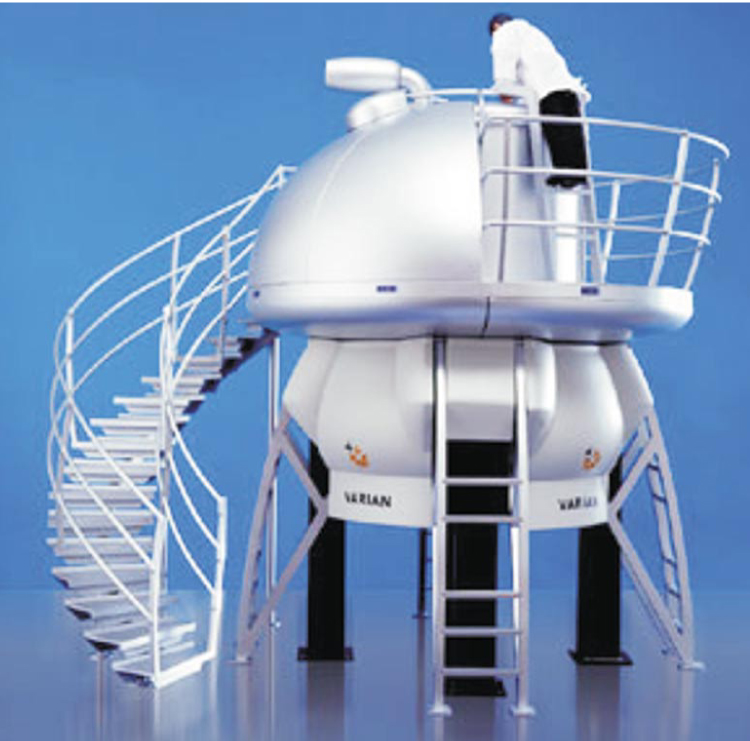
US laboratories are installing the first batch of 900-megahertz (21-tesla) nuclear magnetic resonance (NMR) machines months ahead of their European and Japanese competitors. With a 12% increase in resolution over their 800-MHz (18-T) predecessors, the new machines can resolve previously inaccessible protein structures. “NMR is probably the most versatile if not unique tool to study such complex structures,” says Andrey Geim, a leading expert in high magnetic fields from the University of Manchester in the UK, “and these new machines are incredibly technologically complex.” Ten 900-MHz systems are either deployed or currently in production worldwide; and the only two wide-bore models, which accommodate larger-than-usual samples, will both be in the US.
At the heart of the new machines are superconducting coils, cooled with liquid helium, that create a 21-T magnetic field uniform to one part in a billion. Any slight instability in the magnetic field can create a millikelvin temperature change in the system, which in turn can destroy the superconducting state and crack the magnet. To combat these effects, engineers have developed new ways to contain the immense stresses on the magnets.
NMR machines work by sending a series of radio-frequency pulses through a magnetically polarized sample (see PHYSICS TODAY, September 2000, page 19). When the frequency of the pulses matches the Larmor frequency of a particular type of nucleus in the sample, those nuclei absorb and emit energy. The resonant frequencies identify the isotope—for example, 900 MHz is the resonant frequency of hydrogen in a 21-T field. NMR can also indicate what chemical bonds are in the sample. “This chemical shift is usually small, which makes the resolution so important,” says Geim.
“Even an incremental improvement in magnetic field strength can often lead to dramatic advantages for the spectroscopy or imaging of specific molecular systems,” says Timothy Cross, NMR spectroscopy and imaging program director at the National High Magnetic Field Laboratory (NHMFL) at Florida State University in Tallahassee. Many peaks hidden in previous NMR spectra can now be detected with the increased resolution. And experiments that used to take a month can be done in days.
Building these multimillion dollar machines can take years and, because of the high cost, most of these new systems are being sold to national or international research centers. Last June, the nonprofit Scripps Research Institute in La Jolla, California, took delivery of the first narrow-bore (55-mm diameter) 900-MHz NMR system from Bruker Instruments in Germany. “It’s fantastic,” says Peter Wright, chairman of the department of molecular biology at Scripps. “The capabilities of this instrument take us to a new level.”
Scientists are even more excited about trying out new wide-bore machines. “Mice are commonly used animal models for a variety of biological studies,” says Cross, “and adult laboratory mice cannot be accommodated in a narrow-bore system.” The extra room provided by a wider bore also allows research into solid-state materials, catalysts, and large membrane proteins. One of the wide-bore systems (65 mm), developed by UK-based Oxford Instruments, will be at the William R. Wiley Environmental Molecular Sciences Laboratory at the Department of Energy’s Pacific Northwest National Laboratory. The second instrument (105 mm) is built on a different design with help from Intermagnetics General Corp in Latham, New York, and is based at the NHMFL.
“Physically, they [wide-bore machines] are two to three times the size of a narrow-bore magnet because of the stresses involved, and it’s too expensive to make these systems commercially,” says Alan Street, technical director at Oxford Instruments.
The US research lead in using 900-MHz devices may be shortlived. “Federal support for 900-MHz NMR systems pales in comparison to the support in Japan and Europe,” says Cross. He adds that, without stronger federal support, magnet companies will be reluctant to push ahead with new research until their investments in 900-MHz systems are recouped. Still, says Street, “there’s no doubt that the scientific community wants 1-giga-hertz systems.”

A 900-MHZ nuclear magnetic resonance device.
OXFORD INSTRUMENTS
More about the authors
Paul Guinnessy, American Center for Physics, One Physics Ellipse, College Park, Maryland 20740-3842, US . pguinnes@aip.org