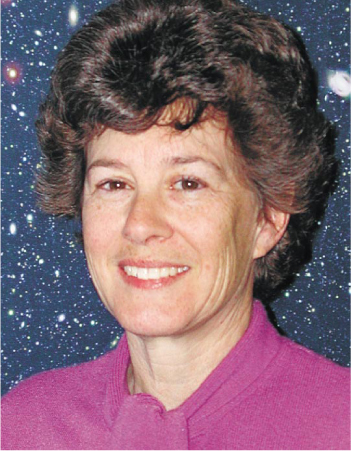
Pilachowski is AAS President-Elect
DOI: 10.1063/1.2405637
Catherine Pilachowski, a scientific staff member at the National Optical Astronomy Observatory (NOAO) in Tucson, Arizona, takes office as presidentelect of the American Astronomical Society next month. In 2002, Pilachowski will succeed Anneila Sargent, a professor of astronomy at Caltech, for a two-year term as AAS president.
The biggest challenge facing AAS in the next few years, according to Pilachowski, is combining budget constraints with the opportunities presented by the recent decadal survey of astronomy and astrophysics (see Physics Today, July 2000, page 45 ). “Our scientific frontiers are expanding at a breathtaking pace. It’s an exciting time for astronomy,” she says.
Pilachowski earned her MS and PhD degrees in astronomy from the University of Hawaii, Manoa, and then worked for four years as a postdoctoral fellow at the University of Washington, Seattle. Since 1979, she has worked for Kitt Peak National Observatory, in Tucson, and NOAO. Her research focuses on the chemical composition of stars and star clusters in the Milky Way, using high-resolution spectroscopy to better understand the evolution of stars.
Also taking office next month for a three-year term as vice president is Joseph A. Burns, a professor of astronomy at Cornell University. Arlo U. Landolt, a professor of physics and astronomy at Louisiana State University, was reelected for three years as AAS secretary. And elected for three-year terms as AAS councilors were Thomas R. Ayres, a research professor at the Center for Astrophysics and Space Astronomy at the University of Colorado, Boulder; Dana E. Backman, an associate professor of astronomy at Franklin and Marshall College in Lancaster, Pennsylvania; and Susana Lizano, a researcher at the National Autonomous University of Mexico’s Institute for Astronomy in Morelia.