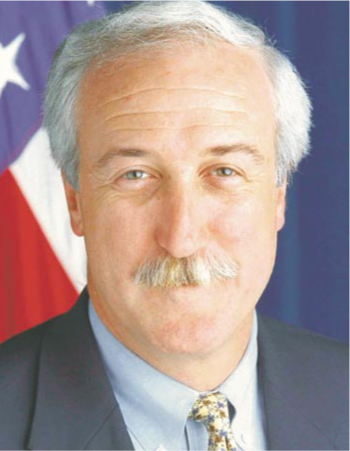
O’Keefe Is New NASA Chief
DOI: 10.1063/1.1457257

Just days after Dan Goldin announced he was leaving his post as NASA administrator (see Physics Today December 2001, page 22 ), President Bush surprised the science community by naming Sean O’Keefe, a nonscientist, for the job. The 45-year-old O’Keefe comes to NASA from his position as deputy director at the White House Office of Management and Budget (OMB). The nomination came on 14 November, after an 11-month search for Goldin’s replacement. “Everyone at NASA feels better now that someone has been named,” says Ed Weiler, NASA’s associate administrator for space science. “It’s not good for morale, having a long time without an announcement about a successor.”
O’Keefe’s Senate confirmation was a shoo-in. “I know he will bring a realistic, results-oriented approach to addressing the management problems that have bedeviled NASA,” says Representative Sherwood L. Boehlert (R-N.Y.), chairman of the House Science Committee. Rep. Ralph Hall (D-Tex.), ranking minority member of the Science Committee and former chairman of the Space Subcommittee, agrees, and says he “looks forward to working with the new administrator.” Goldin, too, praised his successor, calling him “a man of intelligence, energy, and deep integrity.”
“But there is some concern in the community that O’Keefe is not a scientist,” says Anneila Sargent, president of the American Astronomical Society. “It’s a different choice, but I think it doesn’t matter in this case.” The reason, she says, is because space science at NASA is already well managed and O’Keefe is expected to leave the field alone. Weiler has a similarly relaxed view: “I’ve never met O’Keefe,” he says. “I hear he’s a tough manager, but I’m very comfortable with that.”
Former academic colleagues of O’Keefe’s, for their part, are not surprised by his nomination. “Sean’s experience in federal government, on Capitol Hill, in the Defense Department is extraordinary for a man of his age,” says Robert McClure, senior associate dean at Syracuse University, where he cotaught a course with O’Keefe, who is a professor of business and government at the university’s Maxwell School of Citizenship and Public Affairs. “It makes him ideally suited to the job,” McClure adds. O’Keefe joined the OMB last March. He has also been secretary of the US Navy, chief financial officer for the Pentagon, and staff director of the Senate Defense Appropriations Subcommittee.
But O’Keefe’s appointment is not good news for everyone. “The people involved in the human spaceflight program will correctly view this appointment with some trepidation,” says John Logsdon, director of the Space Policy Institute at George Washington University. “O’Keefe is on record as saying their longtime way of doing business is obsolete.”
In a recent House Science Committee hearing on the $4.8 billion cost over run of the International Space Station, O’Keefe gave some indication of where he will lead NASA. He says he is pleased with the technical progress of the program, but adds that “technical excellence at any cost is not an acceptable approach.” He has made it clear that no new funds from the Bush administration will be made available to the space station until, as he put it, NASA “can show it is on track.”
“Over the last 10 years, it is hard to know how many new opportunities for space exploration may have been lost due to the year-to-year struggle of adding funding to the station,” says O’Keefe. NASA, he adds, must “put management excellence … on a par with technical excellence.” Eventually, says O’Keefe, NASA will be “an agency that is lean, agile, and focused on its primary objectives: world-class science, technology, and exploration.”

O’Keefe
OMB
More about the authors
Paul Guinnessy, American Center for Physics, One Physics Ellipse, College Park, Maryland 20740-3842, US . pguinnes@aip.org