Obama, detroit push the limits of electric vehicle batteries
DOI: 10.1063/1.3326980
The Obama administration is pouring a big dose of economic stimulus money, $2.4 billion, into developing and subsidizing production of next-generation plug-in hybrid electric vehicles and fully electric vehicles. Of that total, the Department of Energy (DOE) has handed out $1.5 billion in grants to US-based manufacturers to help them develop and produce the advanced batteries and other electric components that will be needed to meet the administration’s goal of putting 1 million PHEVs and EVs on the road by 2015. Most of the grants are going to manufacturers who have been lured to Michigan by tax breaks and other incentives offered by the recession-ravaged state.
But a recent report by a National Research Council (NRC) committee has cast doubt on hopes that PHEVs and EVs equipped with lithium-ion batteries could make a big dent in the US automobile market and, hence, a parallel dent in US petroleum consumption and greenhouse gas emissions. The committee, comprising 16 experts from industry, universities, and consulting firms, released its report in December. The document states that producing a PHEV that can go 40 miles in all-electric mode—as Chevrolet touts that its Volt, to be introduced late this year, will do—will cost about $18 000 more to manufacture than a similar-sized conventionally powered vehicle. According to the report, an estimated $16 000 of the extra cost is attributable to the complexity of the lithium-ion batteries of the size needed for vehicles. Such a big premium will limit the Volt’s market to affluent buyers.
For PHEVs to penetrate the wider auto market, batteries will have to become significantly cheaper than they are now yet still meet performance requirements and remain durable for 10 years or more, says the NRC committee, which was chaired by Michael Ramage, retired executive vice president of ExxonMobil Research and Engineering Co. With nearly twice the energy density and about three times the power density of the nickel-metal-hydride batteries that are used in hybrids now, lithium ion, according to the report, is the only available near-term option. A high power density will accommodate the high current flows needed for acceleration; energy density determines how far the car can travel in all-electric operation. A third requirement is for the cells to perform across a changing state of charge, as the battery moves from a charged to a depleted condition. (For more on battery technology, see Physics Today, December 2008, page 43 .)
Some improvement expected
“What no Li-ion can do yet is simultaneously deliver both high power density and high energy density at a reasonable cost,” the NRC report says. While costs are likely to drop by as much as one-third by 2020 due to technology improvements and economies of scale, further reductions beyond that will be small. “Li-ion batteries are already being produced in great numbers and are well along their learning curves. The steep early drop in cost often experienced with new technologies is not likely,” the report states.
A PHEV version of the Prius will cost an estimated $6600 more than a comparable conventionally powered car, with $3300 of the premium due to the battery, the report says. Toyota’s lithium-ion vehicle, generically referred to in the report as a PHEV-10, is expected to have an all-electric range of just 13 miles. The document does not address the all-electric Nissan Leaf, expected out later this year in the US and Japan. Nissan officials claim that the five-passenger vehicle will run for 100 miles between charges and reach speeds up to 90 miles per hour.
Commenting on the NRC report, General Motors spokesman Robert Peterson says that the company’s cost of production for the lithium-ion packs is “hundreds of dollars less” than the NRC’s estimate of $875 per kilowatt hour of stored energy. He declined to be more specific on cost, but he says that GM has already produced hundreds of the batteries and has been testing them for more than two years under a wide range of real-world conditions. The Volt’s battery packs are “extremely robust,” he says. Volume production of the packs, using cell technology licensed from South Korea’s LG Chem began on 7 January at a GM plant near Detroit.
Toyota moving cautiously
But Jaycie Chitwood, manager of future fuels and environmental strategies for Toyota Motor Sales USA, calls the cost estimates in the NRC report “balanced and in line with our current view” of the state of lithium-ion technology. Toyota, she said, agrees with the committee that production costs for the batteries aren’t likely to decline a lot as production increases. Though it has led the way in hybrid vehicles, Toyota is moving cautiously into PHEVs. Its lithium-ion-equipped Prius won’t be available in the US until 2012, after 500 of the modified cars are field tested in the US, Japan, and Europe. The testing campaign is being paired with a campaign to educate the public about PHEV technology.
John Hanson, Toyota’s national manager for environmental safety and quality communications, said that PHEVs will require “societal changes,” such as the ability for owners to plug in their vehicles for a daily recharge, if the cars are to make big inroads into the market. The first of several planned demonstrations got under way in October in Boulder, Colorado, where 10 PHEVs are being placed with residents in a partnership with Xcel Energy’s SmartGrid-City program. Test drivers will participate in a research project coordinated by the Renewable and Sustainable Energy Institute, a newly established joint venture between DOE’s National Renewable Energy Laboratory and the University of Colorado at Boulder.
No one disputes that consumers will pay a premium to own PHEV technology, just as they have done to get currently available hybrids that employ nickel-metal-hydride batteries. It will likely be several decades before the extra cost of PHEVs will be balanced by fuel savings over the vehicle’s lifetime, the NRC report says. Although GM has yet to announce pricing for the Volt, published reports indicate that it will be offered in the $40 000 range. Nissan CEO Carlos Ghosn told reporters in November that the all-electric Leaf will be “affordable” and that by 2012 Nissan and its partner, Renault, will have a combined production capacity of 500 000 vehicles.
Ted Miller, Ford Motor Co’s senior manager for energy storage, strategy, and research, chairs the management committee of the US Advanced Battery Consortium (USABC), a 19-year-old collaboration among GM, Ford, and Chrysler Group LLC. He said the conservative approach GM has taken with the Volt is “probably necessary for the first generation of that vehicle,” given the state of lithium-ion technology and the Volt’s series hybrid drivetrain configuration, in which its engine serves solely to generate electricity when the battery is depleted. “I think we would all agree that when you get started, you don’t want to disappoint any customers,” Miller said. “But long term, you’ve got to have the business case right. We’ve said that for a PHEV-40 design, we think we’ll have to be at about $300 per kilowatt hour to have a viable business case.”
Grants in the billions
Virtually all of the $1.5 billion in taxpayers’ investment in advanced vehicle batteries is backing lithium-ion technology. Battery manufacturers who are locating their production plants in Michigan have received two-thirds of that. They include Johnson Controls ($299 million), A123 Systems ($249 million), LG Chem subsidiary Compact Power ($151 million), KD Advanced Battery Manufacturing Group ($161 million), and GM ($106 million). The remainder of the $2.4 billion is divided: $500 million is devoted to DOE grants for the development of motors, power electronics, and other electric-drive components for the vehicles. And $400 million is for federal agencies to purchase thousands of PHEVs and EVs for fleet evaluation and demonstrations, to begin installing the charging infrastructure, to educate the public, and workforce training.
The PHEV batteries will undergo thousands of cycles of deep discharges and recharges over years of daily use. The USABC and the Volt program have set 10-year, 150 000-mile targets for battery lifetime. Seeking to ensure that the Volt will meet those goals, engineers have designed battery packs to hold 16 kWh—twice the energy needed to achieve its 40-mile range. The wide margin will allow cells to be kept within a relatively narrow state of charge, well away from either fully depleted or overcharged conditions, which can reduce battery life.
But an abundance of caution also raises cost. GM’s Peterson acknowledges that the Volt’s 181-kg, 1.8-m-long battery pack has been “over-engineered” in some respects, and says the carmaker plans to incorporate lessons learned from the initial units into future designs. Alex Molinaroli, chairman of joint-venture battery manufacturer Johnson Controls-Saft, says that the first PHEV batteries are likely to outlast the vehicles they’re in. “What do you do with these batteries that still have a useful life?” he said at a November press conference. “Do you purchase them, or lease them?”
The USABC’s goal is to develop lithium-ion batteries that will be capable of using nearly 70% of their energy capacity, a considerable improvement on the Volt’s 50% ratio. That would allow smaller and lighter PHEV and EV batteries to be built. In a report it released in August 2009, the Electric Power Research Institute says modeling of lithium-ion battery designs indicates that battery costs to automakers will decline to a range of $250-$400 per kilowatt hour when production volumes increase to 100 000 or more packs per year. The Electrification Coalition, an ad hoc assemblage of automakers, fleet vehicle operators, battery manufacturers, and electric utilities, says the average cost today is about $600 per kilowatt hour. “No obstacle to [PHEV and EV] adoption has been as formidable as the development of battery technology,” asserts the coalition’s November report.
The industry is focusing its cost-reduction efforts on three major components of lithium-ion batteries, says Ford’s Miller: the separator, a microporous film typically made of a polyolefin material; the cathode materials; and the electrolyte. According to the NRC report, the electrolyte is typically a solution of lithium hexafluorophosphate salt in a solvent blend of ethylene carbonate and various linear carbonates. Finding less energy-intensive manufacturing processes also will be key to reducing costs, Miller says.

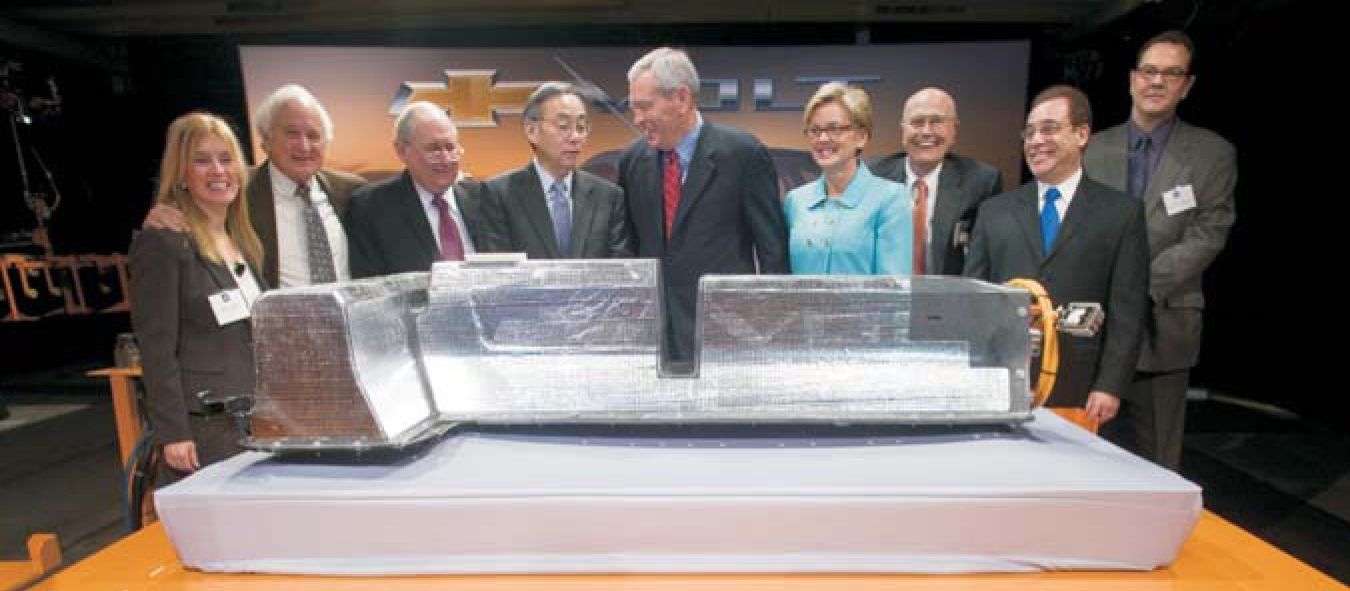
A recharge for Detroit? Government officials and General Motors Corp executives celebrate the 7 January rollout of the first production battery that will power the Chevrolet Volt plug-in hybrid electric vehicle. Pictured at the GM battery plant near Detroit are, from left, plant manager Nancy Laubenthal, Representative Sander Levin (D-MI), Senator Carl Levin (D-MI), US Secretary of Energy Steven Chu, GM CEO Ed Whitacre, Michigan governor Jennifer Granholm (D), Rep. John Dingell (D-MI), Wayne County executive Robert Ficano, and Brownstown Township treasurer Andy Linko.
JEFFREY SAUGER FOR GM

More about the authors
David Kramer, dkramer@aip.org