Nuclear spin polarization induced solely by a rotating magnetic field
DOI: 10.1063/1.2364229
To polarize the nuclei in a material, the standard approach is to apply a static magnetic field in the desired direction. A second method, recently demonstrated by experimenters at the University of California, Berkeley, is to apply a rotating field and induce magnetization in the direction of the rotation axis. 1
Nuclear polarization by a rotating field is a consequence of the phenomenological equations governing nuclear resonance written down by Felix Bloch 2 in the 1940s. The equations were modified some 10 years later 3,4 to describe cases in which a magnetic field rotating in the xy plane is comparable in magnitude to a fixed field B z. The modified equations predict—quite surprisingly—that the magnetization induced in such cases has a z-component even when the static field B z is absent.
Polarization by a rotating field was not entirely unproven. It was demonstrated for the case of electron spins in 1957 measurements done at Columbia University by the late George Whitfield and Alfred Redfield (now at Brandeis University). 5 The comparable experiment on nuclear spins was out of the question at the time because the magnetic moments of nuclei are three orders of magnitude smaller than those of electrons. In the nuclear case, the magnetic fields resulting from spin polarization are on the order of picotesla.
Serendipitously, one of the people involved in the earliest experiments on electron spins in rotating fields—Erwin Hahn—is at Berkeley, where he sometimes collaborates with researchers who have developed superconducting quantum interference devices capable of detecting picotesla fields. Hahn recently joined with two such SQUID experts, Seung-Kyun Lee and John Clarke, to measure—at long last—the static magnetization induced in nuclear spins by a rotating field. 1
“The experiment is a tour de force,” comments Michael Romalis of Princeton. “It demonstrates a counterintuitive effect that is accurately described by the widely used Bloch equations.” Lee notes that the experiment tests the modified Bloch equations in a new region of parameter space, in which the longitudinal relaxation time is much greater than that of electron spins. As a result, the new experiment on nuclear spins is likely to find some practical applications.
Earliest experiments
To understand how a polarization can develop in the absence of a stationary magnetic field, consider a magnetization M 0 subjected to a magnetic field B r that rotates with a frequency ω in the xy plane. If the Larmor precession frequency Ω of M 0 about B r is much larger than ω, M 0 will tend to precess at a very small angle over many cycles, and will remain virtually parallel to B r.
If, however, ω is comparable to or larger than Ω, B r will “pull away” from M 0. This process increases the angle between B r and a lagging M 0 and accounts for an added torque that causes the magnetization to move away from the xy plane. In a frame of reference rotating along with B r, M 0 will become aligned with an effective field given by the vector sum of B r (stationary in the rotating frame) and an apparent field ω/γ oriented along the z-axis and where γ is the spin’s gyromagnetic ratio. The net result in the laboratory frame is a static magnetization component Mz along the z-axis.
Hahn was at IBM’s Watson Scientific Computing Lab at Columbia University in 1954 when several theorists formulated their modifications to the Bloch equations, containing the prediction of a z-axis polarization. Bloch had expressed to Hahn, his former postdoc, his concern about the validity of the modified equations. Hahn recognized that any polarization signal in low fields would be easier to detect with electron spins than with nuclear spins. (He had discovered spin echoes just a few years earlier.) Hahn devised a method of detecting the polarization by measuring induction signals from fast relaxation recovery following RF pulse saturation. He interested Whitfield, a student of his at the time, in using such methods to explore the modified Bloch equations, but because Hahn soon left Columbia for Berkeley, Whitfield worked on the experiment with Redfield.
Whitfield and Redfield measured the polarization induced by a combination of fixed and rotating fields in a paramagnetic solid. By reducing the fixed field to zero, the two researchers confirmed the prediction that the rotating field alone can induce a stationary component of magnetization in the z direction. Although that phenomenon is implied by the equations, it had not been fully appreciated before the Columbia experiment.
New interest in an old problem
Hahn’s interest in testing the modified Bloch equations on nuclei was revived recently by the progress being made on SQUID detectors at Berkeley. The group there has reported high-resolution nuclear magnetic-resonance spectra measured in fields of a few microtesla. 6
Most NMR measurements are done at high fields, as much as 20 T, using a detector in which the signal is proportional to the rate of change of field induced in a pickup coil, according to Faraday’s law. Thus, the signal is proportional to the Larmor precession rate of the nuclear spins, which in turn is proportional to the applied static field. Furthermore, the degree of magnetization scales with the field strength, so that the size of the induction signal goes as the square of the field strength. To get the highest signal, it’s advantageous to work at high fields.
By contrast, a DC SQUID detector responds only to the net flux through the coil, not to the flux’s rate of change. It can thus be sensitive at low frequency precession rates, such as those produced by nuclear spins in magnetic fields as low as a few microtesla.
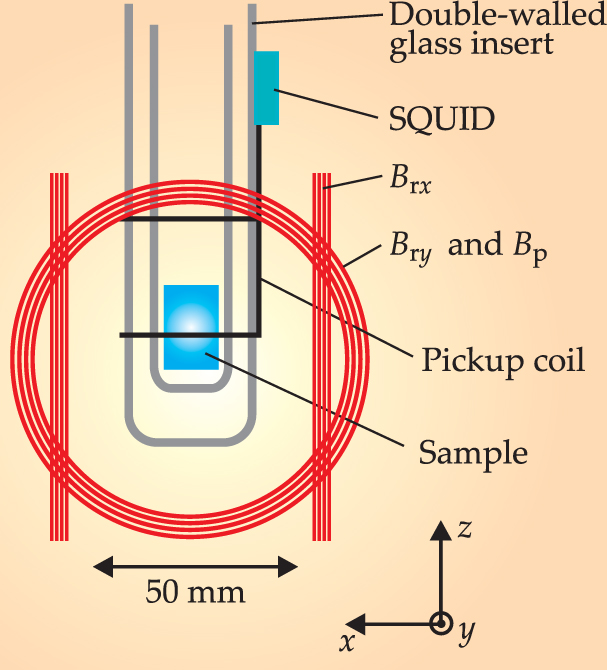
A schematic of the apparatus used by Lee, Hahn, and Clarke is shown in figure 1. The liquid sample (methanol) was placed between two sets of Helmholtz coils, which produced a 260-µT field, B r, rotating at 9.6-kHz in the xy plane (with oscillating components B rx and B ry ). A second set of coils on top of the B ry coils produced a 3.3-µT static precession field B p in the y-direction, which was used to measure the resulting spin polarization. No stationary field was applied in the z-direction. The SQUID was immersed in liquid helium-4 at 4.2 K while the sample, insulated in its double-walled glass insert, was kept at room temperature by heating coils. The entire apparatus was shielded from ambient magnetic fields so that the residual field was 0.24 µT.

Figure 1. Experiment to measure spin polarization induced by a rotating magnetic field. The sample of liquid methanol is surrounded by coils that produce the rotating magnetic field components B rx and B ry as well as a static, y-axis precession field B p used to measure the spin polarization. The free-induction decay of the protons’ spins induces in the pickup coil a current that is detected by the superconducting quantum interference device (SQUID). The sample is kept at room temperature while the SQUID is in a liquid helium bath.
(Adapted from ref. 1.)

Any magnetization induced by B r is expected to persist after B r is turned off, because the relaxation time of nuclear spins in the liquid is long, on the order of 1 second. The relaxation time was much shorter than 1 second in the 1957 Columbia experiment on electrons.
Once B r was turned off, the static precession field B p was turned on, causing the induced magnetization vector to precess around the y-axis. The SQUID recorded the resulting variations in flux through its pickup coils. With time, the amplitude of those variations decreased due to the decay of the magnetization.
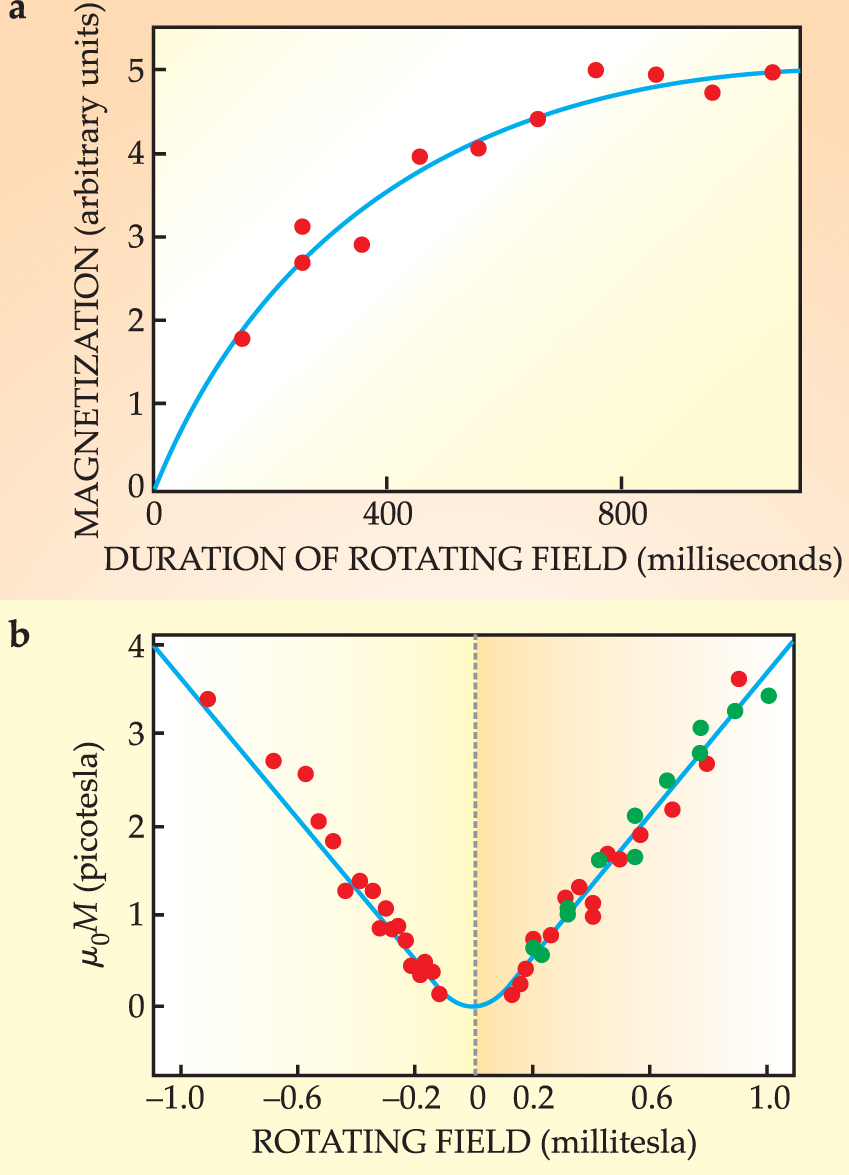
Figure 2(a) shows the magnetization induced in the protons of the methanol as a function of the time that the rotating field is left on. The magnetization saturates with a time constant (350 ms in this case) that is not very different from the longitudinal relaxation time for the protons in the liquid. Figure

Figure 2. Behavior of magnetization as a function of two variables. (a) Magnetization M is larger when the rotating field is left on for longer time intervals. The solid curve is a fit to a single-exponential relaxation with time constant 350 ms. (b) The induced field µ 0 M is shown as a function of the rotating field. The sign of the magnetization M changes when the direction of rotation is reversed. The solid line is calculated from the modified Bloch equations, with no free parameters. Colored dots represent data from two types of methanol samples.
(Adapted from ref. 5.)

Possible applications
The magnetizations produced are extremely small, and the measurements are quite daunting. Nevertheless, the Berkeley researchers still mention one possible application in their paper, and have tested for it. They point out that polarizing nuclei with a rotating field might be particularly advantageous for NMR measurements on a liquid in the presence of magnetic materials. As an example from the field of geochemistry, one could determine the diffusion rate of water in iron-containing rocks by measuring spin echoes on the induced proton polarization. In turn, the diffusion rate provides information on the porosity of the rock, which is of considerable interest in evaluating potential oil wells. The rotating-field technique helps avoid complications of time-dependent, inhomogeneous fields due to remanent magnetization of the rock. Another possible application is the detection of the state of water in reinforced concrete, where the steel bars could be strongly magnetic.
Lee, Hahn, and Clarke repeated their measurements of spin polarization with their liquid sample mounted on a ferrite ring. The presence of the ferrite prevented detection of proton spins prepolarized by a fixed field but did not impact the measurement of proton spins polarized by a rotating field.
Hahn is interested in further testing the modified Bloch equations. What happens when the transverse and longitudinal relaxation times T 2 and T 1, assumed equal in the recent Berkeley experiment, are not equal and not very large? How does the transient magnetization build up from zero to equilibrium? Additional physics to plumb includes nuclear spin coupling in liquids and solids. The mechanism of the induced static polarization in the liquid case bears a resemblance to the Barnett effect—the spontaneous magnetization of a ferromagnetic or paramagnetic body when spun on its axis. 7
References
1. S.-K. Lee, E. L. Hahn, J. Clarke, Phys. Rev. Lett. 96, 257601 (2006) https://doi.org/10.1103/PhysRevLett.96.257601 .
2. F. Bloch, Phys. Rev. 70, 460 (1946) https://doi.org/10.1103/PhysRev.70.460 .
3. R. S. Codrington, J. D. Olds, H. C. Torrey, Phys. Rev. 95, 607 (1954).
4. M. A. Garstens, Phys. Rev. 93, 1228 (1954) https://doi.org/10.1103/PhysRev.93.1228 .
5. G. Whitfield, A. G. Redfield, Phys. Rev. 106, 918 (1957) https://doi.org/10.1103/PhysRev.106.918 .
6. R. McDermott, S.-K. Lee, B. ten Haken, A. H. Trabesinger, A. Pines, J. Clarke, Proc. Natl. Acad. Sci. USA 101, 7857 (2004); https://doi.org/10.1073/pnas.0402382101
R. McDermott, A. H. Trabesinger, M. Muck, E. L. Hahn, A. Pines, J. Clarke, Science 295, 2247 (2002) https://doi.org/10.1126/science.1069280 .7. E. L. Hahn, B. K. Tenn, M. P. Augustine, in Novel NMR and EPR Techniques, J. Dolinsek, M. Vilfan, S. Zumer, eds., Springer, New York (2006).