Novices and Nobelists Gather in Lindau
DOI: 10.1063/1.1801860
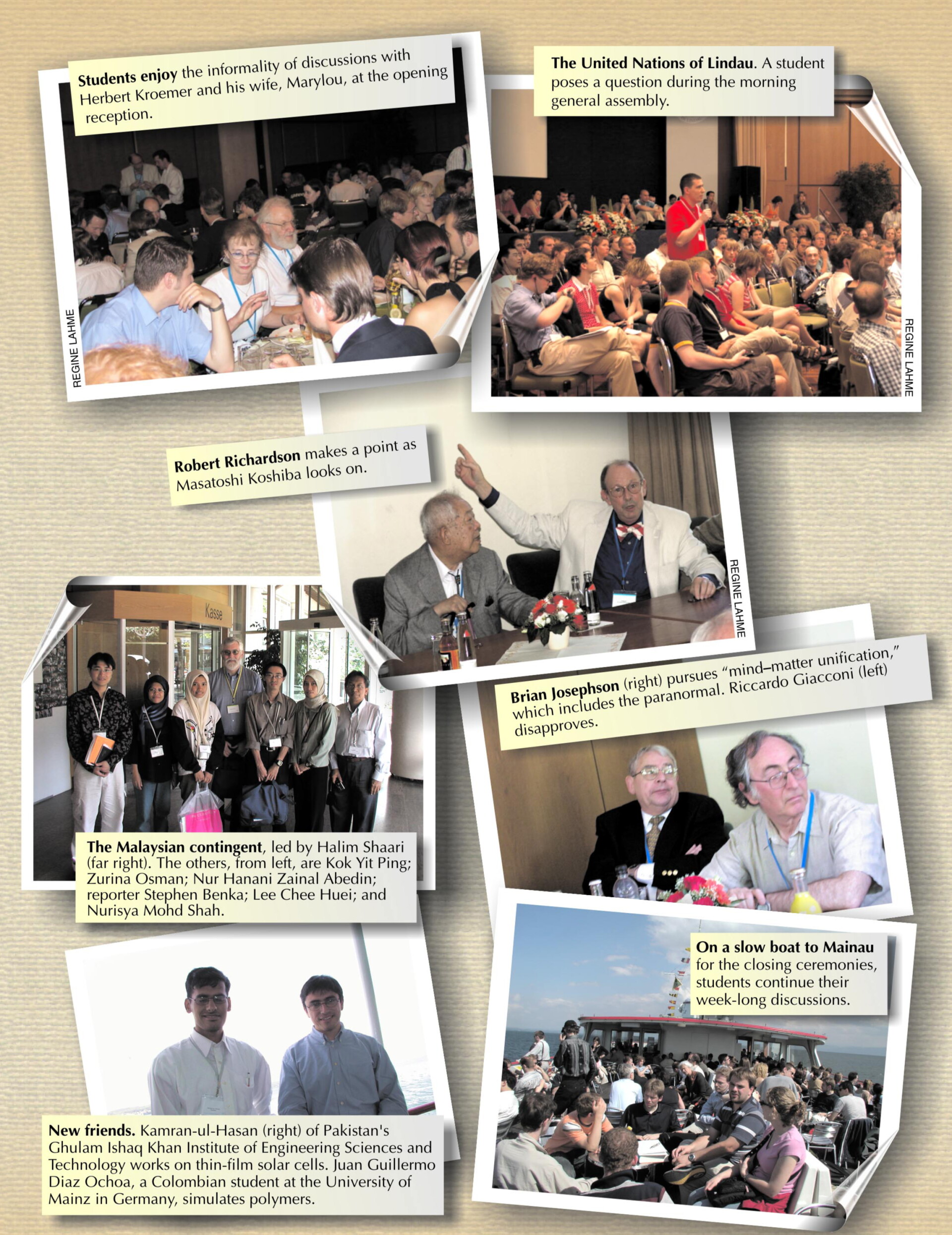
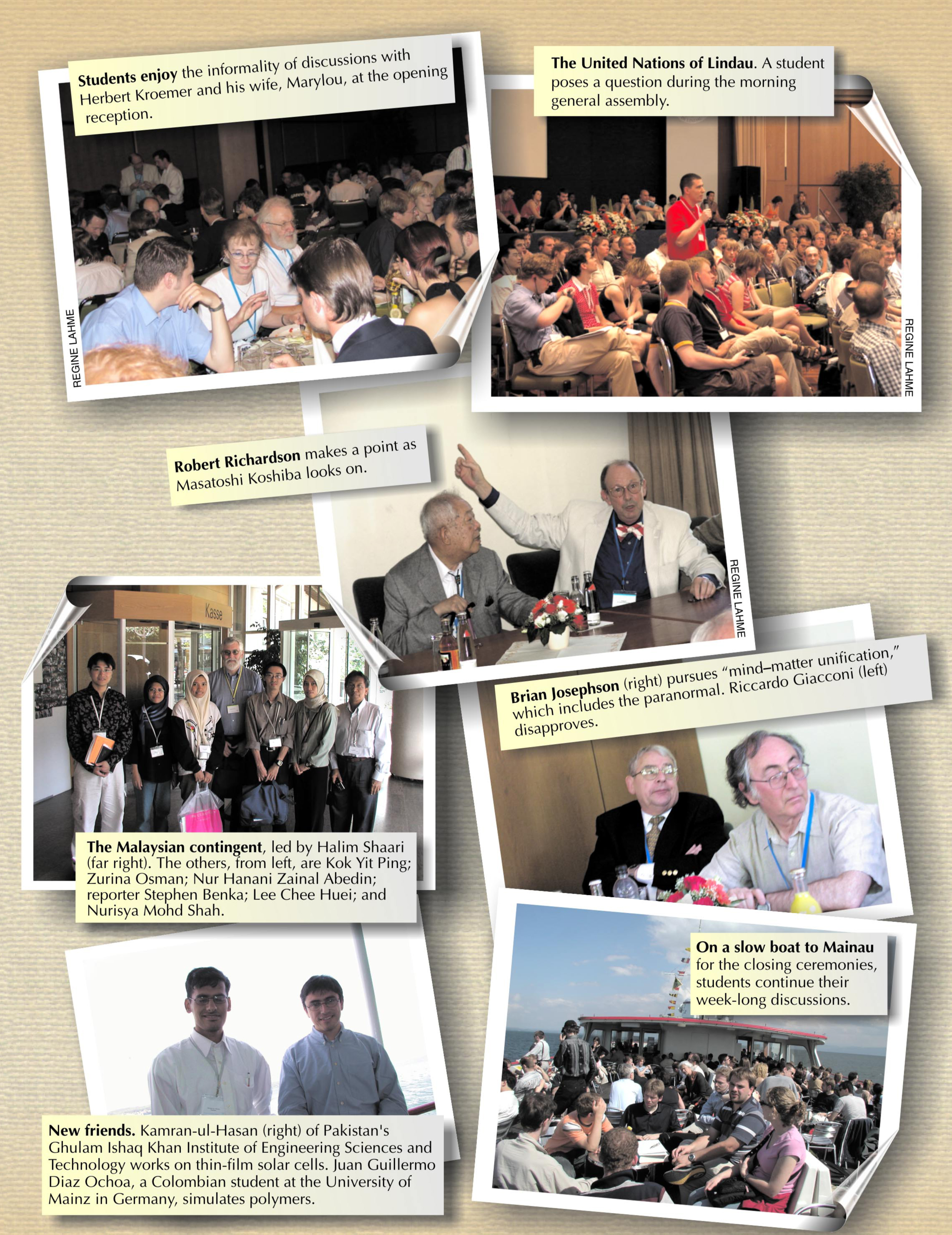
“It’s a dream come true,” said Lu-Jing Hou, who studies dusty plasmas at China’s Dalian University of Technology. That sentiment was echoed by many of the more than 500 graduate students who converged with 16 Nobel Prize winners on the resort town of Lindau, Germany, for a week in June. It was the 54th Meeting of Nobel Laureates, which rotates every three years among the fields of physiology or medicine, chemistry, and physics. Hou added that he was “amazed at how easy it is to see students from all over the world.”
The Kuratorium
The first gathering of laureates in Lindau took place in 1951 with the express intent of rebuilding scientific bridges in central Europe after World War II. Since the second meeting, students have been invited to attend, mainly as a reward for outstanding academic performance. The originators were two Lindau physicians and a local member of the Swedish royal family who chaired the meeting’s volunteer committee—the Kuratorium. The chairman, Count Lennart Bernadotte, is the uncle of Sweden’s current king and, at age 95, still lives on the island of Mainau, across Lake Constance from Lindau. His second wife, Countess Sonja Bernadotte, has been president of the Kuratorium since 1987.
The meeting’s scientific bridges still span the generations, but only over the past decade has the Lindau gathering taken on a truly global character. “And we want to increase the participation of other countries,” said Countess Sonja. “The foreign students are of amazingly high quality. We should probably raise the standards for accepting German students. There are still too many of them relative to the rest of the world. The committee will discuss this.” This year, 260 students came from German institutions; 300 students came from 20 other countries. The US sent 57 graduate students, sponsored by the Department of Energy, NSF, Oak Ridge Associated Universities, and Dickinson College.
Ludwig Feinendegen, retired professor of nuclear medicine, resident of Lindau, and vice president of the Kuratorium, said that this year’s budget was €350 000 (about $430 000). The federal, regional, and local German governments, a worldwide multitude of foundations, and the private sector all contributed. In 2000, the Kuratorium created its own foundation to stabilize the meeting’s finances.
The ‘United Nations of Lindau’
Mornings at the conference were filled with lectures by the laureates and with two roundtable discussions (see the box). Afternoons were reserved for student discussions with laureates who had spoken earlier.
“It was during this meeting that we met people from some part of the world we never thought of making acquaintance with and finding out that their work is very similar to ours,” said Kok Yit Ping, a student at Universiti Sains Malaysia. “Personally, I made my first Brazilian acquaintance during the meeting. It is as remarkable as chatting with the Nobel laureates.”
The feeling resonated with Lee Chee Huei of the Malaysian Institute for Nuclear Technology Research: “Everything was new during the Lindau meeting. It was even my first time taking a flight to another country. I was so happy to make friends with those students from Pakistan, China, Germany, USA, everywhere. They were affable, friendly, and outstanding.”
In one afternoon session, laureate Robert Huber clarified some crystallography questions for Kristine Carlson, a student at the University of North Dakota, and then started a dialogue on ethics. “We all had a vigorous discussion,” said Carlson, “with a lot of give and take, questions and debate. Finally, Professor Huber admitted he could add nothing else and commended us for grappling with the issues. It was amazing.”
The laureates just as clearly enjoyed the informal atmosphere, the camaraderie with each other and with the students, and the seemingly endless supplies of food, intellectual depth, and youthful energy. “It’s a special thing,” said Nobelist Martinus Veltman, “when the older generation—who once did something that someone else might have once thought was important—gets together with the new generation who can yet do something important.”
Erel Levine and Nadav Katz are students at Israel’s Weizmann Institute. Katz applauded laureate Herbert Kroemer’s risk-taking in giving a talk about negative index materials, a topic outside of Kroemer’s field. “It took some guts to do that,” said Katz. Levine revealed that a number of young scientists were initially disappointed. “We had expected some high-level seminars from some of the world’s best researchers—kind of a dream-team summer school,” he said. “But as it turned out, the main merit of the meeting was in the meeting itself, both with the laureates and with our fellow students.”
Said Ping, “After one week in Lindau, my perception of scientific research and contribution to humanity has changed. Professor [Masatoshi] Koshiba did not seem to mind if his work on neutrinos will [take] a good 20 years of his life. In this view, I believe the Nobel Prize is only a small reward for their enormous sacrifice in searching for fundamental truth of nature for the benefit of mankind.”
The Laureates and Their Talks
Nicolaas Bloembergen: “Lasers in Peace and War”
Leo Esaki: “The Birth of a Superlattice and Its Evolution”
Riccardo Giacconi: “X-Ray Astronomy” and roundtable discussion on astrophysics
Ivar Giaever: “How to Start a High-Tech Business” and roundtable discussion on fundamental and applied physics
Gerardus ‘t Hooft: “Supertheories” and roundtable discussion on astrophysics
Robert Huber: “Aerobic and Anaerobic Life on Carbon Monoxide”
Brian Josephson: “Pathological Disbelief”
Walter Kohn: “New Perspectives on Van der Waals Interactions Between Systems of Arbitrary Size, Shape, and Atomic Composition”
Masatoshi Koshiba: “The Birth of Neutrino Astrophysics” and roundtable discussion on astrophysics
Herbert Kroemer: “Negative Optical Refraction”
K. Alexander Müller: “Some Remarks on the Symmetry of the Superconducting Wavefunction in the Cuprates”
Douglas Osheroff: “Understanding the Columbia Shuttle Accident” and roundtable discussion on fundamental and applied physics
Arno Penzias: “A Classical View of Cosmology” and roundtable discussion on astrophysics
Robert Richardson: “Pseudoscience, Marvelous Gadgets, and Public Policy”
Martinus Veltman: “The Development of Particle Physics” and roundtable discussion on fundamental and applied physics
Klaus von Klitzing: “Spin Phenomena in the Electronic Transport of Semiconductor Quantum Structures”

REGINE LAHME