It was darkest before Dawn. Now Ceres’ secrets have been illuminated as the NASA mission reaches low-altitude orbit around the largest object in our Sun’s asteroid belt. Some new findings were presented this past December at the annual meeting of the American Geophysical Union in San Francisco.
Named after its purpose—to provide information on the dawn of the solar system—the Dawn spacecraft orbited giant asteroid Vesta in 2011–12, and now it is exploring a second new world, dwarf planet Ceres. When the solar system began to form some 4.6 billion years ago, the two bodies are thought to have been among the first to coalesce. Both have remained fully intact since their formation.
Dawn‘s principal investigator Christopher Russell, a UCLA geophysicist, proposed the mission as a peek back in time to the early processes of planetary formation. Because the two asteroids lie near the ecliptic plane in near circular orbits, a spacecraft could reach both Vesta and Ceres, “the two most important asteroids out there, for the price of one mission. That was a winner!” says Russell.
Verified by Vesta
In some ways Vesta is easier to understand than Ceres. That’s because meteorites suspected to have originated on Vesta have found their way to Earth. The meteorites, called HEDs (howardite-eucrite-diogenite, based on mineral composition and texture), consist of material similar to terrestrial igneous rocks, but they have been differentiated due to melting and recrystallization on their parent body—in this case, Vesta.
“We had evidence about HED meteorites and put together a model for solar system formation from that . . . The meteorites tell [not only] about overall formation, but also [let us test] predictions about Vesta,” says Russell. Such tests, he says, helped to “verify our paradigm of solar system formation.”
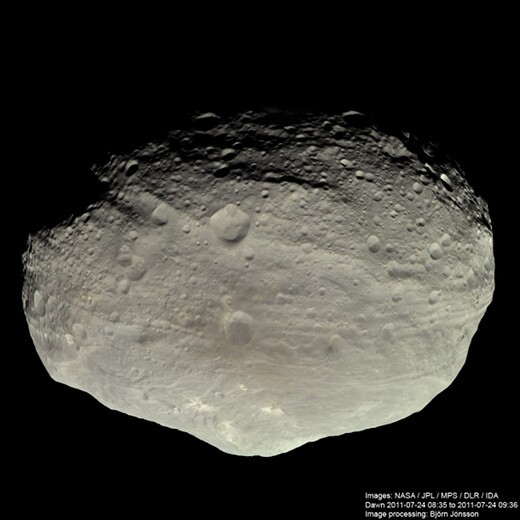
Vesta color portrait from Dawn‘s visit in 2011. CREDIT: NASA/JPL-Caltech
An impact that left a massive crater near Vesta’s south pole ejected large chunks of the otherwise nearly-spherical body’s magnesium-and-iron-rich crust and mantle, some of which formed smaller asteroids that entered near-Earth orbit and landed on our planet. Dawn‘s gamma-ray and neutron detector proved that elemental ratios at Vesta matched those of the meteorites.
Dawn verified evidence for a fully differentiated body including an iron-rich core, convecting olivine-rich mantle, and lava flows that hardened into a basaltic crust. Vesta indeed formed early.
Surprised by Ceres
Until Dawn, scientists were unclear about Ceres’ formation and composition, which are manifested in the body’s exterior through rheological processes. One surprise came in images of Ceres’ surface, which revealed highly varied topography marked by craters and roughness.
The 950 km-diameter, roughly spherical dwarf planet has long been suspected of harboring water-rich materials. Knowledge of Ceres’ topography and gravitational field are leading to a more detailed understanding.
“At the very long timescale, the material that makes up Ceres is viscous and behaves like a fluid,” explains Roger Fu, planetary scientist at Columbia University. “On Earth, because the surface is rock, this is not a familiar surface process, as mountains get eroded long before they have a chance to viscously relax. But glaciers undergo viscous relaxation and on bodies where the surface is not rock, such as icy satellites, the topography becomes similarly subdued.” Over time, a mountain on an icy satellite flows and eventually “relaxes” to a plain.
“What we’re doing now is determining how relaxed Ceres is,” adds Russell. “It isn’t as relaxed as we thought.” The school of thought that predicted a relatively pure ice mantle or shell expected a smooth surface. But if rock and ice are mixed together, the ice–rock becomes more rigid and does not relax as quickly.
Dawn‘s images revealed big craters alongside tiny ones. Over time, craters that are 100 km across will relax and lose their amplitude. But those that are a few km across hold their shape over time.
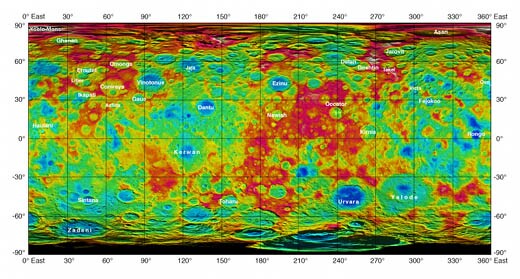
Color-coded map from the Dawn mission shows the elevations (red=high; blue=low) and surface topography of Ceres. CREDIT: NASA/JPL-Caltech/UCLA/MPS/DLR/IDA
Spherical harmonic decomposition is a common technique to show the degree of large and small structures on a surface. Broad features, like plateaus or large craters, have long wavelengths. But a small crater indicates perturbation on a very localized topography. Ryan Park of NASA’s Jet Propulsion Laboratory and Anton Ermakov of MIT used crater shape and size-frequency distribution to determine the topographic power spectrum. Fu and colleagues then experimented with different models of interior structure, based on temperature and compositional viscosity, to match the topographic spectrum.
A model with an icy shell and a rocky interior relaxed far too quickly to match Ceres’ surface. The best fit was yielded by strong shell with a weak interior. Some long-wavelength features relaxed as expected, whereas the short wavelength topography associated with small craters remained intact for a simulated 4 billion years. That finding came as a surprise. “This implies that whatever material is building Ceres needs to have mechanical strength on order of much harder than ice, and more consistent with some rock-salt mixture,” Fu explains.
A numerical model by geophysicist Scott King of Virginia Tech helps to visualize a process that may have led to a strong shell with a weak interior. Treating the first billion years of Ceres’ formation as a slow-moving flow, internally-generated heat balances heat leaving the body’s surface. When buried heat from radiogenic elements nears the surface, instability ensues and the body cools dramatically with internal temperature remaining asymmetric throughout subsequent evolution, consistent with a low-density outer shell over a dense and viscous core.
“Our models only give a profile of strength with depth. Material strength is a function of temperature and composition and if you want to pinpoint which salt or how much, that’s going to be difficult. Part of the story must come from spectral observations,” adds Fu.
Water and rock
Asteroids are classified based on their visible and near-IR spectral properties. The group that is mostly dark in the visible, including Ceres, is composed of water, clay, and organic materials. “When you look at just the visible, there are a lot of objects that look like Ceres,” says Andy Rivkin, planetary scientist at the Johns Hopkins University Applied Physics Laboratory. “There was this idea that Ceres is just a big, dumb rock. Good mass and size measurements acquired 10-15 years ago let us know we needed better compositional information,” Dawn‘s Visible and IR Spectrometer (VIR) instrument provides this compositional understanding.
The wavelength range from 2.5 to 4 microns provides information about hydroxyl, organic, and ammoniated materials. Some of these wavelengths can be observed from Earth, but our planet’s atmosphere makes others impossible to observe.
“What VIR got us is the region that we couldn’t get from Earth: 2.5 to 2.8 microns,” says Rivkin. “That shows a big absorption feature due to phyllosilicates, or clays.” These silicate minerals with hydroxyl groups appear all over Ceres’ surface.
Other absorption lines observed with VIR indicate ammonium and carbonates. All are formed through aqueous alteration, indicating that liquid water had at some point come in contact with minerals. Carbonates indicate carbon combined with water; ammoniated materials suggest the presence of nitrogen.
Dawn VIR images taken from 46 000 km away, showing the same region of Ceres including Occator crater’s bright spot (circled) in visible light (left); IR wavelengths (center); and (right) thermal IR (right). CREDIT: NASA/JPL-Caltech/UCLA/ASI/INAF
“All we’ve seen are the VIR spectra from large averages of places. We’re getting the edge pieces of the puzzle,” says Rivkin. “We haven’t seen spectra of the bright spots, likely the youngest places on Ceres, for instance. I imagine, when we do, that will show what minerals are there.”
Dawn‘s framing camera provides an unprecedented view into different units on Ceres’ surface and reveals bright spots and variation in surface albedo, suggesting compositionally distinct material.
“With color filters, we cover the visible wavelength of light only . . . from which we can derive some assumptions,” explains Thomas Platz, geophysicist at the Max Planck Institute for Solar System Research and member of the team that built the framing camera. “To get the full picture we need infrared data. But the color data are superior to [the] VIR instrument in terms of resolution.” Color distinction also indicates crater age, with unweathered features leading the team to believe that Occator crater is a youthful 78 million years old.
In Occator, “we observe the highest albedo on Ceres. We think it’s hydrated magnesium sulfate and ice,” says Platz. The finding suggests that salt-rich areas were left behind when water-ice sublimated. Further evidence of water at Occator comes from diurnal variation in brightness in localized water vapor sources measured by the Herschel Space Telescope, indicating possible sublimation of water-ice that produces haze clouds inside the crater with a diurnal rhythm.
Knowing the density of Ceres, it should be possible to determine water and silicate content. “How much of the water is in the form of ice or water flowing inside?” asks Russell. “The best geochemical estimate is around 20%. The body is about 80% either dry or hydrated silicate. We expect there should be a lot of water in one form or another.” Geochemical models make good predictions when given some constraints on temperature and pressure.
Bringing the heat
Dawn‘s Gamma Ray and Neutron Detector (GRaND) instrument will provide key information about Ceres’ surface heat content and composition at the elemental level.
Scientists believe that over 4.5 billion years ago, material left over from the gravitational collapse of the Sun formed a cloud of gas and dust—the solar nebula—where protoplanets began forming through accretion. “The explanation that we’re tying everything on is that there was a supernova explosion nearby that seeded our solar nebula with highly radioactive materials like aluminium-26,” says Russell. GraND will tell how much of these materials are present in the surface.
When Vesta began to accrete, material that would become Ceres still existed in a thin disk. Radiogenic materials would have spread throughout Vesta’s interior. But the same radionuclides had started to decay by the time Ceres accreted, losing heat into space.
Vesta’s Earth-like differentiation of an iron core, olivine mantle, and basaltic crust might be explained by its higher heat content at formation. Ceres’ later start could explain its more gradient-like interior. At the time of the AGU meeting, the GRaND data had not come home. The models await testing.
Dawn will remain in low-altitude orbit about Ceres for the rest of its mission. The VIR and GraND will continue their intense observation periods, supplementing the highest resolution images ever provided of the protoplanet.
Ceres is not what we thought it would be, and we can look forward to more surprises from this mysterious little world.