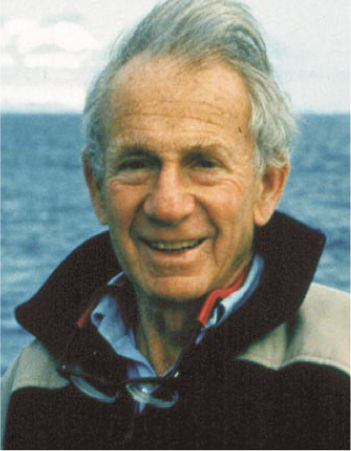
New International Medal Honors Munk
DOI: 10.1063/1.2405686
Oceanographer Walter Munk became the first-ever recipient of the Prince Albert I Medal from the International Association for the Physical Sciences of the Oceans (IAPSO). The IAPSO presented the award at its joint assembly with the International Association for Biological Oceanography, held in Mar del Plata, Argentina, in October.
Prince Rainier III of Monaco created the award, which will be presented biannually, to acknowledge particularly distinguished scientists in the physical sciences of the oceans. The IAPSO recognized Munk for “a half century of superb science and discoveries in physical oceanography.” He is a professor of geophysics and holds the Secretary of the Navy/Chief of Naval Operations Oceanography Chair at the Scripps Institution’s Cecil H. and Ida M. Green Institute of Geophysics and Planetary Physics in La Jolla, California. He is also a member of JASON.
During World War II, Munk and Harald Sverdrup, then the director of Scripps, developed a system for predicting breakers and surf on beaches, information that was essential to the military for making amphibious landings. In the 1960s, Munk studied the attenuation of ocean swells generated in Antarctica. He also used sophisticated pressure-sensing instruments to measure tides in the deep sea. In the 1990s, he helped develop a method for tracking long-term changes in climate associated with global warming.
The medal is named for the late Prince Albert I of Monaco, who, in 1919, organized the oceanography section of the International Union of Geodesy and Geophysics. The IAPSO is one of seven associations of the IUGG.