New Experiments Demonstrate Quantum Optics on a Chip
DOI: 10.1063/1.1839369
Reaching the limit where a single atom couples strongly enough with a single photon to exhibit coherent behavior has been a major focus in quantum optics for much of the past two decades. That strong coupling limit is hard to achieve because photons and atoms interact so weakly in general. But by placing an atom inside a small optical cavity bounded by mirrors that are reflective enough to trap a photon for hundreds or thousands of roundtrips before it escapes, researchers can strengthen the interaction.
According to quantum electrodynamics (QED), the vacuum field of the cavity fluctuates, polarizing the atom that enters it; in return, the induced atomic dipole fluctuates, polarizing the cavity field, an interaction that prompts the exchange of a photon. As a result, an excited atom placed within an optical cavity tuned to the frequency of the atomic transition can repeatedly emit and reabsorb a photon at a characteristic rate known as the vacuum Rabi frequency.
In 1992, a group led by Jeffrey Kimble of Caltech observed strong coupling in the splitting of the eigenvalue spectrum from this oscillatory exchange of energy between single atoms and an electromagnetic cavity mode. 1 Kimble and his collaborators passed a dilute, thermal stream of atoms through the cavity so that only one, on average, would contribute to the interaction. Since then, cavity-QED researchers have gradually prolonged the dwell times of individual atoms in their cavities by using laser-cooling techniques (see Physics Today, January 2004, page 16 ). Exploiting such advances, for example, Gerhard Rempe and colleagues at the Max Planck Institute for Quantum Optics in Garching, Germany, recently reported probing the energy spectrum and splitting from a single trapped atom interacting with the cavity field. 2
Meanwhile, condensed matter researchers have refined their own techniques by customizing mesoscopic structures like semiconducting dots, wells, and gates, and superconducting junctions that can behave like atoms. Two separate research groups—one at Yale University and one at Delft University of Technology—now report observations of strong coupling in all-solid-state implementations of the cavity-QED concept using circuit elements that play the role of a two-level atom and cavity. The notion of quantizing electrical circuits has been around for a half century, but the technology required to minimize the dissipation in mesoscopic objects millions of times larger than a single atom has matured only in the past few years.
Artificial atoms
Both groups use Josephson junctions, in which two superconducting grains are separated by a thin insulating oxide, as the heart of their circuits. The number of Cooper pairs and the phase of the wavefunction in a superconductor are conjugate variables. The Yale group, led by Robert Schoelkopf and Steven Girvin, operates in the charge regime. A small aluminum island—a so-called Cooper-pair box—uses two Josephson junctions that permit Cooper pairs to hop between the island and a larger superconducting reservoir, all on a silicon chip. If those junctions’ capacitances and temperatures are small enough, the number of Cooper pairs on the island is well defined. Tweaking the voltage applied to its gate electrode can cause the island’s charge states to differ by just a single Cooper pair, which tunnels back and forth through the barrier separating the two aluminum grains. The energy difference forms the basis states of what’s known as a quantum bit, or qubit, allowing it to behave like a two-level atom, but with a transition frequency in the microwave regime (a few GHz).
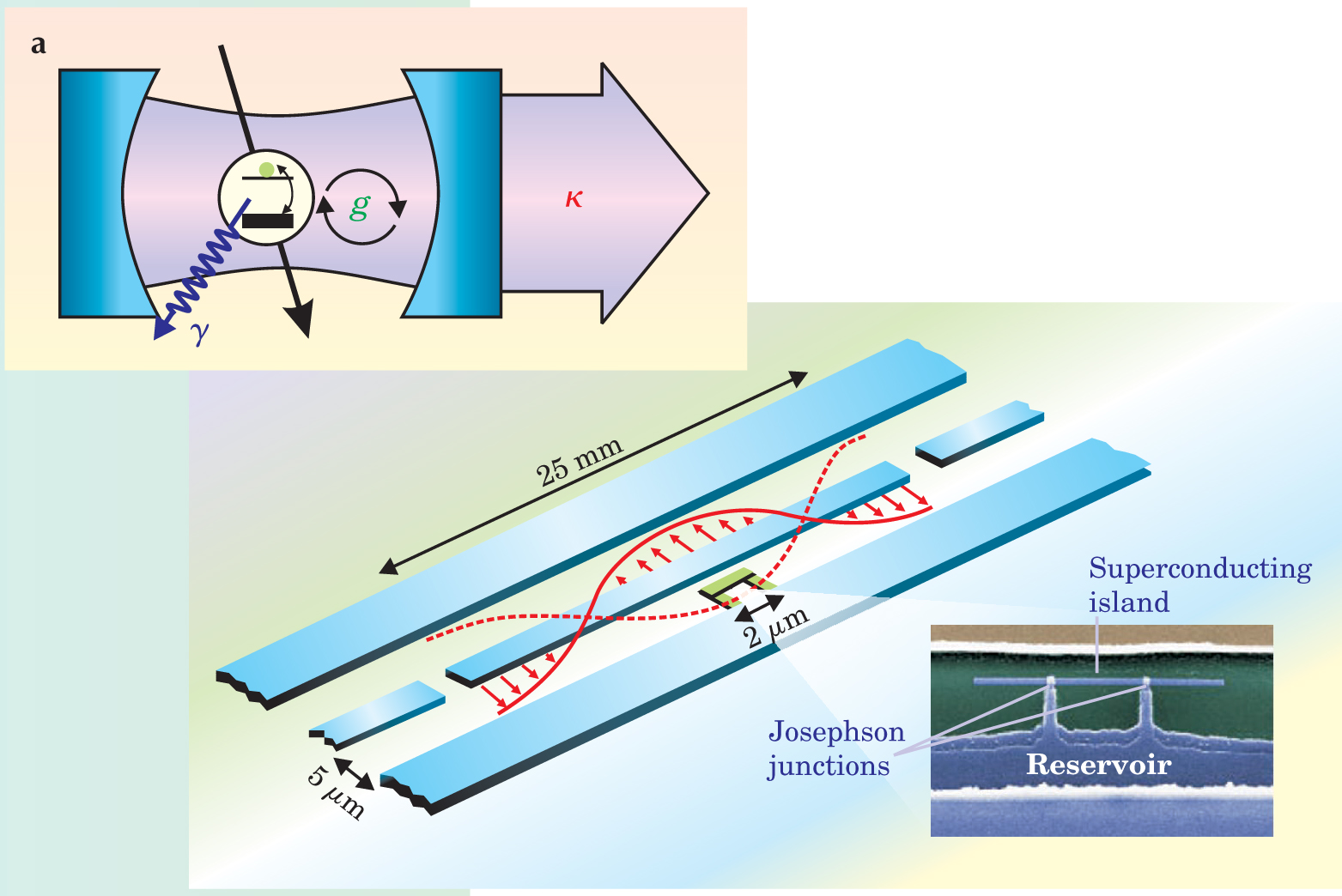
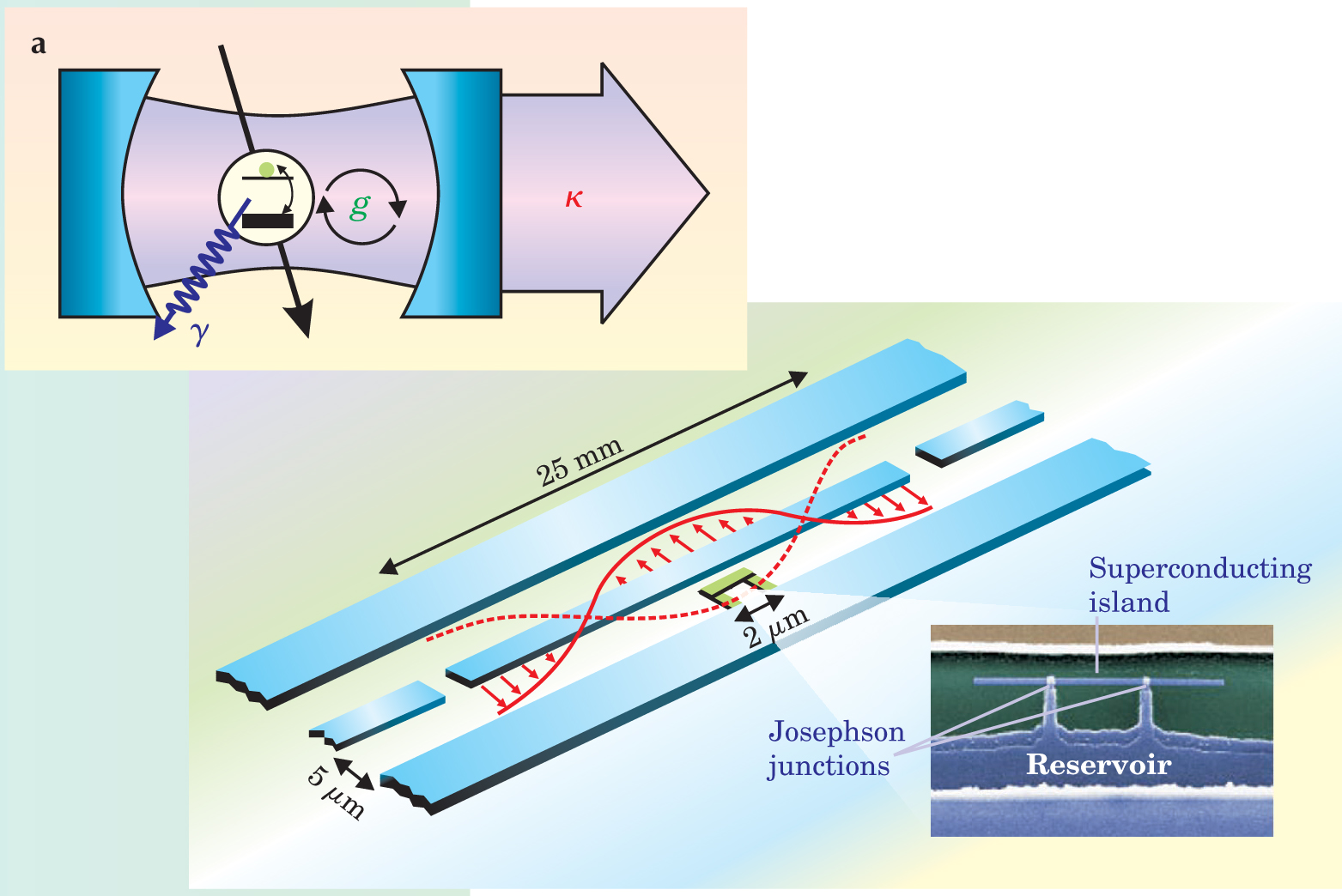
The Yale circuit couples this charge qubit to a transmission-line resonator. 3 Figure 1 compares their device with the traditional cavity-QED concept of an atom that briefly passes through a cavity. Because the qubit is made from millions of aluminum atoms acting in concert, its dipole moment can be huge, 10 times larger than a typical Rydberg atom 4 —a highly excited atom that emits and absorbs microwaves—and as much as 104 times larger than an alkali atom in its ground state. Similarly, the “cavity” volume of the one-dimensional transmission line is a tiny fraction of a cubic wavelength; at that scale the vacuum electric field is concentrated on the qubit. The ability to engineer tunable-atom analogs illustrates the advantage of the solid-state approach. Because of advances in microlithography, researchers can build increasingly higher dipole moments into their qubits, or even drastically shift their transition frequencies, just by adjusting design parameters—changing the oxide-layer thickness, say, to alter the capacitance or inductance. With real atoms, chemistry alone determines the dipole size. Moreover, the circuit approach can permanently affix the qubit within the cavity—it’s engineered to sit still within the antinode of the standing wave. That avoids the motion and jitter associated with real atoms inside maser- or laser-QED systems.

In cavity QED, an atom dropped through a pair of mirrors (a) strongly couples for a brief time with a single mode of the electromagnetic field. The coherent rate of interaction (g) is higher than both the rate at which photons leak through mirrors (κ) and the rate of spontaneous decay (γ). The system exists as a superposition of an atomic excitation and photon. (b) In the circuit-QED analog, a 2 µm-wide Cooper-pair-box qubit (the atom, green) sits in the antinode formed by a standing microwave in a capacitively coupled section of a superconducting transmission waveguide (the cavity). Input and output signals are coupled to the waveguide resonator via the capacitive gaps in the center line, and microwave pulses manipulate the qubit state.
(Adapted from ref. 6.)
The challenge in solid-state systems is to mitigate decoherence. Wires are ideal electromagnetic receivers, and at room temperature circuits are awash in blackbody radiation. To ensure an average photon number in the cavity much less than 1, circuit temperatures must remain at or below 20 mK, and careful filtering must isolate the circuits from other sources. Mesoscopic circuit elements contain stray charges that move around or surface impurities that could couple to the qubit. The Yale group gained about two orders of magnitude in coherence time (compared with usual Cooper pair boxes) by biasing their qubit at a point where it becomes insensitive to DC electric fields, a trick they learned from Michel Devoret (now at Yale) and Denis Vion and colleagues at France’s Atomic Energy Commission (CEA) in Saclay (see Physics Today, June 2002, page 14 ).
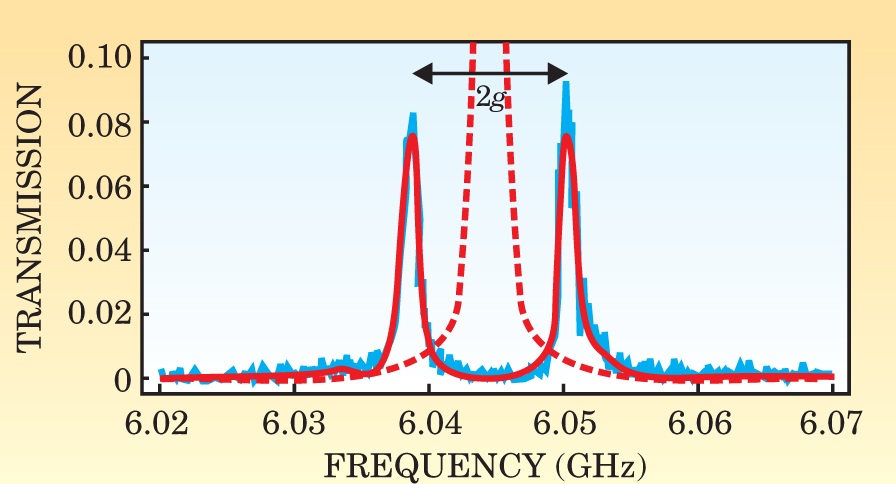
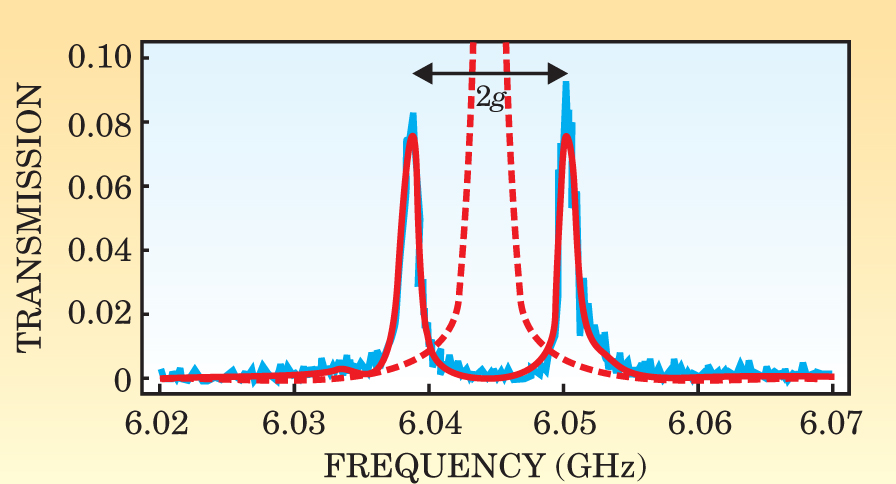
To explore the coupling between the qubit and microwaves, Yale postdoc Andreas Wallraff sent microwave pulses through the cavity and monitored the amplitude and phase of the transmitted radiation using an ultra-sensitive amplifier similar to those used by radioastronomers to detect distant galaxies. Dialing down the power to a level at which the cavity contained a single photon only 10% of the time, he monitored the output as a function of frequency. For a cavity mode in resonance with the qubit transition frequency, the transmission peak was split by an amount equal to the vacuum Rabi frequency, 2g (see figure 2). The eigenstates of the coupled system are symmetric and anti-symmetric superpositions of a single photon in the resonator and a qubit excitation—that is, |excited qubit with no photons≫ ± ground-state qubit with 1 photon≫. The large ratio between splitting and linewidth indicates how strongly the system couples—12 Rabi flops would be observed in a time-resolved experiment as the system oscillates between the two states.

A microwave photon sent through the cavity excites the qubit from the ground state. When the transition frequency of the qubit is tuned in resonance with the cavity’s frequency, the coupling of the qubit and photon levels lifts the energy degeneracy between them, a result evident as a splitting in the transmission spectra. (The dashed line shows the transmission spectra off resonance.) The 12 MHz vacuum Rabi splitting, 2g, measures the rate at which excitations oscillate between the qubit and the microwave field. A theoretical fit (red) overlays the data (blue).
(Adapted from ref. 3.)
Operating in a mode in which the cavity is slightly detuned from the qubit transition frequency is potentially more useful. The detuning enhances the lifetime of the qubit excitation and may preserve the coherence more effectively because the chip heats up less—the interaction alters the qubit wavefunction but does not cause energy exchange. In that regime, so-called nondemolition experiments measure the phase shift in the output light to infer the state of the qubit without actually changing it.
Magnetic coupling
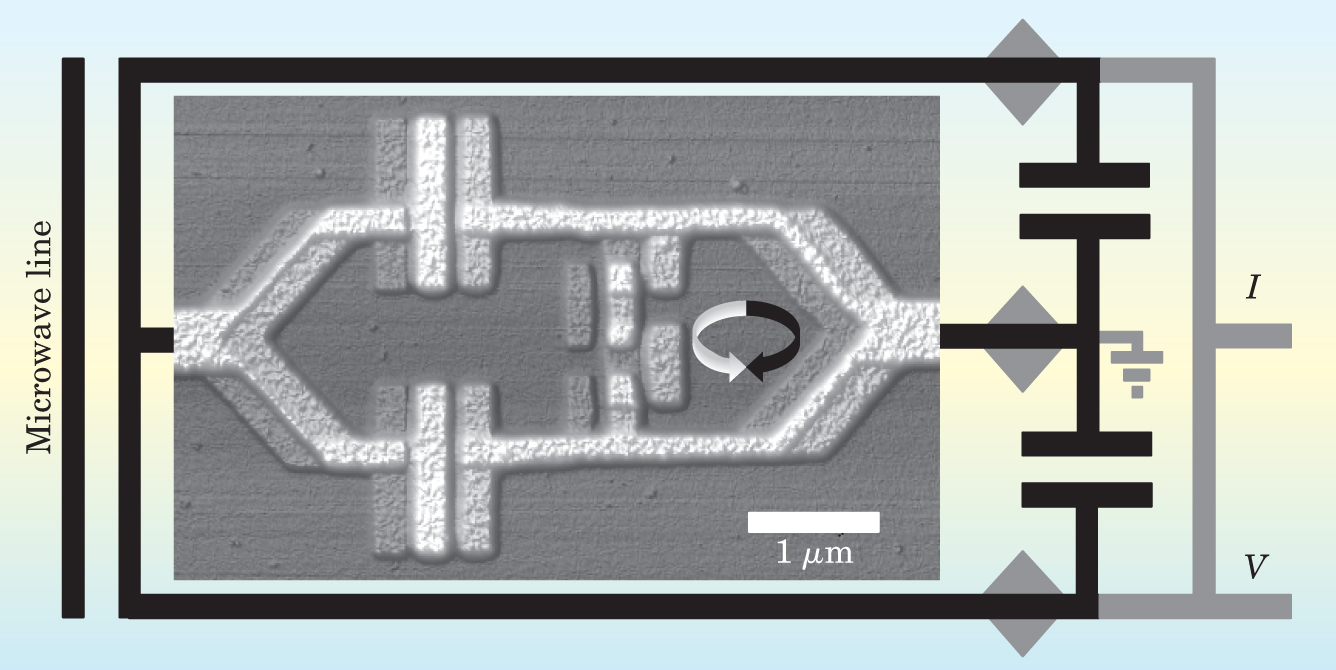
The Delft researchers used a different kind of circuit in their work: A magnetic-flux qubit, whose clockwise or counterclockwise currents form the two-level states, is coupled to a superconducting quantum interference device (see figure 3). 5 The group’s leader, Hans Mooij, explains that he had set out to simply explore the dynamic evolution of the qubit itself, using the SQUID as a readout magnetometer that would register the qubit’s precise state.

This AFM image shows a superconducing quantum interference device (SQUID) circuit (the large hexagonal loop) coupled to a magnetic flux qubit (the smaller loop), whose current directions, clockwise or counterclockwise, correspond to its states. Microwave pulses manipulate the qubit state into the ground or excited state, which the SQUID reads. But the SQUID also serves as a harmonic oscillator with its own set of quantum levels, which can coherently couple to the qubit.
(Adapted from ref. 5.)
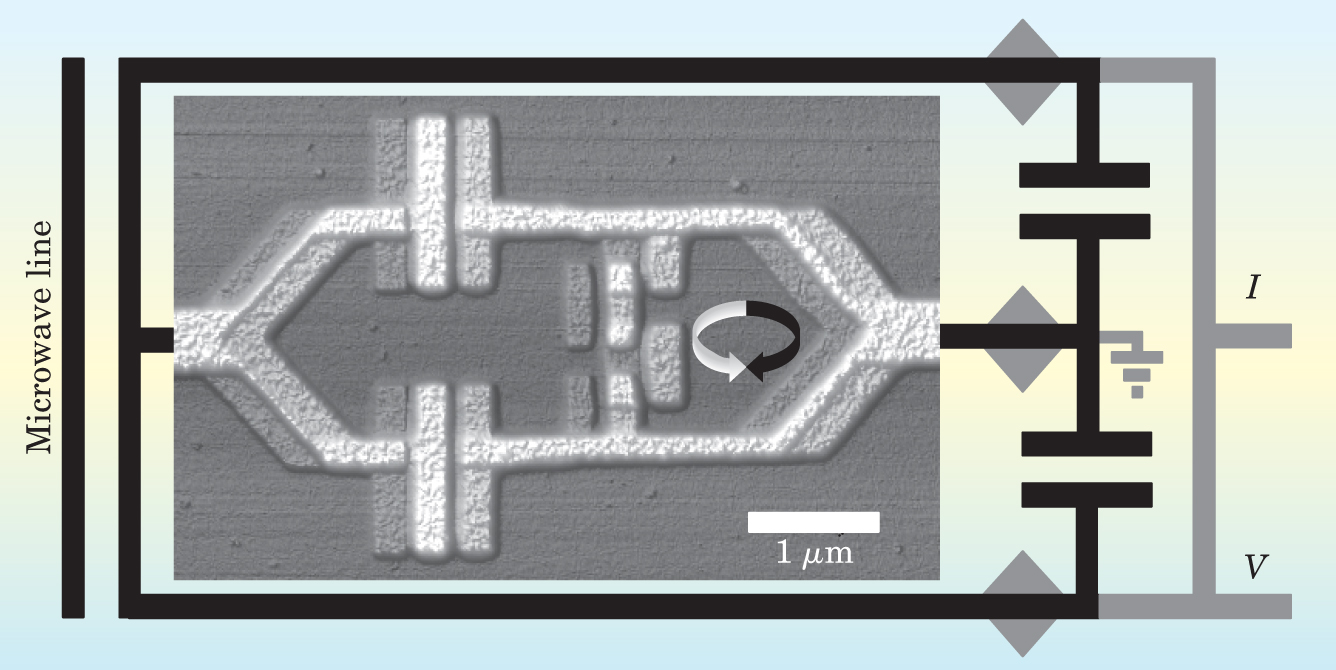
But a SQUID has a sizable inductance, and when combined with the filtering capacitors that shunt noise and stray frequencies, it forms an LC oscillator. By doing spectroscopy on the qubit, Irinel Chiorescu, Mooij’s postdoc at the time, noticed a fortuitous strong coupling between all the states—the ground and excited states of the SQUID’s oscillator (analogs of 0 and 1 states of the cavity) and the qubit’s ground and excited states (analogs of the atomic system)—because of an asymmetry in the qubit–SQUID system. “It was accidental,” says Mooij, but a genuine effect, partly due to the flux qubit’s long coherence times.
To explore the periodic exchange of energy between the quantum state of the oscillator and the qubit’s ground and excited states, the Delft group induced various Rabi oscillations in the system. They first measured the coherent transitions in the qubit with the SQUID in the ground or excited state. The asymmetry in the levels enabled them to then resolve transitions among the different qubit and SQUID states. Time-resolved spectroscopy of the qubit–oscillator system—fixing the state of the qubit and then scanning over pulse length as a function of microwave power—confirmed the dynamics.
Mooij plans to hitch another SQUID to the circuit to serve as a high-Q (low-attenuation) oscillator to avoid the resistive attenuation that currently damps their SQUID.
Designing the future
Both groups are optimistic that the flexibility built into their circuit designs brings the coherent interaction of multiqubit systems on a chip within reach. Qubits may behave like atoms, but each one differs subtly from the others, cautions Schoelkopf. So the ability to tune each qubit in situ may be important in any architecture that imagines entangled qubits connected to a common photon bus or SQUID oscillator. But such a device would represent a direct analog to the quantum computers now envisioned using ion traps.
Alternatively, the circuits could be adapted for a more immediate application: detecting single microwave photons.
References
1. R. J. Thompson, G. Rempe, H. J. Kimble, Phys. Rev. Lett. 68, 1132 (1992).
2. P. Maunz, T. Puppe, I. Schuster, N. Syassen, P. W. H. Pinkse, G. Rempe, http://arXiv.org/abs/quant-ph/0406136v2 .
3. A. Wallraff, D. Schuster, A. Blais, L. Frunzio, R.-S. Huang, J. Majer, S. Kumar, S. M. Girvin, R. J. Schoelkopf, Nature 431, 162 (2004).
4. For a review of microwave cavity QED, see J. M. Raimond, M. Brune, S. Haroche, Rev. Mod. Phys. 73, 565 (2001).
5. I. Chiorescu, P. Bertet, K. Semba, Y. Nakamura, C. J. P. M. Harmans, J. E. Mooij, Nature 431, 159 (2004).
6. A. Blais, R.-S. Huang, A. Wallraff, S. M. Girvin, R. J. Schoelkopf, Phys. Rev. A 69, 062320 (2004).