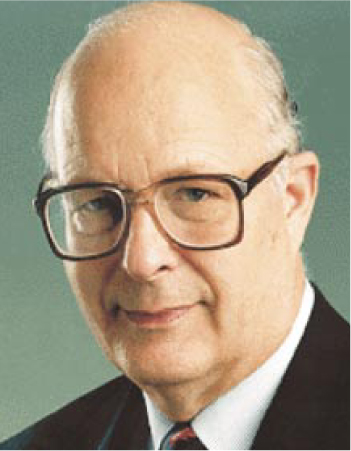
Neureiter Increases State Department Science Acumen Through Salesmanship and Outside Experts
DOI: 10.1063/1.1603070
When the State Department’s Norman Neureiter showed up at a recent Capitol Hill reception for the US Physics Olympiad team, he did what he has become adept at doing during his past two years in Washington: He saw the science-oriented gathering as a recruiting opportunity and worked the room. Neureiter congratulated the high-school physics students for their achievements, and then urged them to consider the State Department as a career option. As he left for his next event, Neureiter made sure there was a stack of his recruitment brochures on the table just outside the door.
“Calling all adventurous scientists and engineers,” the bright blue brochure announces above photos of exotic places around the globe. “Join the Foreign Service and do the most interesting work in the world!”
Neureiter, who retired from Texas Instruments in 1996, was lured to the State Department in 2000 to fill the newly created position of science and technology adviser to the secretary. The job was created in response to a National Research Council report that chronicled a serious decline in the role of science at the department (see Physics Today, November 2000, page 44 ). Neureiter, an organic chemist, linguist, and Fulbright scholar, had extensive federal government experience. He’d been the State Department’s first science attaché to Eastern Europe, had helped develop President Richard M. Nixon’s science and technology cooperation programs with the Soviet Union and China, and had worked as an international affairs specialist with the old Office of Science and Technology.
When he returned to the State Department, Neureiter had three stated goals. “The first was outreach to the scientific community, and that went fine,” he said in a recent interview. “The second was bringing more science resources into the building, and I think we’ve had some success at that. And the third was to find issues which seemed to need some help and in which we were interested. I tried to pick issues where I knew there was a political interest to demonstrate that science might be an important part of the foreign policy portfolio.”
Neureiter revived some languishing science initiatives with India and Vietnam, and became active in the multiagency effort to involve the US once again in the International Thermal Experimental Reactor (ITER) project, reflecting the strong interest among all the member countries in having the US rejoin the ITER consortium. He also helped to reinvigorate the Joint Committee on Science and Technology Cooperation with Russia, whose US chair is presidential science adviser John Marburger. The committee, which works on common concerns about energy, the environment, technology, and science, began in 1993 as one of Vice President Al Gore’s personal projects but collapsed after the 2000 presidential election. “We’ve reestablished the functioning joint committee under a bilateral science agreement with Russia,” Neureiter said.
While all of these efforts are enormously valuable in and of themselves, he said, they also have increased the visibility of science within the State Department. “We’ve tried to demonstrate the political value of these science dimensions whenever we can,” he said. “What you really want to do to be totally effective is make sure that the science, technology, and health considerations that are relevant to any given policy issue are somehow integrated into the decision making process. I’ve often been quoted as saying you don’t make policy around here by just whispering in the secretary’s ear, and believe me, you don’t.”
Instead of reestablishing the professional career track for science officers in the State Department, Neureiter has used another strategy. He has populated the State Department with scientists brought in from the outside through fellowships and internships (see previous story).
Scientists in the system
“I realized early on that my three-man office, to have an impact on a 25 000-person institution, was going to be pretty complicated,” he said. “There are 8000 people in this building alone,” he said of the State Department headquarters in Washington. “Then we’ve got some 268 posts around the world. So I decided what we needed was more scientists in the system.” An existing fellowship program of the American Association for the Advancement of Science was providing only four or five scientists each year to the department, he said, so he bumped that number up to the current level of 27. American Institute of Physics fellowships provided more researchers, as did a new partnership with the Institute of Electrical and Electronics Engineers. “We have 32 of those scientists in the building right now and we’ll have 40 by fall. I consider that an incredible accomplishment.”
The Embassy Science Fellows Program, which is administered by the State Department’s Oceans, International Environmental and Scientific Affairs Bureau, takes scientists from NSF, NASA, and a host of other federal agencies and places them in embassies. More than 30 scientists served in embassies for one- to three-month tours last year and, Neureiter said, there is growing demand from the embassies for even more scientists.
The value to the scientists is high, he said, “because everyone in the science world has to think internationally because science is a global enterprise.” The program helps the State Department, he said, because, “in the minds of our embassies, it demonstrates the value of these kinds of people to the conduct of an active foreign policy. I’d like to see the number of short-term scientists go to at least 50 per year, and I continue to talk to agencies about providing long-term detailees, people who would actually become members of embassy staffs.” Add about 20 science student interns, often from graduate-level programs, to the mix, he said, “and we’re approaching about 100 scientists that have been added to the system.”
What the scientists learn, he said, “is that most public debates are not very technical in nature. Where you have to have the technology input is among the people who are writing the initial position papers.” The scientists have to be “bringing their technical background and smarts to an issue on a daily basis, when all of the countless little decisions that end up in a final policy are being made.”
Still, he said, scientists working with the State Department have to realize “that the ultimate decision is usually not a technical or scientific one. It’s a position taken in a political context, and that can be frustrating for a scientist. But you have to understand that if you’re going to be in the policy business, the decisions are ultimately political.”

STATE DEPARTMENT

More about the authors
Jim Dawson, American Center for Physics, One Physics Ellipse, College Park, Maryland 20740-3842, US .