Physics Today: The National Ignition Facility (NIF) at Lawrence Livermore National Laboratory (LLNL), which is at the heart of the stockpile stewardship program to maintain the reliability of US nuclear weapons without conducting nuclear underground tests, has successfully delivered more than 1 megajoule of laser energy to a target in a few billionths of a second.This is about 30 times the energy ever delivered by any other group of lasers in the world. In the near future it’s only competitor will be NIF’s clone, Megajoule in France, which is still under construction.
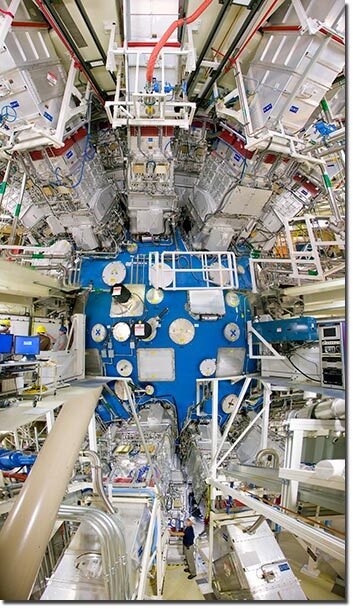
Composite photo shows all three floors containing the 132-ton, 10-meter diameter target chamber. Diagnostic instruments will be attached to the round hatches.Credit:Jacqueline McBride/LLNL
“This accomplishment is a major milestone that demonstrates both the power and the reliability of NIF’s integrated laser system, the precision targets and the integration of the scientific diagnostics needed to begin ignition experiments,” said NIF Director Ed Moses. “NIF has shown that it can consistently deliver the energy required to conduct ignition [fusion] experiments later this year.” A demonstrationIn order to demonstrate fusion, the energy that powers the Sun and the stars, NIF focuses the energy of 192 powerful laser beams into a pencil-eraser-sized cylinder containing a tiny spherical target filled with deuterium and tritium, two isotopes of hydrogen.Inside the cylinder, the laser energy is converted to x rays, which compress the fuel until it reaches temperatures of more than 93 million °C and pressures billions of times greater than Earth’s atmospheric pressure.The rapid compression of the fuel capsule forces the hydrogen nuclei to fuse and release many times more energy than the laser energy that was required to initiate the reaction. The NIF laser system began firing all 192 laser beams onto targets in June 2009.In order to characterize the x ray drive achieved inside the target cylinders as the laser energy is ramped up, these first experiments were conducted at lower laser energies and on smaller targets than will be used for the ignition experiments. These targets used gas-filled capsules that act as substitutes for the fusion fuel capsules that will be used in the 2010 ignition campaign. The 1 MJ shot represents the culmination of these experiments using an ignition-scale target for the first time. A new directionThe next step is to move to ignition-like fuel capsules that require the fuel to be in a frozen hydrogen layer (at 19 Kelvin or −218 °C) inside the fuel capsule. NIF is currently being made ready to begin experiments with ignition-like fuel capsules in the summer of 2010.NIF, the world’s largest laser facility, is the first facility expected to achieve fusion ignition and energy gain in a laboratory setting.Paul Guinnessy