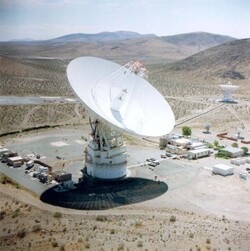
Los Angeles Times: A little-known NASA structure, the 44-year-old Deep Space Station 14, is undergoing a major remodeling.
Nicknamed the “Mars antenna,” the remote structure, located in the Mojave Desert, is the size of a football field and weighs almost 2000 tons. It is the largest antenna in the world that can both rotate fully and send and receive data. Overseen by NASA’s Jet Propulsion Laboratory, Deep Space Station 14, originally constructed in 1966 to track a spacecraft as it flew past Mars, was intended to last only until the 1980s, but it has since tracked asteroids, rovers on distant planets, and probes traveling through and out of the solar system. With a manned mission to Mars on the horizon, NASA is working to renovate the antenna that has, in the words of Los Angeles Times writer Kurt Streeter, “shepherded, at least partly, every NASA spacecraft that has traveled far past the Moon.”