Nanoscience outreach rolls out nationwide
DOI: 10.1063/1.2930729
“The NanoExpress is a mobile scientific theme park,” says Gary Harris, electrical engineering professor at Howard University and director of the trailer-turned-laboratory that its scientists use to explain how atomic force and electron microscopes work. “We go wherever people are interested in learning about nanotechnology.”
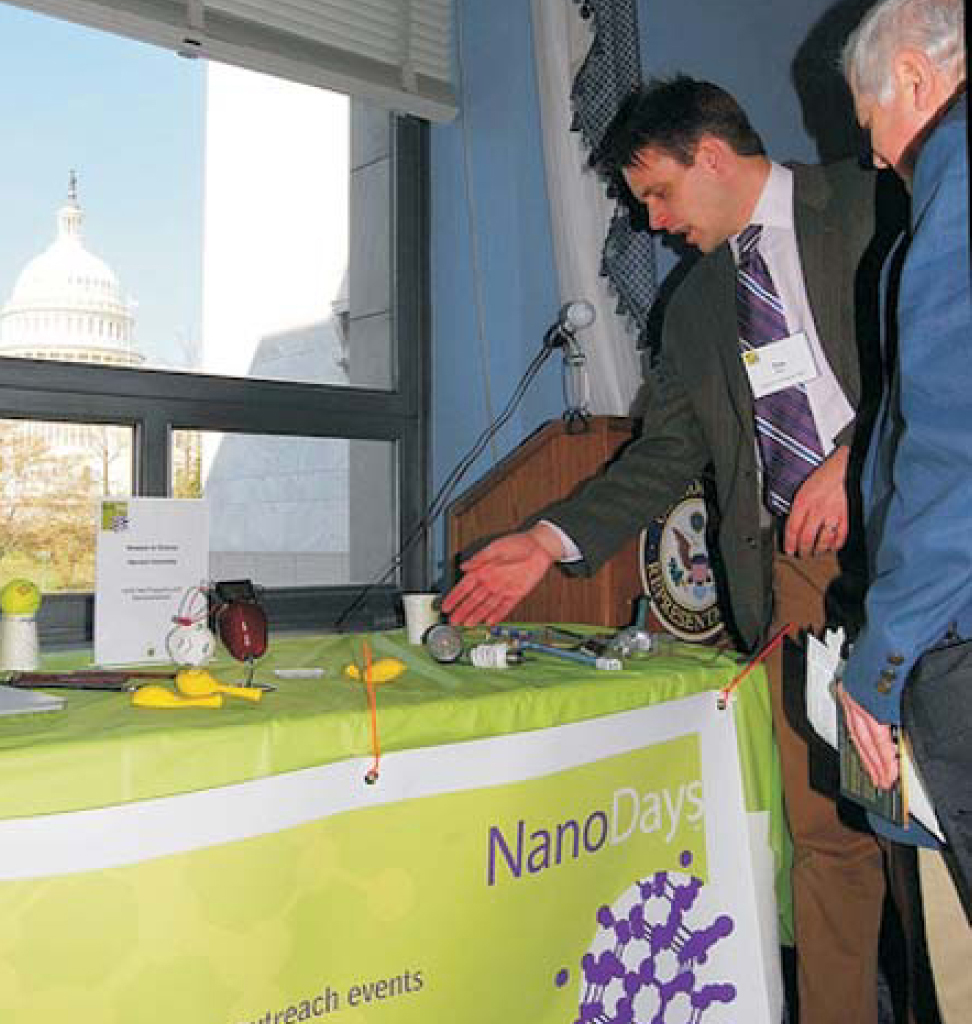
On 2 April the trailer was parked outside the Rayburn House Office Building in Washington, DC. Inside the building, congressional staffers, science policy advocates, and others watched video clips of role-playing dialog exploring the societal and ethical implications of nanotechnology (see http://www.powerofsmall.org ) and used a vibrating joystick to simulate the forces of an atom moving across a surface.
The stop on Capitol Hill was part of the first nationwide NanoDays, a week in which some 100 or so museums and universities carried out educational activities organized by the Nanoscale Informal Science Education Network. NISE Net was funded by NSF in 2005 and has grown from three founding partner museums to more than a dozen partner museums and universities. The White House Office of Science and Technology Policy advocated “continued support for efforts such as NISE Net” in the 2007 National Nanotechnology Initiative Strategic Plan, the document that will guide reauthorization hearings for NNI this year.
“One of the reasons that faculty have been hesitant to get involved in outreach is because of the huge time commitment involved to do it right, but interest goes way up once people have prepared tools that can make an impact,” says Ellen Williams, director of the materials research science and engineering center at the University of Maryland, College Park, which hosted a NanoDays open house for local elementary- and middle-school students. “The NanoDays kits are wonderful,” she adds, referring to the supplies and instructions put together by NISE Net staff for six nanoscale hands-on activities.
Some NISE Net partners put on original shows. The Museum of Science, Boston, presented The Amazing Nano Brothers Juggling Show—an original script by NISE Net principal investigator Carol Lynn Alpert in which two comic performers act out the behavior of matter at the nanoscale by jointly juggling macroscopic objects, sometimes while riding 2-meter unicycles.
“When I came to the Museum of Science 37 years ago from MIT, all I could do was draw formulas on a blackboard, so I had to learn how to explain things by using analogies, similar objects, and common experiences,” says physicist and lead NISE Net principal investigator Larry Bell. “I’m now a bit surprised that we can actually gather a small group of people and keep them for 15 to 20 minutes while we talk about nanotechnology, which they can’t see and which has a level of complexity that makes it hard to understand.”

NanoDays educational activities were performed in the Rayburn House Office Building by Tim Miller, education associate at the Museum of Science, Boston.
CHRISTINE RUFFO/ASSOCIATION OF SCIENCE-TECHNOLOGY CENTER INC