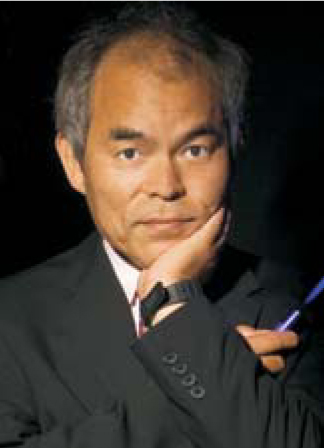
Nakamura wins prize for solid-state lighting
DOI: 10.1063/1.2349726
The creator of the first blue, green, and white light-emitting diodes and the first blue laser diode—each of which has represented an important milestone in the development of new energy-saving light sources—has won the 2006 Millennium Technology Prize.
Shuji Nakamura will receive the award from Finland’s Millennium Prize Foundation at a September ceremony in Helsinki. The honor, which carries a cash prize of €1 million ($1.3 million), recognizes outstanding technological achievement aimed at promoting quality of life and sustainable development. Nakamura is a professor of materials and of electrical and computer engineering at the University of California, Santa Barbara, where he is also codirector of the solid-state lighting and display center.
In a recent interview with Physics Today, Nakamura said he started working with LEDs and laser diodes some 26 years ago in hopes of developing more efficient light sources.
“The conventional incandescent bulb lamp and fluorescent lamp are technology-based vacuum-tube lighting. LEDs and laser diodes could replace [them] as the semiconductor-based transistor replaced the vacuum-tube-type circuit in the past,” Nakamura said. LEDs convert electrical energy to bright light with 50% efficiency, he pointed out, a rate 10 times better than that of an incandescent bulb. Moreover, he added, the life span of an LED is “almost forever,” meaning it requires virtually no maintenance.
Although LEDs had already been discovered by the time Nakamura began researching them, no one had yet determined how to make blue LEDs. According to Steven DenBaars, also a professor of materials at UCSB and the other codirector of its solid-state lighting and display center, discovering how to make blue LEDs was important because it increased the available palette of colors, which in turn increased the potential number of applications for the technology.
“You can’t paint with just red and green. Blue was the missing color,” DenBaars explained. “Everybody was looking for the blue LED, trying to find it with zinc selenide. But that did not produce a bright blue light or a reliable blue light. You couldn’t see it, so it wasn’t useful for room lighting or illumination. It was not commercially viable.”
Nakamura successfully used a gallium nitride–based material to develop the blue LED and laser diode. And the LED light required significantly less power to operate.
Once he successfully created the blue LED in 1993, it took just two more years to discover how to create a green LED, by adding indium to a blue LED. Before Nakamura’s invention, the green in full-color displays was a phosphorescent yellow. His technology gives the greens in large full-panel LED displays a far richer hue, the prize foundation said.
In 1996, Nakamura discovered how to convert the output of blue LEDs to make white LEDs. He said the efficiency of white LEDs is expected to approach 100% as they are more widely produced.
“Then, all of the conventional lighting, such as incandescent bulbs and fluorescent lamps, could be replaced with the white LEDs in order to save energy and resources,” he said. “Also, the white LEDs could be operated by a battery powered by a solar cell in the daytime. So the lighting could be operated with clean energy thanks to its high efficiency and low voltage operation.”
Nakamura believes that use of solid-state lighting in industrialized nations would save enormous amounts of energy. “In the US alone, using white LED lighting could save the equivalent of 133 power plants of energy by 2025. It could also help reduce global warming by lowering carbon emission.”
Researchers have already moved into the UV with LEDs, Nakamura added. UV LEDs with a wavelength of 370 nm have been used for air purification for cars and refrigerators, while 280-nm UV LEDs are used to purify water.

Nakamura
RANDY LAMB, UCSB