Musical pitch perception starts early
DOI: 10.1063/PT.3.2537
When a musical instrument plays a note, the sound wave produced is not a single frequency but a spectrum of harmonics. The composition of that spectrum determines the note’s timbre: the distinguishing factor between the sounds of, for example, a flute and a trumpet, or different vowel sounds in a spoken or sung syllable. Even when the fundamental frequency is absent and only the higher harmonics are present, the adult human brain can fill in the missing fundamental and perceive the note’s pitch.
Now Bonnie Lau and Lynne Werner of the University of Washington have tested whether infants in different stages of development can do the same. 1 Pitch perception is related to how infants learn to segregate different sounds occurring at the same time, an important skill in making sense of the complex environmental sounds encountered every day.
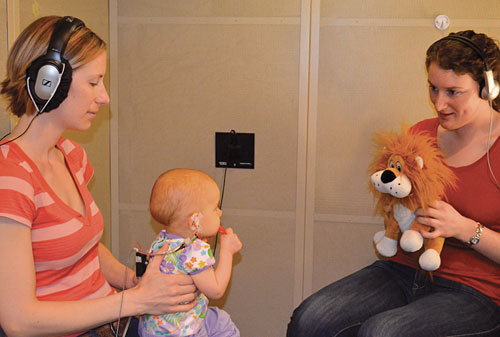
The researchers had their infant participants listen to sequences of notes drawn from a set of 10 high-harmonic complexes, 5 for each of 2 fundamental frequencies. The complexes consisted of different combinations of the 12th through 31st harmonics—between 3½ and 5 octaves above the fundamental—and they bore little resemblance to their respective fundamental frequencies. Still, Lau and Werner were able to condition the infants to associate changes in fundamental frequency with the activation of a mechanical toy (just outside the field of view in the figure).

Testing pitch perception. An infant participant listens to a series of harmonic complexes through an earphone. Whenever the fundamental frequency changes, a mechanical toy to the infant’s right (not shown) turns on. The stuffed lion keeps the infant otherwise facing forward. An experimenter observes the infant’s behavior from another room. (Courtesy of Bonnie Lau.)

Once they were conditioned, the infants responded behaviorally whenever the missing fundamental was changed—but before the mechanical toy was turned on. None of the adults involved in facilitating the experiment listened to the same notes the infants did; they had to judge whether the infants were hearing a change in fundamental from behavioral cues alone.
Curiously, three-month-old and seven-month-old infants performed equally well at the task, even though the sensory pathways in the brain change radically between those ages. At three months, the auditory cortex is not yet mature, and sounds are most likely processed in the brain stem.
Lau and Werner then repeated the experiment with adult participants, who were instructed, cryptically, to listen for “the sound that makes the toy come on.” “We tried to keep the testing as similar as possible,” explains Lau. “Adults weren’t told explicitly to respond to a pitch change because infants were not told to.”
Adult participants who had had any musical training—defined loosely to include two or more years of band or choir at school—performed about as well as infants of either age. Adults with no musical training performed markedly worse, but that finding conflicts with several previous studies showing that regardless of musical training, adults can indeed perceive the pitch of high-harmonic complexes. 2
To reconcile that discrepancy, Lau and Werner hypothesize that adults are more easily distracted than infants by changes of timbre rather than pitch. Perhaps infants perceive pitch and timbre with different relative priority than adults do—or perhaps they don’t perceive changes in timbre at all. Says Lau, “That’s an experiment we’re working on right now.”
References
1. B. K. Lau, L. A. Werner, J. Acoust. Soc. Am. 136, 760 (2014). https://doi.org/10.1121/1.4887464
2. A. J. M. Houstma, J. Smurzynski, J. Acoust. Soc. Am. 87, 304 (1990); https://doi.org/10.1121/1.399297
T. M. Shackleton, R. P. Carlyon, J. Acoust. Soc. Am. 95, 3529 (1994); https://doi.org/10.1121/1.409970
J. G. Bernstein, A. J. Oxenham, J. Acoust. Soc. Am. 113 3323 (2003).https://doi.org/10.1121/1.1572146
More about the authors
Johanna L. Miller, jmiller@aip.org