Most luminous supernova ever seen may be manifesting a new eruption mechanism
DOI: 10.1063/1.2761787
Last fall University of Texas graduate student Robert Quimby was reimaging the same large galaxy clusters night after night with a modest 46-cm robotic telescope at the McDonald Observatory in west Texas. He had organized this project to find interesting, relatively nearby supernovae soon after onset so that other, larger instruments could follow them in detail as they waxed and waned. On 18 September he discovered a new light in a minor galaxy of the Perseus cluster, 200 million light-years away, that would soon prove to be the most luminous supernova ever recorded.
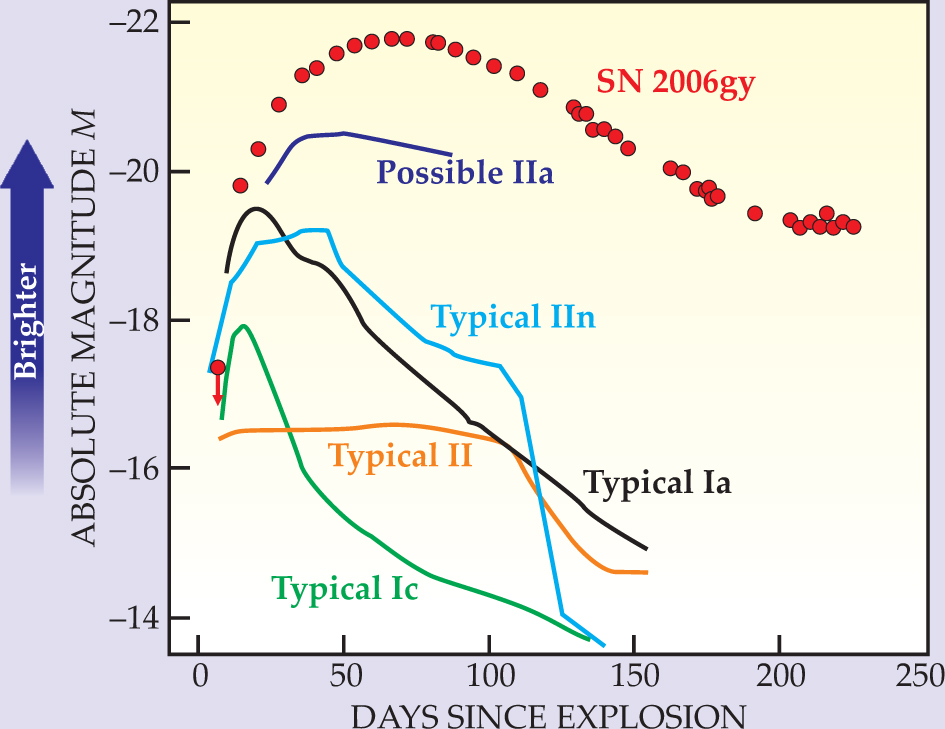
When SN 2006gy, as it was labeled, finally peaked 40 days later (an estimated 70 days after onset), it was 10 times brighter than the peak luminosity of a type Ia, the brightest of the ordinary supernovae (see figure 1). And five months after peaking, when a type Ia would long since have faded, SN 2006gy was still going strong.

Figure 1. Light curve of the record supernova SN 2006gy compared with those of various supernova types. Absolute magnitude M is a traditional logarithmic measure of intrinsic luminosity at visible wavelengths. A ΔM of −5 means a hundred-fold luminosity increase. The other supernovae are labeled by spectroscopic type. All types are attributed to core collapse of massive stars except for Ia and IIa, which manifest the destruction of white dwarfs. The brightest supernova shown here, other than SN 2006gy, is tentatively classed as IIa.
(Adapted from ref. 2.)

The supernova’s unprecedented peak luminosity, together with its very long rise and fade times, implies a total radiated energy of about 1044 joules at visible wavelengths. That exceeds the light output of an ordinary supernova by at least two orders of magnitude. The photometric and spectroscopic data favor a mass of order 100 solar masses (M ⊙) for the supernova’s progenitor. All this suggests that a previously unseen mechanism for stellar explosions is revealing itself, and that the new mechanism is peculiar to such massive stars—which are quite rare in the modern cosmos.
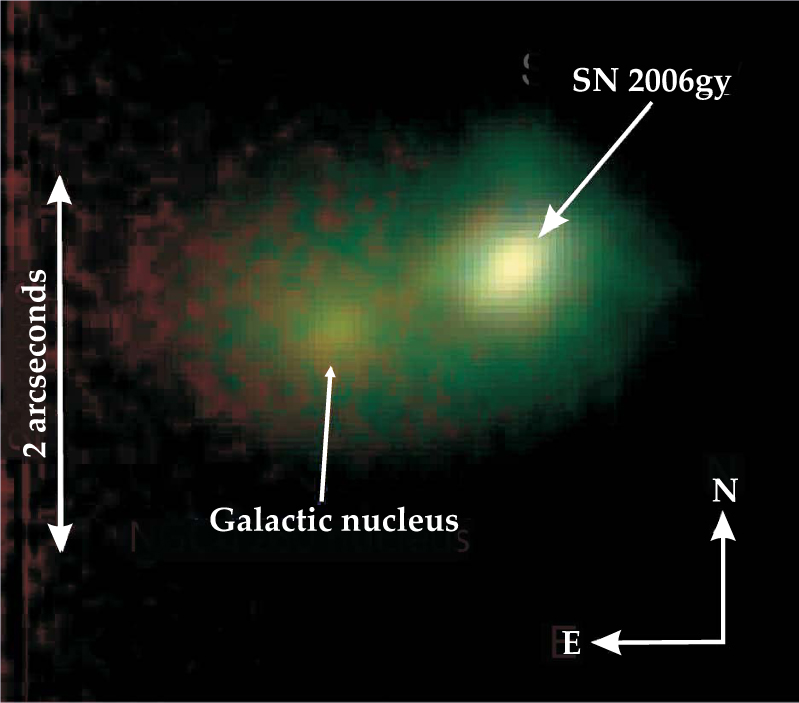
After Quimby announced his discovery, he and groups at other universities promptly trained larger telescopes on the new object. Eran Ofek and coworkers at Caltech reported their early observations soon after the supernova peaked. 1 A group at the University of California, Berkeley, led by Alex Filippenko and Weidong Li had in fact been routinely imaging the same galaxy in search of supernovae for several months with a 76-cm telescope at the Lick Observatory. But SN 2006gy had failed to ring the bell of that highly automated search, whose software protocol ignores the vicinity of galactic nuclei as too bright and noisy. But soon after Quimby’s announcement, the Berkeley team used a 3-m telescope at Lick to produce a high-resolution adaptive-optics image (figure 2) that clearly showed the brightening object to be about 1000 light-years from the center of its host galaxy, and therefore not just another active galactic nucleus.

Figure 2. Adaptive-optics image of the host galaxy (NGC 1260) of SN 2006gy at near-IR wavelengths, taken a week after the supernova’s discovery last fall. The image’s high resolution clearly showed the new light offset from the galactic center by about 1000 light-years, thus precluding the possibility that it was an active galactic nucleus rather than a supernova of unprecedented luminosity.
(Adapted from ref. 2.)

The Berkeley group continued to measure SN 2006gy’s light curve out to the end of April (figure 2) with the 76-cm telescope. The archived prediscovery data let the group estimate that the outburst had begun about 29 days before Quimby found it. Filippenko and company also monitored the supernova’s spectrum with the 3-m telescope and the 10-m Keck telescopes in Hawaii. And the group provided x-ray surveillance of the supernova with the Chandra X-ray Observatory .
At the moment, the supernova’s proximity to the direction of the Sun imposes an observing hiatus until August. The Berkeley group, Quimby, and his thesis adviser, theorist Craig Wheeler, have written a joint paper detailing the observations to date and speculating about their meaning. 2 The paper’s principal author is Berkeley’s Nathan Smith. Wheeler had proposed that SN 2006gy might well be the first pair-formation-instability supernova ever recorded. “That’s very exciting,” he says. “Perhaps we’ll find the smoking gun when observations resume in August.”
Pair-formation instability
The most common supernova explosion of a star heavier than 8 M ⊙ at birth results from its core’s sudden collapse and rebound when all the nuclear fuel has burned to iron—the end of the exothermic fusion road—and radiation pressure no longer counterbalances gravity. The result is the classic type II supernova (see figure 1), whose luminosity integrated over the supernova’s duration is about 1042 J. The designation II indicates the presence of spectral emission or absorption lines from the star’s hydrogen envelope, Doppler-broadened by the envelope’s rapid expansion in the wake of the supernova’s shock wave.
Heavier stars, born with masses above about 30M ⊙, usually lose their H envelopes and much of their outer-core mass before they finally experience core collapse as type Ic supernovae (see figure 1). The I always indicates that the spectrum shows no H lines. The much more common type Ia supernovae, famous for serving as standard candles in studies of the cosmic Hubble expansion, are not core-collapse supernovae at all. They are thermonuclear explosions of white dwarfs not much heavier than the Sun.
The spectroscopic classification of SN 2006gy is the relatively rare type IIn. The n means that the H emission lines are much narrower than those of a typical core-collapse supernova. The standard explanation for this weak Doppler broadening is that the star was massive enough to have recently lost much of its H envelope; but then the core-collapse supernova’s shock wave slammed into the nearby, slowly coasting shell. However, the typical type IIn supernova, as shown in figure 1, is shorter-lived and much fainter than SN 2006gy.
For 40 years, theorists have been pondering a different explosion mechanism for stars born with masses greater than about 100 M ⊙. But until now there’s been no direct observational evidence. In 1967 Zalman Barkat and coworkers at the Hebrew University of Jerusalem pointed out that when a sufficiently massive stellar core gets hot enough during thermonuclear burning of oxygen, it radiates a profusion of MeV photons that can convert to electron–positron pairs on their way out. This conversion of radiant energy to particle mass, they concluded, would suddenly reduce the radiation pressure, causing the oxygen core to contract and burn explosively.
Since 1982 theorist Stan Woosley (University of California, Santa Cruz) and coworkers have been elaborating Barkat’s pair-formation scenario for various core mass ranges. If the core mass at the end of helium burning exceeds about 63 M ⊙, they conclude, the pair instability would produce an energy pulse sufficient to blow the star completely apart, leaving behind neither the neutron star nor the black hole one expects, respectively, from an ordinary type II or a Ic.
For core masses between 40 and 63M ⊙, Woosley argues for what he calls a pulsational pair-formation scenario. 3 That is, the first occurrence of pair-formationinstability is not energetic enough to blow up the star, but it does expel the H envelope and some of the outer core in a faint, nondestructive supernova. The residual core then cools, reheats, and eventually encounters the pair instability again after days, years, or even centuries—depending on the remaining core mass. Indeed this episodic eruption should typically recur several times before the star finally does experience iron-core collapse as a type Ic supernova. But the earlier nondestructive pair-instability pulsations—especially the second—could produce exceptionally bright supernovae as fast ejecta from one pulse collide with slower material from its predecessor.
A thing of the past?
Before the discovery of SN 2006gy, all such analysis of pair-formation instability had an archaeological tinge. The physics of creating a supernova by pair instability is actually much less problematic than the physics of core-collapse explosion. But it was generally assumed that few if any stars in the present epoch remain massive enough long enough to experience pair instability.
The issue was metallicity, the astronomers’ name for the abundance of elements heavier than helium in stars at their birth and in the environments in which they form. Because the heavier elements are created almost exclusively in stellar cores or supernovae, the first generation of stars would have had little or no metallicity. High metallicity impedes the formation of very massive stars, and it facilitates the stellar winds that are thought to cause very rapid mass loss in heavy stars. Therefore much of the pair-instability discussion was limited to how it would have affected nucleosynthesis in first-generation stars.
Even the largest telescopes have thus far failed to see any first-generation stars, some of which are assumed to have had masses up to 300M ⊙. No later-generation stars have been found with masses exceeding 130 M ⊙. But even a 130-M ⊙ star would be left with a core of less than 40 M ⊙ at the end of helium burning if prevailing assumptions about high mass-loss rates are true.
“But,” says Smith, “observations in recent years of winds from massive stars cast doubt on that prevailing wisdom.” 4 In any case, the physics of mass loss in massive stars remains unclear. Whatever the mechanism that produced SN 2006gy, Smith and company argue that its enormous luminosity and long rise and decay times clearly require a very massive progenitor. “If, as I strongly suspect, this is a pulsational pair-instability supernova,” says Woolsey, “we really have been exaggerating the inevitability of high mass-loss rates at modern metallicity.”
High-resolution SN 2006gy spectra from Keck not only reveal the narrow Hα emission and absorption lines that indicate a circumstellar shell of several M ⊙ of hydrogen expanding at a leisurely 200 km/s. They also reveal broader Hα lines indicating supernova ejecta traveling much faster—about 4000 km/s. The narrow emission lines indicate that the circumstellar hydrogen was photoionized by the ejecta. So interaction between supernova ejecta and circumstellar material plays some role in generating the luminosity of SN 2006gy. The question is, How much?
Smith and company, like Woosley, favor the hypothesis that pair-formation instability is the supernova’s most likely energy source. Only type IIa supernovae come anywhere near SN 2006gy’s luminosity (see figure 1). These are type Ia white-dwarf explosions that happen to occur inside the hydrogen envelope of a massive companion. But Smith points out that SN 2006gy’s record luminosity would require an implausibly massive envelope. And its spectrum has none of the telltale features one would expect from an exploding white dwarf.
So much light
How would pair-formation instability produce the observed 1044 J of light? The Berkeley–Texas paper argues that the very weak x-ray signal recorded by Chandra makes it difficult to account for most of the luminosity by collision between the supernova’s ejecta and the circumstellar material. Instead the paper suggests that the light comes mainly from heating by the radioactive decay of nickel-56 produced in the supernova. The group calculates that the observed luminosity implies about 22 M ⊙ of 56 Ni, orders of magnitude more than an ordinary core-collapse supernova produces. That would require total pair-instability obliteration of the progenitor star.
Woosley and coworkers Alex Heger and Sergei Blinnikov have been comparing SN 2006gy’s light curve to detailed simulations of the much gentler pulsational pair-instability scenario. Taking prior stellar-wind mass losses to be significantly less than is traditionally assumed, they argue that the progenitor star was born with a mass of something like 110 M ⊙. Experiencing pair-formation instability for the first time some 10 years ago, they calculate, it expelled its H envelope plus about 5 M ⊙ of outer core at low velocity. The resulting light show would have been too faint to see at a distance of 200 million light-years.
The superluminous SN 2006gy, they conclude, manifests the residual core’s second bout of pair-formation instability, which launched less material than the first, but at much higher velocity and a total kinetic energy of about 1044 J. That, however, is no more than the kinetic energy of the ejecta from an ordinary type II core collapse. So what makes a pulsational pair-formation supernova so much brighter?
An ordinary type II supernova converts only about 1% of the kinetic energy of the ejected core material to light. The rest is lost adiabatically as the ejecta expand the star’s envelope. But in the pulsational scenario, the ejecta first encounter the shell of liberated envelope some 1011 km from the star. In such an encounter, Woosley argues, almost all the kinetic energy is converted to light. Radioactivity plays no significant role, and x-ray emission would not be seen until long after the optical spectacle is over.
When observations resume in August, the matter may be settled by telltale evolution of the light curve, the spectrum, or the x-ray afterglow. “If, as it seems, there are no stars in the modern epoch massive enough for a single obliterating pair-formation explosion,” says Woosley, “it may be that the brightest supernovae we ever see come from stars that can give repeat performances. And when the star finally does die in a type Ic core collapse, its passing is likely to be accompanied by a gamma-ray burst.”
References
1. E. Ofek et al., Astrophys. J. Lett. 659, L13(2007). https://doi.org/10.1086/516749
2. N. Smith et al., Astrophys. J. (in press), available at http://arxiv.org/abs/astro-ph/0612617 (version 3).
3. A. Heger, S. E. Woosley, Astrophys. J. 567, 532 (2002). https://doi.org/10.1086/338487
4. N. Smith, S. P. Owocki, Astrophys. J. Lett. 645, L45(2007). https://doi.org/10.1086/506523