Most automobile brakes emit charged aerosols into the atmosphere
DOI: 10.1063/pt.udey.hotb
Automotive brake wear adds significantly to automotive pollution, despite having nothing to do with tailpipe exhaust. Wear particles are produced where the brake pad and rotor meet and generate friction. The heat produces vapors that nucleate into nanometer-sized particles, 35–55% of which become airborne. Those aerosols make up as much as 21% of total traffic-related emissions by mass. Pulmonary inflammation and oxidative stress in the lung tissues of animals are among their health effects.

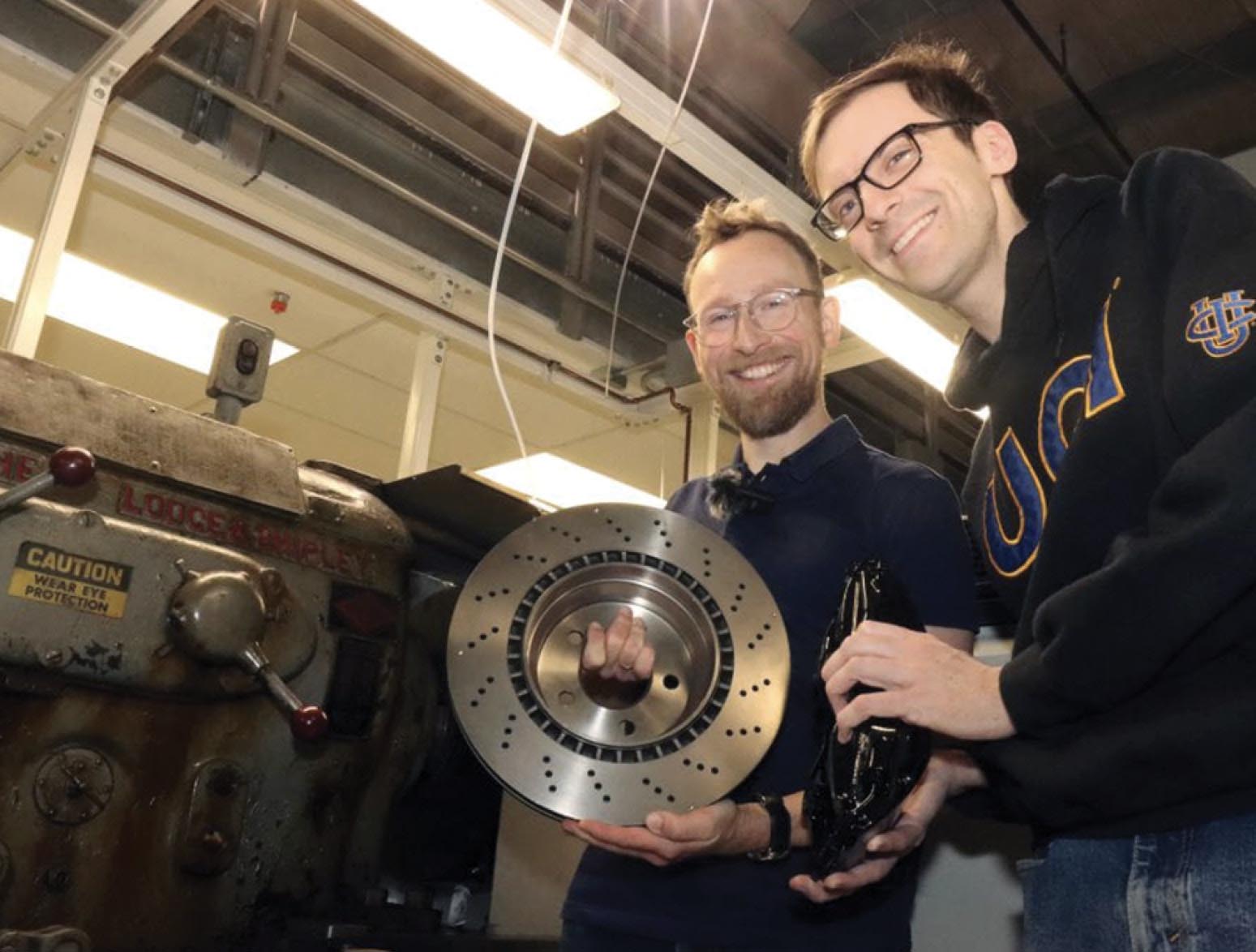
University of California researchers Paulus Bauer (left) holds a brake rotor and Adam Thomas holds a brake caliper next to the lathe that they and their colleagues used to simulate automotive brake emissions. (Courtesy of Lucas Van Wyk Joel, University of California, Irvine.)

Led by chemistry professor James Smith, a team comprising doctoral student Adam Thomas, postdoctoral researcher Paulus Bauer, and three of their colleagues at the University of California, Irvine, has now studied the electrical properties of the particles emitted from ceramic and semimetallic brake pads. They were surprised to find that up to 80% of the aerosol particles were electrically charged.
In their experiments, the researchers used a dynamometer that consisted of a brake rotor rotating at a constant speed of 173 rpm and a brake caliper mounted on a rotational torque sensor. Thomas and Bauer, shown in the photo, applied the brakes in a series of hydraulic pulses over periods of one to two hours. In each experiment, they measured the particles’ sizes across a wide range—from 10 to 22 000 nm—and found that the number of particles emitted depended on the specific type of brake-pad material that was used. Semimetallic pads resulted in higher rotor temperatures than ceramic pads, while emitting fewer particles. But the two materials shed both positively and negatively charged particles, and each of those particles were found to hold dozens of elementary changes.
The presence of electric charges on aerosol particles has potentially far-reaching climate significance. They enhance the growth of newly formed particles in the atmosphere and the coagulation rates of larger particles. What’s more, they make it relatively easy to remove brake aerosols from the air. Exposing the charged particles to an electric field could sweep them away. (A. E. Thomas et al., Proc. Natl. Acad. Sci. USA 121, e2313897121, 2024 .)
A version of this story was originally published online on 19 March 2024.