Making pions with lasers
DOI: 10.1063/PT.3.4015
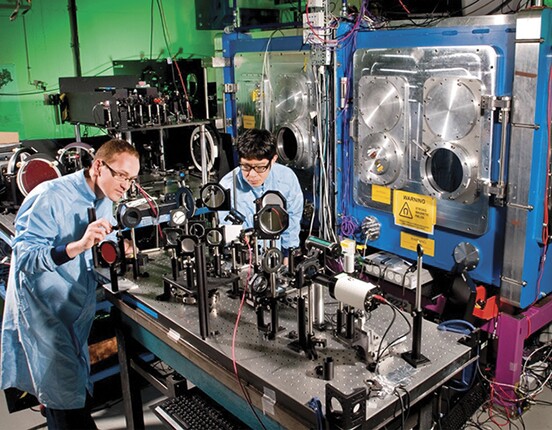
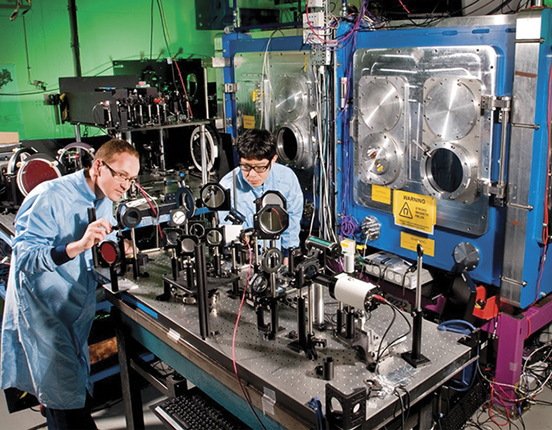
Of the 140 or so two-quark composites known as mesons, pions are the lightest. First discovered from tracks left by cosmic rays in photographic emulsions, pions are brought fleetingly to life whenever high-energy protons slam into other particles. Besides Earth’s atmosphere, pions are also produced in particle accelerators, supernova explosions, and the interstellar medium. Now an international team led by Karl Krushelnick of the University of Michigan has demonstrated a new way to make pions: with short, intense pulses of laser light. The method depends on laser wakefield acceleration (LWFA). When a plasma is hit with a laser pulse, the electrons respond far faster than the sluggish, heavier ions do. As the pulse propagates, it is followed by a wake—a wave of charge separation—whose electric field gradient exceeds those in conventional accelerators by at least 1000 times. In their implementation of LWFA, Krushelnick and his collaborators used 43 fs pulses from the 300 TW Astra Gemini laser at the UK’s Rutherford Appleton Laboratory (the photo shows the experiment at the facility). A pion-producing shot begins when laser pulses are fired into a cell containing helium gas. The resulting ionization and wakefield acceleration generate a beam of 1 GeV electrons, which passes through a 1.5-cm-thick lead target to produce additional electrons, positrons, and gamma rays. Electrons and positrons are removed from the beam by magnets. The surviving gammas hit the final target, a 20-cm-long rod of aluminum. When a gamma encounters an 27Al nucleus, it yields either 26Al and a neutron or, at higher energies, 27Mg and a positive pion. Positive pions last just 26 ns before they decay into an antimuon and a muon neutrino. The researchers inferred the particles’ presence by recording the 843 keV gammas, which the unstable 27Mg nuclei emit when they decay. With the help of the FLUKA simulation code, the team estimated that each shot generated 150 ± 50 pions. (W. Schumaker et al., New J. Phys. 20, 073008, 2018, doi:10.1088/1367-2630/aace0c .)

IMPERIAL COLLEGE LONDON