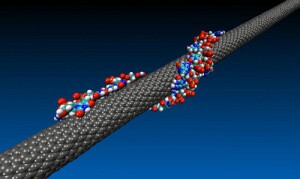
Scientists at Lockheed Martin are using a combination of molecular biology and materials science to develop an “artificial nose"—a microscopic device that can detect and distinguish a wide variety of molecular targets, or odorants. The key element of the technology, based on research by Charlie Johnson of the University of Pennsylvania, is simple but ingenious: a single strand of DNA wrapped around a carbon nanotube.
When a passing chemical binds to the DNA and changes its molecular conformation in subtle ways, it also influences the electrical properties of the nanotube, resulting in a change of conductivity: The device thus turns a chemical signal into an electrical one. Lockheed Martin hopes to build a sensor that can detect and distinguish tiny amounts of toxins, nerve gases, residues of explosives, or other telltale chemical traces.
The main obstacle to developing such a sensor is the difficulty of predicting the response of a given DNA sequence to a particular odorant. Johnson has found that the sensing technique can make extraordinarily fine distinctions, such as responding differently to left-handed and right-handed versions of the same molecule. But those discoveries have emerged mainly in an empirical, trial-and-error, way. So he’s now working with Lockheed Martin scientists who hope to bring a more systematic approach to the venture with the help of their program in integrated computational materials engineering (ICME).
The goal of ICME, on the grandest scale, is to do away with trial and error, and instead use an array of computational techniques that draw on a wide variety of data and models to predict the properties and behavior of new materials and new devices before they are built. That goal remains some distance away, but the methods of ICME are already changing how materials scientists work, not just at Lockheed Martin and other companies but also in the world of academic research.
Although computational methods have been used throughout science and engineering for a long time, a new milestone was reached in 2008 when the National Research Council published a study on integrated computational materials engineering as a distinctive methodology. Rick Barto, manager of computational physics at Lockheed Martin’s Advanced Technology Laboratories, says that “Lockheed has a century-long legacy of developing new materials, and ICME has been around for a decade. But the NRC study . . . drew academia and industry together.” Lockheed Martin created a computation physics group in 2008, and then launched an advanced materials and nanotechnology enterprise; those became the foundation of the company’s ICME program.
In the case of the carbon nanotube sensors, Lockheed Martin’s ICME team uses molecular dynamics simulations to understand how the binding of an odorant alters the configuration of a DNA strand with a particular sequence. Those structural results are then fed into quantum models of the electronic structure of the nanotube to predict how its conductivity will change. The model outputs guide experimental investigations in Johnson’s lab, the results of which are used to further refine the modeling. At that stage, another aspect of ICME comes into play: Data analytics and pattern recognition techniques optimize the set of DNA sequences that can most effectively provide distinctive responses to a wide range of odorants.
When ambient molecules bind to DNA, they change its structure. Those changes elicit an electrical signal that is transmitted along the carbon nanotube. Understanding and optimizing that process for a sensor requires considerable computational prowess. CREDIT: Lockheed Martin
ICME is also proving its worth in the design of novel materials. Lockheed Martin’s APEX (advanced polymers engineered for the extreme) program produces thermoplastic nanocomposite materials tailored for a wide variety of uses in defense and aerospace applications, as well as in the automotive and civil industrial sectors. It makes use of basic data on material properties and combines them with computational fluid dynamics and laminate dynamics in what Travis Earles, senior manager for advanced materials and nanotech initiatives, calls a multiscale approach to design.
The idea here is not to predict the properties of a complex material by starting with molecular models—an impossible task – but to meld basic physics with practical knowledge of the characteristics and behaviors of nano- and microstructures, as well as the capabilities of manufacturing processes. “The ultimate goal is to design a material to suit a purpose,” says Earles, “and predict the performance [of manufactured parts] at the design stage.” The F-35 Lightning II fighter includes materials created through the APEX program.
A crucial ingredient of ICME is building databases that give scientists and engineers access to the information they need in a useful way. “You can do a lot with sources that already exist,” says Barto, citing NASA and GE, among others, as partners of Lockheed Martin that have over the years amassed huge quantities of data on materials and devices they have investigated and developed.
Data mining such sources may seem pedestrian, says Earles, but “having access to those characteristics in an available and queryable way” is a huge step forward. Merely putting an array of previously disparate information into one coherent system can be a spur to invention. “Innovation doesn’t always mean making a whole new material,” says Barto. "[It] can be a combination of things that have already been done.” Earles adds, “We’re still building the system” but already ICME is “leading a materials revolution in aerospace and defense.”
Although ICME at Lockheed Martin is focused on core customers in the defense sector, the company works closely with academic partners who are developing ICME methods for civilian purposes. As part of its corporate mission, Earles says, Lockheed Martin is keen to engage with efforts to strengthen STEM (science, technology, engineering, and mathematics) education and “capture the imagination of young people.” There’s a certain amount of self-interest – Lockheed Martin hires 5% of the annual US cohort of engineering graduates—but there’s also a recognition that many innovations from the defense and aerospace sector have applications in the civilian world. “We are world-class systems integrators,” says Earles, “and we want to partner with those who know how to work in these spaces.”
From his vantage at the University of Pennsylvania, Johnson confirms that ICME and other novel methods are having an effect not just on research but on students’ ambitions. His university, like many today, is eager to transfer ideas from academic research into the marketplace, but some faculty members remain cautious—"it’s not the way they’ve led their careers thus far.” Undergraduate and especially graduate students, on the other hand, are drawn to innovation and to interaction with the commercial and defense sectors. Much of the impetus for this embrace of the new “is bubbling up from the bottom,” he says.