Liquid-explosives scanners stand trial in airports
DOI: 10.1063/1.3463623
Air passengers may once more be allowed to pack beverages, lotions, and hair spray in their carry-on luggage, if imaging technologies to detect liquid explosives can prove their worth. Several competing systems, including multi-energy x-ray systems and a low-field magnetic resonance imaging (MRI) scanner, are undergoing field tests at some airports worldwide.
The evaluations are part of a move by some governments to relax restrictions on the transport of liquids, gels, and aerosols through security checkpoints; they also figure in the overhaul of airport security technologies for detecting trace and bulk explosives (see accompanying story). Since the foiled plot four years ago to bomb several transatlantic flights with hydrogen peroxide–based explosives, security regulations have restricted passengers in the US and more than 60 other countries to transparent 100-ml containers that can fit into a small plastic bag.
A new x-ray scanner developed by UK-based Kromek Ltd can analyze up to 2 liters of liquid regardless of the container’s wall thickness or opacity. The company grew out of the physics department’s efforts at the University of Durham in 2003 to commercialize a vapor-phase process of fabricating cadmium telluride single crystals, which are used as a solid-state detector for x rays and gamma rays. But Kromek cofounder Arnab Basu quickly saw the opportunity to use the crystals for digital x-ray systems in security applications. Baggage screening requires up to 1 MeV, says Basu, but x-ray baggage screening systems traditionally use silicon detectors, and “most high-energy radiation above 20 keV goes straight through [them].” The denser CdTe detector is more sensitive and can identify classes of chemicals by performing multispectral x-ray analysis; in contrast, conventional x-ray systems measure only density and atomic number, which are not enough to distinguish liquids. Kromek’s liquid scanners are already being evaluated in several airports around Europe.
“Why would you use an old-fashioned x-ray machine that just gives you a picture when you’re looking for explosives?” says Dolan Falconer Jr, CEO of Atlanta-based ScanTech Holdings, whose dual-energy x-ray checkpoint baggage system is being considered by the Department of Homeland Security’s (DHS’s) Transportation Security Administration. In dual-energy x-ray systems, metals absorb the lower-energy radiation; organics and lighter materials such as narcotics and explosive compounds in liquids and powders absorb the higher-energy x rays. ScanTech’s technology, which was recently selected for installation at Abu Dhabi International Airport in the United Arab Emirates, also uses multiple planes and angles and an advanced detection algorithm to strip out the clutter around objects of interest, says Falconer.
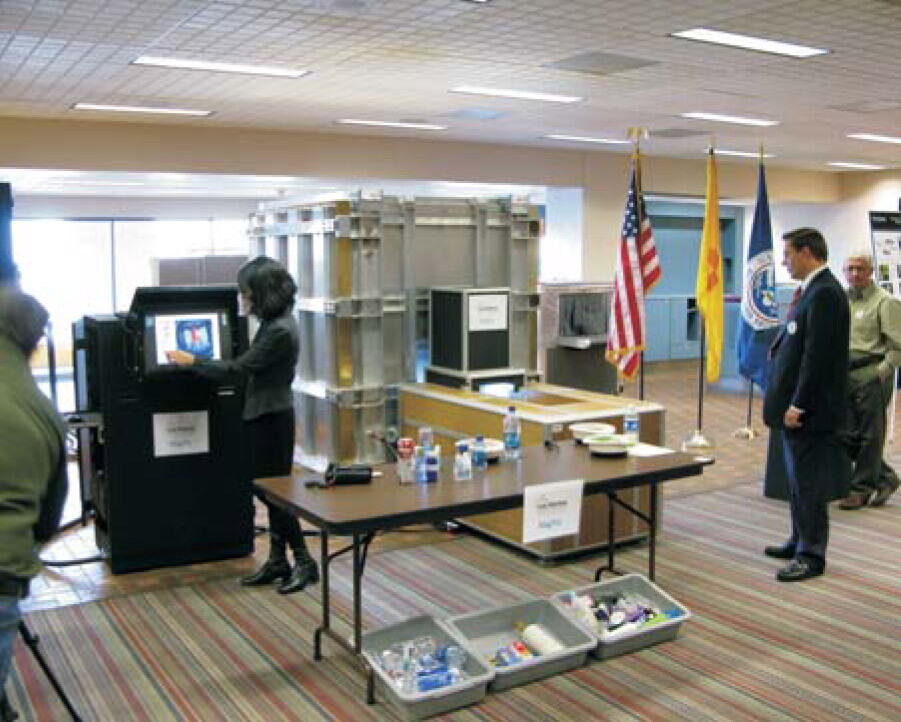
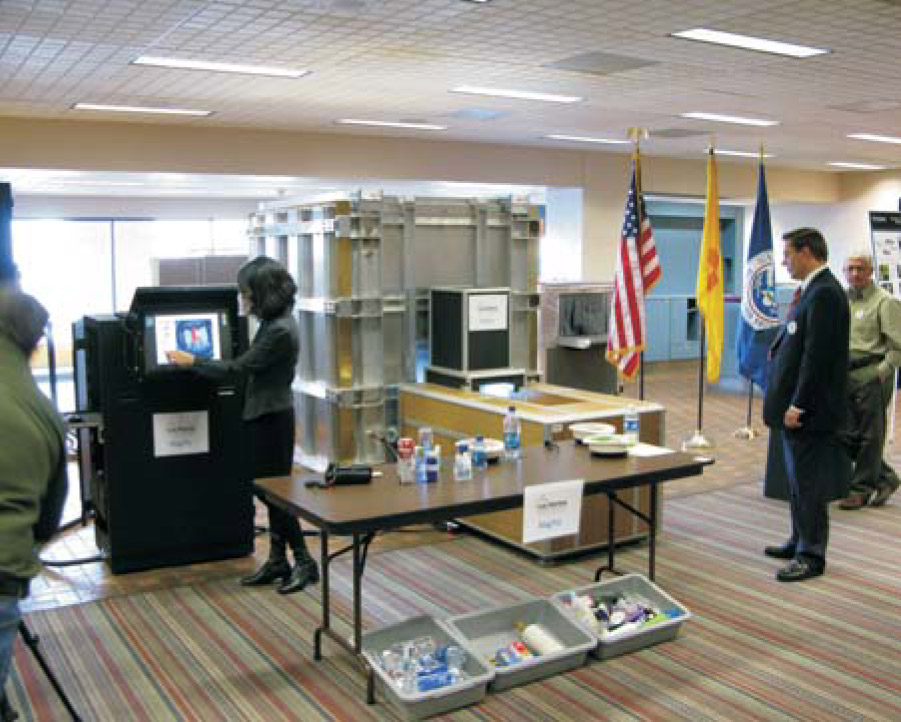
Development of another liquid-scanning technology is being funded by the DHS. Conceived at Los Alamos National Laboratory to map the brain’s neuronal activity, MagViz uses an applied low-field (50 µT) MRI to spot liquid explosives and other potentially dangerous materials that may be masked by liquids. “White matter and gray matter in the brain are essentially the same thing to an x-ray machine, but look quite different” on a magnetic resonance image, says MagViz project leader Michelle Espy. An airport-ready model of the system (gray crate and black box in photo) was tested at New Mexico’s Albuquerque International Sunport in December 2008.
At low magnetic fields, MagViz does not have the ability to determine the “chemical shift” of resonant frequencies from a reference frequency, which is how MRIs and nuclear magnetic resonance spectrometers determine a material’s identity, says Espy. Instead of looking for frequency shifts, the machine gauges chemical differences by measuring spin relaxation times. Espy is pursuing alternatives to the extremely sensitive superconducting quantum interference device (SQUID) detectors, which are needed to pick up the weak magnetic signal, but require bulky cryogenic equipment. Despite that constraint, the technology has attracted several suitors looking to commercialize it.
Even though the liquid embargo remains in place for the foreseeable future, Espy says she’s a witness to how quickly, in response to new threats, the government identifies new technologies. “After the [August 2006] terrorist plot, we had DHS in our lab in September looking at our instrument,” she says. “It was that fast.”

LOS ALAMOS NATIONAL LABORATORY