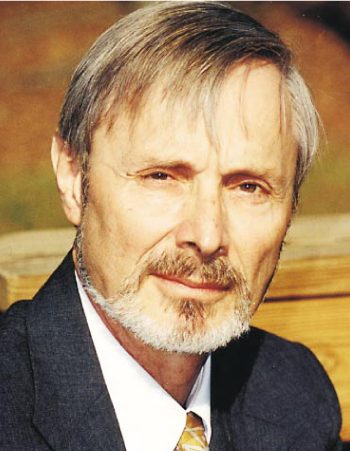
Leemann leads Jefferson lab
DOI: 10.1063/1.1457259

After about a year as interim director of the Thomas Jefferson National Accelerator Facility in Newport News, Virginia, Christoph Leemann now holds the top job. He succeeds Hermann Grunder, the founding director of the nuclear physics lab, who left in fall 2000 to head up Argonne National Laboratory.
Leemann earned his PhD in experimental nuclear physics in 1969 in his native Switzerland. He spent most of his early career at Lawrence Berkeley National Laboratory, and joined Jefferson Lab at its inception in 1985.
As associate director for accelerators, Leemann oversaw construction of Jefferson Lab’s centerpiece, the Continuous Electron Beam Accelerator Facility, a 6-GeV accelerator with a high-intensity, spin-polarized beam, which came online in 1994. CEBAF is used to probe atomic nuclei and to understand how their constituent quarks and gluons affect nucleon–nucleon interactions.
Jefferson Lab’s other big facility is a free electron laser, used for basic, industrial, and defense research (see the article on page 35 ). A $25 million upgrade adding ultraviolet capability and increasing the free electron laser’s power at infrared wavelengths from 2.1 kW to about 10 kW was begun in November and will be ready later this year. “We see potential for industrial applications and for exciting science,” says Leemann. “The free electron laser has the power to do two-photon experiments and its very short pulses could be important for studies of dynamic systems.”
A third thrust at Jefferson Lab is building superconducting radio-frequency cavities and a helium refrigeration plant for the Spallation Neutron Source at Oak Ridge National Laboratory in Tennessee.
“We are entering into what is scientifically the most exciting period in the history of this unique facility [Jefferson Lab],” says Jerry Draayer, a nuclear physicist and president of the Southeastern Universities Research Association, which runs Jefferson Lab for the US Department of Energy. The challenge will be to put the scientific program in the forefront now that the accelerator is online, and to shepherd the facility through a planned $150 million upgrade to 12 GeV, says Draayer. “Christoph has shown his unique ability to lead in bringing this facility into existence, so I am confident that he has the skills to take it to the next level.”
“Christoph played an essential and critical role in taking the accelerator from an idea to the actual world-class facility that it is today. I am thrilled that he is the new director,” says Keith Baker, a high-energy physicist at both Jefferson Lab and nearby Hampton University, and a member of the search committee, which considered 46 candidates for the lab directorship. In addition to upgrades for both CEBAF and the free electron laser, Baker hopes Leemann will win an increase in the lab’s overall budget, which is about $100 million a year. “We are not running at full efficiency. We could do a lot more physics for a modest increase in the operating budget,” Baker says.
“The challenges are all to some extent funding related,” says Leemann. “All scientists need to make the case for our science, to make clear that it’s relevant, beautiful, and exciting, in terms that decision-makers can understand. I hope [Jefferson Lab] can stay at the forefront. At the moment we are there. We want to keep it that way.”

Leemann
GREG ADAMS, JEFFERSON LAB

More about the authors
Toni Feder, American Center for Physics, One Physics Ellipse, College Park, Maryland 20740-3842, US . tfeder@aip.org