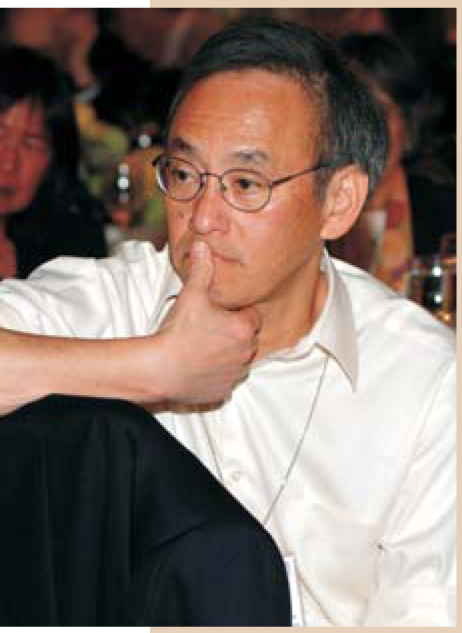
LBNL director Chu to head DOE
DOI: 10.1063/1.3074253
Physicists reacted with elation to President-elect Barack Obama’s selection of Steven Chu to be secretary of the Department of Energy. If confirmed by the Senate, Chu, a Nobel laureate physicist and director of the Lawrence Berkeley National Laboratory since 2004, will become the first working research scientist to head DOE since the agency’s inception in 1977.
Chu, a staunch supporter of renewable energy and a forceful advocate of urgent actions to curb global warming, shared the 1997 Nobel Prize in Physics for developing methods that use lasers to cool and trap atoms. At LBNL, he has built up the lab’s portfolio of R&D in carbon-neutral alternative-energy and energy-saving technologies. With other national laboratories and universities in the San Francisco Bay area, Chu, 60, organized the Joint BioEnergy Institute, one of three DOE-funded centers that are conducting basic research to lower the cost of producing ethanol and other renewable fuels from a variety of biomass. He also was instrumental in bringing together the University of California, Berkeley; LBNL; and the University of Illinois into a BP-funded collaboration known as the Energy Biosciences Institute.
Speaking at a 15 December press conference at which Obama announced his nomination, Chu said he believes “the US and the world can and will prevail over our economic, energy security, and climate change challenges.” Obama said Chu has been “working at the cutting edge of our nation’s effort to develop new forms of energy,” noting that “the scientists at our national labs will have a distinguished peer at the helm.” Obama added that his selection of Chu “should send a signal that my administration will value science, we will make decisions based on the facts, and we understand that the facts demand bold action.”
“My reaction is hooray,” said Nobelist Burton Richter, retired director of SLAC. “He’s a great scientist and a very good administrator,” he said, adding that from Chu’s interactions with Silicon Valley businesses, he also has a good understanding of how industry works.
“It’s the finest appointment to that position that has ever been made,” said Richard Muller, a physics professor at UCB and author of Physics for Future Presidents: The Science Behind the Headlines (Norton, 2008). “He has the management experience, the political finesse, and solid scientific credentials.” Under Chu, said Muller, LBNL has developed “the most diverse set of energy and environmental research projects in the US.”
“He’s a wonderful scientist and is passionate about energy,” said Mildred Dresselhaus, institute professor at MIT and a former director of DOE’s Office of Science. “We will need some national and world leadership on energy. A few individuals can make a big difference there.”
All three applauded Obama’s selection of a scientist for a post that has typically gone to individuals with little or no background in physical sciences. Previous secretaries have included an economist, lawyers, former members of Congress, a retired admiral, and a dentist. An exception is the outgoing secretary, Samuel Bodman, who holds a doctorate in chemical engineering.
Chu will vault from managing a lab with a budget of around $600 million and 4000 staff to an agency with annual expenditures of more than $23 billion and more than 100 000 federal and contractor employees. About two-thirds of the department’s budget goes for nuclear weapons maintenance, environmental cleanup of cold war–era weapons production, and disposing of spent nuclear fuel from the nation’s commercial nuclear industry.
“I hope he will have some time left over for science,” cautioned Richter, who said DOE lab managers are hopeful that Chu may “rein in the bureaucracy overload” at the department and restore a partnering relationship that Richter said once existed between the agency and the labs. Today’s relationship is more arms-length; DOE treats the labs as it might if it was making a purchase from a supplier. “That’s not healthy,” he said.
The selection of Chu is in line with Obama’s campaign promises to spend $150 billion over 10 years on clean energy R&D and to increase the amount of energy from renewable sources to 10% of total US energy supplies by 2012 and 25% by 2025. As a member of the National Research Council committee that wrote the 2006 Gathering Storm report, Chu has emphasized the report’s call for the creation of an “advanced research projects agency-energy” office within DOE. ARPA-E would fund high-risk projects that could lead to new clean energy technologies and big gains in energy efficiency (see Physics Today, June 2006, page 27 ).
Obama also named former Environmental Protection Agency administrator Carol Browner to a new White House post that will coordinate energy and climate change policy throughout the federal government.

Chu

More about the authors
David Kramer, dkramer@aip.org