Iron-rich object closely orbits a white dwarf
DOI: 10.1063/PT.3.4219
Stars like our Sun can burn brightly for billions of years, generating heat in their cores by fusing hydrogen into helium. When a medium-size star—up to eight solar masses—finally runs out of fuel, nuclear burning no longer drives an outward pressure gradient, and the star starts to collapse due to its own gravity. The contracting star generates a final burst of heat by fusing helium into carbon and oxygen, which causes the outer layers to expand outward.
The star turns into a red giant. In doing so, it engulfs any nearby planets but cannot sustain heat production. Within a billion years, all that remains of the star is the dense (109 g/cm3) stellar core composed of carbon and oxygen. The hot, Earth-sized ember, now called a white dwarf, glows faintly as it cools over tens of billions of years. (See Physics Today, March 2019, page 14 .)
Theoretical models suggest that asteroids and planets beyond the expanding red giant survive. The largest remaining planetary bodies can scatter the smaller ones into orbits closer to the newly formed white dwarf. Most bodies that wander too close are ripped apart by the dwarf’s gravity to form clouds of debris. But the stripped cores of some of those planets, hundreds to thousands of kilometers in diameter, could remain intact if they have sufficiently high internal strength and density.
Observation of objects in orbit around white dwarfs could offer both a preview into the demise of our solar system and a means to directly measure the chemical composition and structure of a planet’s inner core. Current technology does not offer a way to directly observe the core of our own planet. But identifying solid bodies that orbit around a dim stellar core, though difficult, is feasible.
Christopher Manser, Boris Gänsicke (both at the University of Warwick), and colleagues have developed a spectroscopic approach with which they have now identified an asteroid-like body orbiting a white dwarf 400 light-years from our solar system.
1
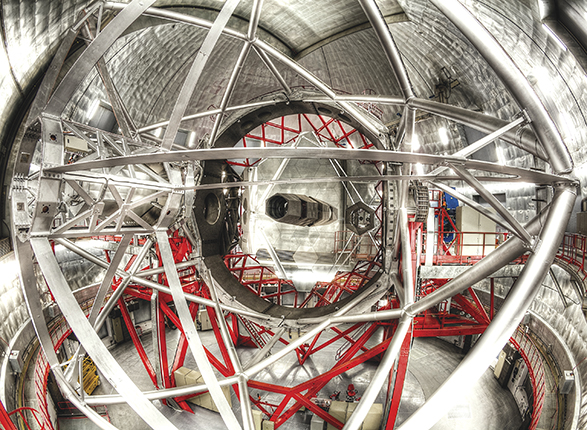
Observations at the largest reflecting telescope in the world, the 10.4 m Gran Telescopio Canarias (figure
Figure 1.

The Gran Telescopio Canarias in La Palma, Spain. Shown here is the 10.4 m primary mirror. Spectroscopic observations in rapid succession at the telescope provided evidence of a solid, metal-rich body orbiting closely around white dwarf SDSS J1228+1040. (Image courtesy of GRANTECAN/IAC.)

Gas lighting
The current tally of exoplanets and host stars in the Milky Way exceeds 4000 and 3000, respectively. Most of those discoveries were made with NASA’s Kepler space telescope using the transit method, which involves identifying periodic dimming as an object passes in front of its host star. (For more on exoplanet detection see the article by Jonathan Lunine, Bruce Macintosh, and Stanton Peale, Physics Today, May 2009, page 46 .)
Most of those host stars will eventually become white dwarfs. 2 In 2015 Andrew Vanderburg (Harvard University) and colleagues used the transit method to uncover the first direct evidence for a planetary remnant around a white dwarf. Every 4.5 hours, the light from a white dwarf in the constellation Virgo dipped and recovered in a complex pattern as if occulted by several small objects. 3
Extending the transit method to other white dwarfs has proven difficult. For one thing, it requires that the planetary system’s orbital plane lie along the line of sight to Earth. For another, white dwarfs are relatively faint, so the transit technique is limited to those parts of the sky in which other stars are both scarce and dim.
Spectral observations of the residual disks of debris swirling around white dwarfs offer a potentially better tool for detecting planetary remnants. Most disks are composed of dust, as indicated by mid-infrared emissions. In the mid 2000s, Gänsicke had observed emission lines of calcium, iron, and oxygen in the spectra of some disks. He proposed that those lines arise when a white dwarf irradiates the exposed surfaces of rocky planetary debris. 4
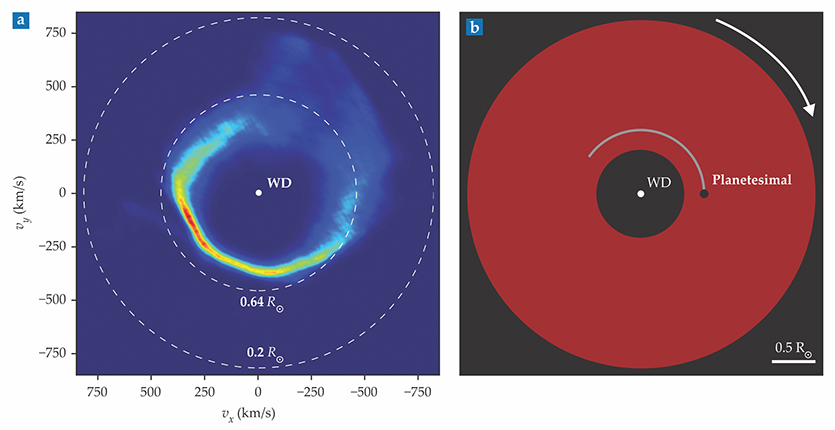
That observation was part of an ongoing project. Manser and Gänsicke had monitored white dwarf SDSS J1228+1040 for 15 years, with the majority of the observations conducted at the European Space Observatory’s Very Large Telescope in Chile. From those observations, which made use of the telescope’s Ultraviolet and Visual Echelle Spectrograph (UVES) and X-Shooter spectrograph, they created the first detailed image of a white dwarf’s debris disk, shown in velocity space in figure
Figure 2.

The debris disk surrounding the white dwarf (WD). (a) A map in velocity space shows the pattern of gas swirling in the disk (red is highest flux, dark blue is lowest). The pattern precesses on a time scale of 25 years. The overlaid dashed circles indicate material in orbits at two different distances from the star. The configuration appears inside out because material moves faster in closer-in orbits. The radius of the Sun, R⊙, is 6.96 × 10⁸ m. (Adapted from ref.

Clockwork calcium
For a more detailed look at the white dwarf and its disk, Manser and Gänsicke turned to the Gran Telescopio Canarias and the OSIRIS imager and spectrograph. By collecting emissions spectra from gases in the debris disk of SDSS J1228+1040 every two to three minutes over several nights in 2017 and 2018, the researchers determined the time it takes material in the disk to orbit the white dwarf.
The spectra contained three bright lines produced by calcium (ii) ions between 850 nm and 866 nm, a signature of metal-rich gases. As expected, each line had two broad peaks, the result of Doppler shifts as the swirling gas in the disk moved toward and away from Earth, oriented at an inclination of 73o as viewed from Earth. But on top of the varying spectrum, light pulsed from one peak to the other every two hours.
Manser explains, “We were originally searching for signs of random variations in the gaseous emission, as we thought gas was being produced by random collisions in the dust.” Instead, the periodic variation led the team to conclude that the emissions came from a cloud of gas trailing a likely metallic planetary core that orbited the white dwarf with a two-hour period. Collisions between the planetary core and other surrounding debris could excite the gas as the body sped around its host. The gas cloud trailed the rocky body and boosted one emission peak while the body moved toward Earth and boosted the other while it moved away an hour later.
“Detecting a periodic variation from an emission feature in a white dwarf debris disk is a real first, and characterizing the extra emission as gas from a solid object orbiting close to the white dwarf is very exciting,” says Scott Kenyon (Harvard University). Looking for spectral differences in rapid succession offers a new way of detecting solid bodies in any system that shows the calcium ion emission lines.
SDSS J1228+1040 and the seven dwarfs
The satellite’s extraordinarily short two-hour orbital period surprised Manser. As shown in figure
A series of calculations led Manser to propose two possibilities for the object’s structure. A spherical body as small as tens of kilometers across could be held together by its own gravity provided its density is that of metallic iron, 8 g/cm3, or higher. Alternatively, an iron-dominated larger body, hundreds of kilometers across, could have a layered internal structure that is strong to avoid being ripped apart. In either case, the original planet would have had distinct layers, like the dwarf planet Ceres. The surviving body could be the iron- and nickel-rich core of a former planet that once orbited much farther away from the star and had its crust and mantle ripped off during the star’s explosion. Kenyon observes that “it’s interesting to contemplate how the planetesimal got into this mess after having spent most of its previous life far away from its host star.”
As of now, astrophysicists know of only seven other white dwarfs that have gas in their disks. Those systems are the next candidates to check for orbiting rocky bodies. Tracking planetesimal behavior over time will help astronomers explain how rocky bodies behave during the final stages of stellar evolution as they form disks around white dwarfs and will also provide the only direct views of planetary inner cores.
References
1. C. J. Manser et al., Science 364, 66 (2019). https://doi.org/10.1126/science.aat5330
2. E. Han et al., Publ. Astron. Soc. Pac. 126, 827 (2014). https://doi.org/10.1086/678447
3. A. Vanderburg et al., Nature 526, 546 (2015). https://doi.org/10.1038/nature15527
4. B. T. Gänsicke et al., Science 314, 1908 (2006). https://doi.org/10.1126/science.1135033
5. C. J. Manser et al., Mon. Not. R. Astron. Soc. 455, 4467 (2016). https://doi.org/10.1093/mnras/stv2603