The rapidly globalizing world of applied physics was the topic of the forum‘s first talk, given by Caroline Taylor, a senior visiting fellow at the University of Bath and the Energy Biosciences Institute at the University of California, Berkeley. Physicists everywhere, she said, can take advantage of the new opportunities that globalization brings.
The cover of the IPF program book.
Taylor began by asking which students in the audience were thinking of working outside academia. More than half raised their hands. She next asked who, of those participants already working, were in a field they wouldn’t have predicted in grad school. Another wave of hands went up. The point, Taylor said, is that scientists, engineers, and innovators who work in industry must often respond to uncertain shifts in job markets. And the world is now entering an era of rapid change.
A new world order
Growth in the traditional economic centers of North America and Europe is slowing in comparison to the rest of the world. The International Monetary Fund and World Bank predict that in 2016 high-income countries’ GDP will grow 2-3%, whereas developing countries will grow 5-6%. Already in 2013, 68% of the global economic growth came from emerging economies.
A rapidly expanding middle class fuels this growth. The Brookings Institute predicts that the global middle class will balloon from 1.8 billion people in 2010, to 3.2 billion in 2020, and 4.9 billion in 2030. More than half of the growth from 2010 to 2020 will occur in the four countries of Brazil, China, India, and Indonesia. By 2030 72% of the middle class will live in Central and South America and the Asia Pacific region.
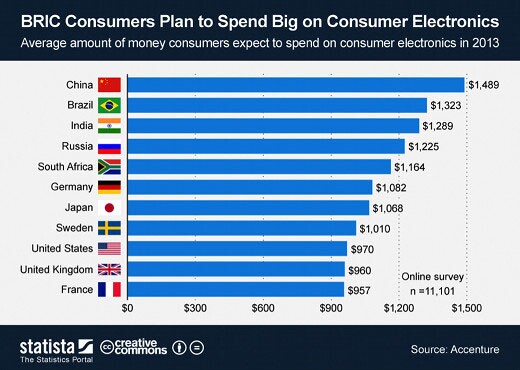
When people reach the middle class, they want to buy more high-tech goods and services. Consumer electronics are in particularly high demand. In 2012, the average Chinese consumer surveyed by the consulting group Accenture spent $403 more on electronics than did the average American, and the average Brazilian surveyed spent $232 more than the average American. When asked about expected purchases in 2013 the difference grew to $519 for Chinese consumers and $353 for Brazilians. In capital cities in particular, the demand for high-speed broadband services is also surging.
High tech is in high demand: Emerging market consumers plan to spend big money on new electronics.
Overall, consulting group BCG expects middle class spending in emerging markets to increase by $11 trillion between 2010 and 2020.
Challenges ahead
The growing demands of emerging economies will place strains on infrastructure, and natural and human resources.
As cities in the emerging markets grow and more goods flow in and out, companies start to locate supply chains closer to their new consumers, which increases infrastructure needs. Currently there is an approximately $1 trillion gap between estimated infrastructure needs and the planned investments in the emerging markets. By 2025 the gap is expected to increase to $25 trillion.
The growing demand for goods will also require a sharp increase of natural resources—an unsustainable trend if it continues at historical rates. Between 1900 and 2000, the extraction of raw materials such as copper, molybdenum, and nickel increased by orders of magnitude. While the amount companies spend on exploration continues to grow, discoveries of new deposits are becoming more rare.
And lastly, the human population in emerging markets must become more educated to meet growing demand in technology companies. In 2010 60% of companies surveyed in Brazil and 40% of companies surveyed in China reported difficulty filling open positions, compared with less than 15% in the United States. The hardest to fill gaps included technicians, skilled trades, and professionals and management. World Bank statistics also show a correlation between innovation and the number of workers with doctoral degrees, Taylor noted.
Finding opportunities in change
Despite the challenges, opportunities are rich for physicists, entrepreneurs, and innovators to take advantage of the growth of the developing world, Taylor said. Analysis of successful products suggests that approximately 80% of success is determined by market pull factors, she noted.
Multinational companies such as Microsoft, IBM, and Agilent Technologies are responding to the demand by locating branches and research and development facilities in emerging market countries, while homegrown companies in these markets are also taking root and spreading to the rest of the world. Between 2008 and 2013, the percentage of Fortune 500 companies with headquarters in emerging markets approximately doubled.
Challenges such as climate change, lack of infrastructure, and global health needs also present opportunities for innovation, from green energy technologies to point-of-care medical diagnostic devices.
The presentations in the 2014 Industrial Physics Forum showcase physicists around the world responding to and shaping economic growth in the new world order, from fields as diverse as biotechnology, information technology, aerospace, and precision agriculture.
Catherine Meyers is a writer in the Media Services division of the American Institute of Physics.
His 1988 sketch of how to use Antarctic ice to detect neutrinos led to the IceCube Neutrino Observatory, which made the first detections of high-energy neutrinos in 2013.